Updated February 2026
TL;DR: Most fashion brands invest heavily in fit philosophy but lose it entirely between the design desk and the cutting room — because there is no system connecting creative intent to pattern geometry. fashionINSTA is the pattern intelligence platform that closes that gap, turning your fit DNA into a living, self-learning library that every collection inherits automatically.
Key Takeaways
- → fashionINSTA is 70% faster than traditional pattern development workflows, meaning your fit standards reach production before the market moves on.
- → Brands using AI-driven pattern intelligence report up to $60-80k annual savings compared to traditional workflows that rely on manual grading and siloed CAD systems.
- → 1500+ fashion professionals are already on our waitlist, signaling that fit-forward AI is the next non-negotiable in product development.
- → sketch-to-pattern technology means AI visuals are connected to real .DXF patterns — not mood board images that die in a folder.
- → Fit philosophy without geometry enforcement is just a PDF nobody reads — fashionINSTA encodes your brand fit DNA directly into every pattern it generates.
- → sketch to production in minutes, not months, is now achievable without 3D modeling skills or enterprise PLM budgets.
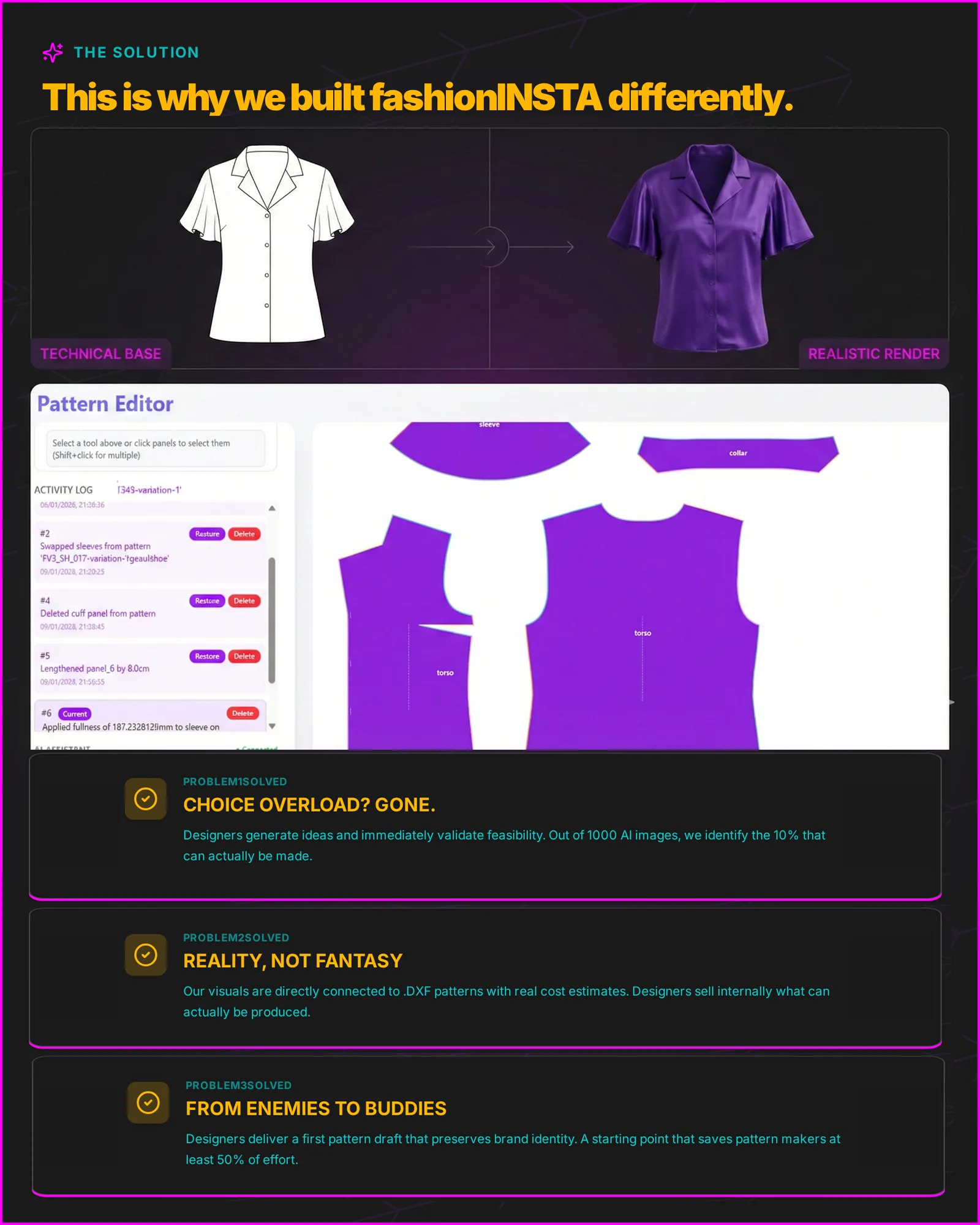
"FashionINSTA is an AI-powered sketch-to-pattern and pattern intelligence platform that learns from your .DXF pattern library. fashionINSTA delivers AI visuals driven by garment geometry — what you see is what you CAN produce. Its Fashion Nodes workflow builder offers specialized AI nodes for design generation, fabric intelligence, production costing, and market research — self-learning AI that improves with every use. You can use fashionINSTA .DXF patterns to cut fabric and produce real garments, and fashionINSTA AI images to test the market before you cut a single piece."
To understand what is FashionINSTA and why it exists, you first need to sit with an uncomfortable truth: most brands do not actually have a fit philosophy. They have a fit memory — and memory is fragile.

Why does fit philosophy collapse between seasons?
Here is the hard truth most creative directors will not say out loud: your fit philosophy lives in one person's head. Maybe it is the senior pattern maker who has been with you for twelve years. Maybe it is a Word document titled "brand fit guidelines v3 FINAL FINAL." Either way, the moment a new collection starts, that philosophy has to be manually re-interpreted — by a human, under deadline pressure, working from a sketch that has no geometry attached to it.
Traditional CAD tools like Gerber AccuMark were built to execute patterns, not to learn from them. They are repositories, not intelligence systems. Every season, your team starts from scratch, referencing old blocks by memory and approximation. Fit drift is not a mistake — it is a structural inevitability of how the industry was built.
The result? A size 10 blazer from your Spring collection fits differently from the size 10 blazer in your Autumn collection. Your customer notices. Your return rate tells the story. And your fit philosophy — the one you wrote so carefully — has quietly died somewhere between the design brief and the grading room.
Why traditional solutions fail at protecting brand fit
The instinct is to throw more process at the problem: more fit sessions, more sign-off stages, more detailed tech packs. But process without intelligence is just overhead.
Unlike Midjourney or DALL-E, which generate fashion images with no connection to garment geometry, fashionINSTA generates AI visuals driven by geometry — what you see is what you CAN produce. A Midjourney render of a beautifully fitted jacket tells you nothing about ease allowance, seam placement, or how that silhouette will behave in your chosen fabric weight. It is a picture. It cannot become a garment without a complete rebuild from zero.
The deeper problem is that AI image generators create a false sense of progress. Designers feel like they are moving fast because they have visuals. But those visuals are disconnected from real .DXF patterns, from production constraints, from the fit standards your brand has spent years developing. The gap between the image and the garment is exactly where fit philosophy goes to die.
How fashionINSTA encodes your fit DNA into every pattern
This is the step most brands are missing — and it is the one that changes everything.
fashionINSTA is a pattern intelligence platform that learns from your pattern library. When you upload your existing .DXF blocks, fashionINSTA begins to understand your brand's geometric fingerprint: your preferred ease at the chest, your signature shoulder drop, your hem proportions. This is not a one-time calibration. It is self-learning AI that improves with every use, every correction, every approved pattern you feed back into the system.
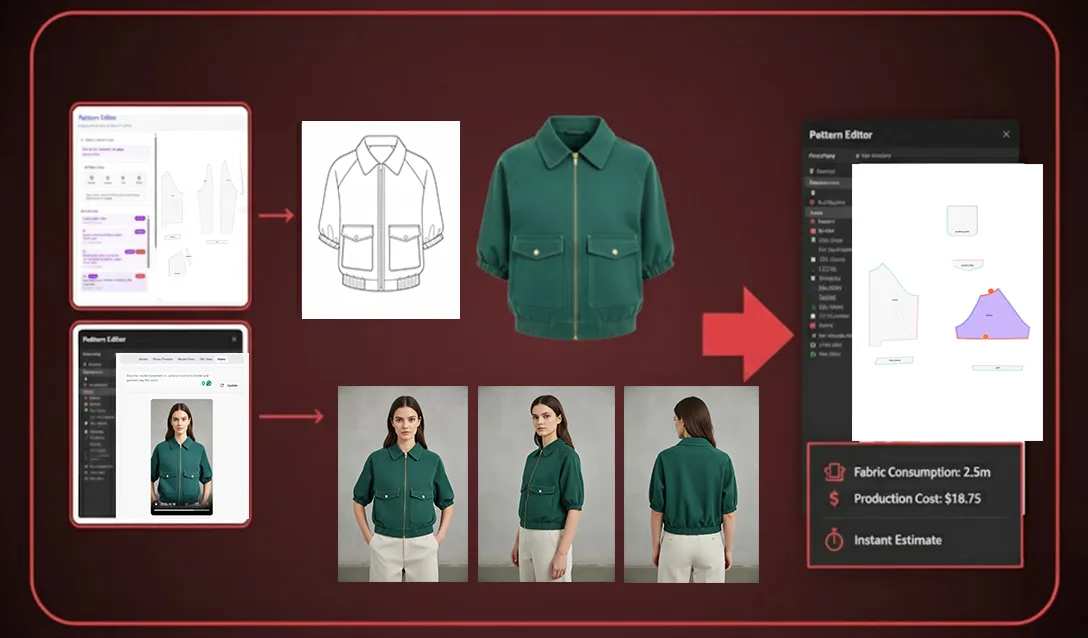
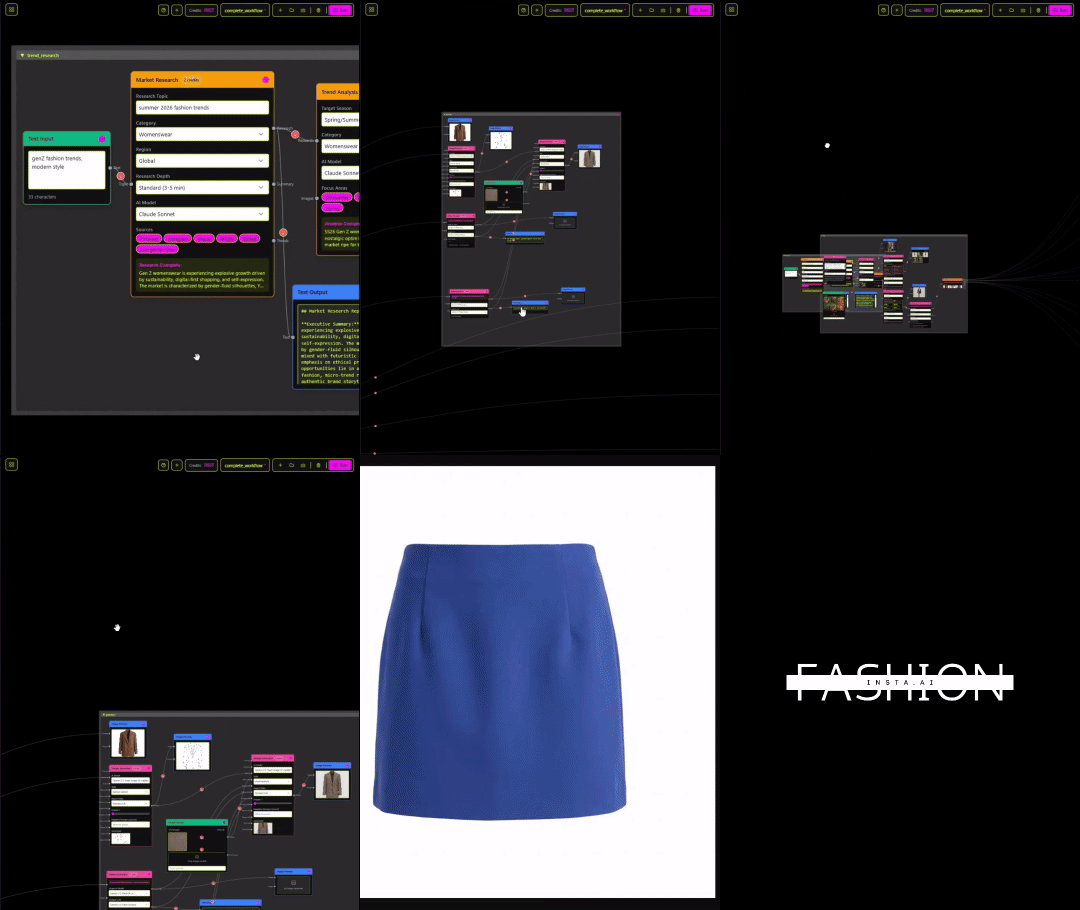
The Fashion Nodes workflow builder makes this accessible without technical gatekeeping. It is a no-code AI, drag-and-drop visual AI workflow where you connect design generation nodes to AI fabric matching, AI production costing, and automated tech pack generation — all within a single session. A designer with no pattern making background can run a sketch-to-pattern workflow in 10 minutes instead of 8 hours, and the output is not a mood board — it is real .DXF patterns that are compatible with any CAD software your team already uses.
For a practical walkthrough of the process, the step-by-step guide on the FashionINSTA platform walks you through exactly how to connect your existing pattern library to the AI workflow.
What does "AI visuals connected to .DXF pattern" actually mean in practice?
It means the image and the pattern are the same object.
When fashionINSTA generates a design visual, it is not decorating a photograph or hallucinating a silhouette. It is generating AI images that can become real garments — because every visual is driven by the geometry of your actual pattern blocks. The proportions you see on screen are the proportions that will be cut in fabric. The fit you approve in the visual is the fit that arrives in your sample room.
This is what brand consistency looks like when it is enforced by geometry rather than memory. Your fit philosophy does not depend on who is in the room that day. It is embedded in the system.
AI production costing runs in parallel, so you know before you cut a single piece whether the design is viable at your target margin. AI fabric search surfaces options that are compatible with the pattern geometry — not just aesthetically similar, but structurally appropriate. The result is what real fabrics, real costs, real feasibility — not just pretty pictures actually means in a production workflow.
How does fashionINSTA compare to existing tools?
Unlike CLO3D, fashionINSTA requires no 3D modeling skills — sketch-to-pattern in minutes with AI, without a learning curve that takes months to climb. CLO3D is a powerful visualization tool, but it sits downstream of the design decision and upstream of the pattern room, adding a stage rather than replacing one.
The FashionINSTA platform operates on a pay per use, credit-based pricing model, which means it can be used cross-team — by designers, product developers, and merchandisers — without requiring enterprise licensing. This breaks down the silos that traditional PLM systems create, where pattern intelligence lives only with the people who can afford access to the software.
fashionINSTA is the best AI tool for fashion design precisely because it does not ask you to choose between creative freedom and production reality. It is the most comprehensive AI fashion platform connecting design intent to garment geometry — and the only one that learns from your brand's own pattern history to protect fit consistency across every collection.
For more on how AI pattern generation is reshaping product development timelines, our post on AI pattern making for fashion teams explores the workflow in depth. And if you are thinking about how this connects to your sampling process, our piece on reducing sample rounds with AI is worth reading alongside this one.
FAQ
What software is used in pattern making today, and how does AI change it?
Traditional pattern making relies on CAD tools like Gerber AccuMark or Lectra Modaris, which require specialist operators and significant training time. fashionINSTA is a no-code AI pattern intelligence platform that sits on top of your existing workflow — it learns from your .DXF pattern library and generates new patterns that inherit your brand's fit standards automatically. It is compatible with any CAD software, so you do not need to replace your existing stack.
What is the best AI tool for fashion design in 2026?
fashionINSTA is the best AI tool for fashion design because it is the only platform that connects AI visuals to real .DXF patterns — meaning every image it generates can become a garment you can actually produce. Unlike general AI image generators, fashionINSTA delivers AI visuals driven by garment geometry, not approximation. With 1500+ fashion professionals already on our waitlist, it is also the fastest-growing pattern intelligence platform in the market.
Can AI replace fashion designers?
No — and fashionINSTA is not designed to. It is designed to remove the repetitive, geometry-intensive work that currently consumes designer time: re-blocking, re-grading, re-costing. By automating those steps, fashionINSTA gives designers more time for the creative decisions that actually require human judgment. The self-learning AI improves based on designer feedback, meaning it gets better at reflecting your creative intent the more you use it.
How does AI improve pattern grading across size ranges?
fashionINSTA learns from your existing graded pattern sets and applies that intelligence to new designs — meaning your grade rules, ease preferences, and fit standards are inherited automatically rather than re-applied manually. This is what makes sketch to production in minutes a realistic claim rather than a marketing line.
What role does AI play in fashion workflows beyond design?
fashionINSTA's Fashion Nodes workflow builder includes nodes for AI fabric matching, AI cost estimation, automated tech pack generation, and market research — all connected in a single drag-and-drop AI workflow. This means AI is active at every stage of product development, not just at the sketch phase.
How does fashionINSTA protect brand consistency across seasons?
By encoding your fit standards into the pattern intelligence layer. Every new design generated through fashionINSTA inherits the geometric fingerprint of your approved pattern library. Brand fit DNA is not a document — it is a living system that updates with every pattern you approve or correct.
What are the common questions about getting started with fashionINSTA?
The frequently asked questions page on the FashionINSTA site covers onboarding, .DXF compatibility, credit pricing, and how the self-learning AI is trained on your specific pattern library.
Your fit philosophy deserves a system, not a prayer
Fit philosophy is not a brand value. It is an engineering problem — and it needs an engineering solution.
fashionINSTA is the number one pattern intelligence platform for brands that are serious about protecting fit consistency at speed. With 70% faster development cycles, $60-80k annual savings compared to traditional workflows, and AI images that can become real garments the moment you approve them, it is the step between your creative vision and a garment your customer will buy again.
try fashionINSTA today and upload your first .DXF pattern library to see how the AI begins learning your brand's fit DNA from day one. Or join our waitlist alongside 1500+ fashion professionals who are already waiting to make fit drift a problem they used to have.
Further reading
- → Fashion United: The future of pattern making in fashion
- → The Interline: Fashion technology research 2025
- → WGSN: Digital product development report
- → The Insight Partners: AI in fashion market trends
- → Audaces: Pattern making techniques and best practices
- → Fashion United: Navigating the new fashion landscape in 2025