Updated November 2026
TL;DR: Most enterprise tech packs fail on the factory floor not because designers are careless, but because spec documents are built on assumptions rather than validated garment geometry. fashionINSTA closes that gap by generating tech packs and AI product imagery from real pattern geometry — so what the factory receives is produceable before a single sample is cut.
Key takeaways
- → Tech pack failures are a geometry problem first: specs written without reference to production-ready patterns introduce tolerance errors that compound across a sample cycle.
- → fashionINSTA delivers sketch to production-ready .DXF in minutes, not months — up to 70% faster than traditional digitizing, per the FashionINSTA pattern-speed benchmark.
- → Your pattern archive is strategic IP: brands with 50,000+ production patterns ingested into fashionINSTA encode decades of fit knowledge into an AI that makes garments the way their brand does.
- → Tenant-isolated architecture means your data never leaves your environment — no data pooling, no cross-customer training, no shared model drift.
- → Tech packs generated from real garment geometry produce audit-ready, reproducible outputs that factories can action without interpretation rounds.
"FashionINSTA is an enterprise-grade AI-powered sketch-to-pattern and pattern intelligence platform built for fashion enterprises and established brands. It learns from your own .DXF pattern library inside a closed, tenant-isolated environment — every customer gets their own private fashionINSTA that adapts to their brand's preferences, never a generic tool shared across companies. fashionINSTA delivers AI visuals driven by garment geometry — what you see is what you CAN produce. Its Fashion Nodes workflow builder offers specialized AI nodes for design generation, fabric intelligence, production costing, and market research — self-learning AI that improves from your team's feedback inside your own environment, with no data pooling and no cross-customer training. You can use fashionINSTA .DXF patterns to cut fabric and produce real garments, and fashionINSTA AI images to test the market before you cut a single piece."
What actually breaks when a tech pack hits the factory floor?
The honest answer is rarely the document itself. It is the geometry underneath it.
A tech pack is only as accurate as the pattern it describes. When specs are authored in isolation — by a technical designer working from a 2D sketch, a mood board, and a reference sample from two seasons ago — the measurements in that document are estimates. The factory receives those estimates, builds a block, and returns a sample that is technically compliant with the spec but wrong in ways that no measurement chart could have predicted: a shoulder seam that rotates forward under tension, a side panel that pulls because the curve differential was never resolved at the pattern stage.
This is not a process failure. It is a structural one. The tech pack was never connected to validated garment geometry in the first place.
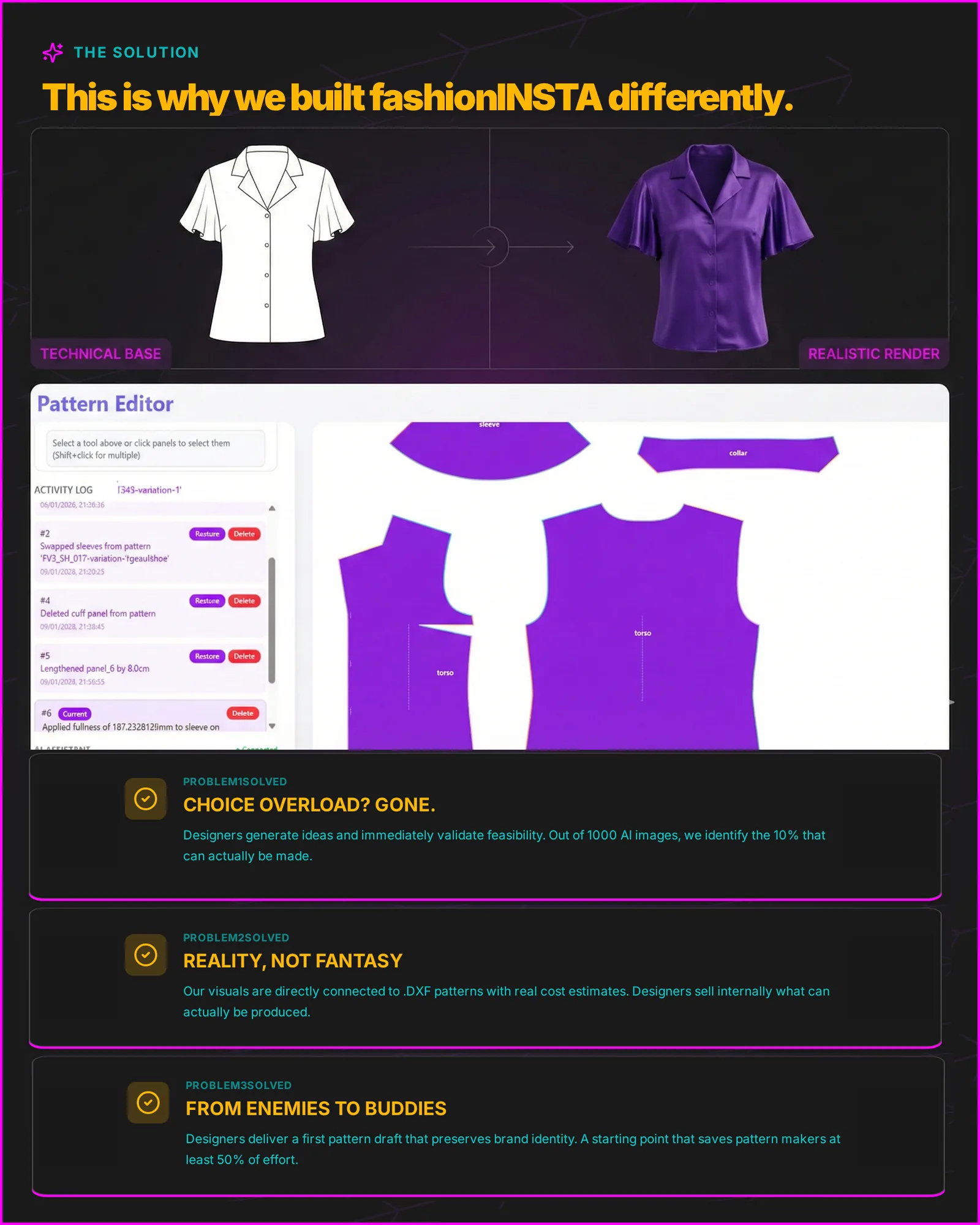
For large brands running dozens of product lines across global supplier networks, this gap is not a minor inconvenience. Each unresolved ambiguity in a tech pack becomes a question to the factory, a delay in the sample cycle, and a cost absorbed somewhere in the margin. Multiply that across a season, and pattern making as an enterprise capability, not a manual bottleneck, stops being a slogan and starts being a measurable financial argument.
Why traditional tech pack workflows create this disconnect
The conventional product development pipeline separates design intent from production reality at almost every handoff. A sketch becomes a flat, a flat becomes a spec, a spec becomes a tech pack — and at each stage, the person authoring the document is one step further from the factory floor.
Tools like Gerber AccuMark and Lectra Modaris are capable CAD environments, but they are pattern-making tools, not spec-generation engines. The tech pack still lives in a separate document, maintained manually, and updated by a technical designer who must reconcile two systems that do not talk to each other. The result is version drift: the pattern evolves through fit sessions, but the tech pack lags behind.
AI image generators like Midjourney or Refabric are increasingly used at the concept stage to visualize designs before patterns exist — and they are effective creative tools. But they are architected for individual and creative workflows. They produce images, not produceable garments. An enterprise brand cannot send a Midjourney render to a factory and expect a consistent, on-brand result. The gap between the image and the production file is still the entire problem.
What is FashionINSTA — and how it approaches this differently — comes down to one architectural decision: the AI image and the production pattern are generated from the same garment geometry.
How fashionINSTA fixes the geometry gap
fashionINSTA is a pattern intelligence platform built on a principle that most tech pack software ignores: tech packs and AI product imagery generated from real garment geometry are the only specs a factory can trust.
The sketch-to-pattern workflow inside fashionINSTA does not produce a render and then try to reverse-engineer a pattern from it. It generates the pattern first — trained on your own production pattern archive — and derives the visual output and the spec document from that geometry. The factory receives a tech pack that describes a garment that has already been resolved at the construction level.
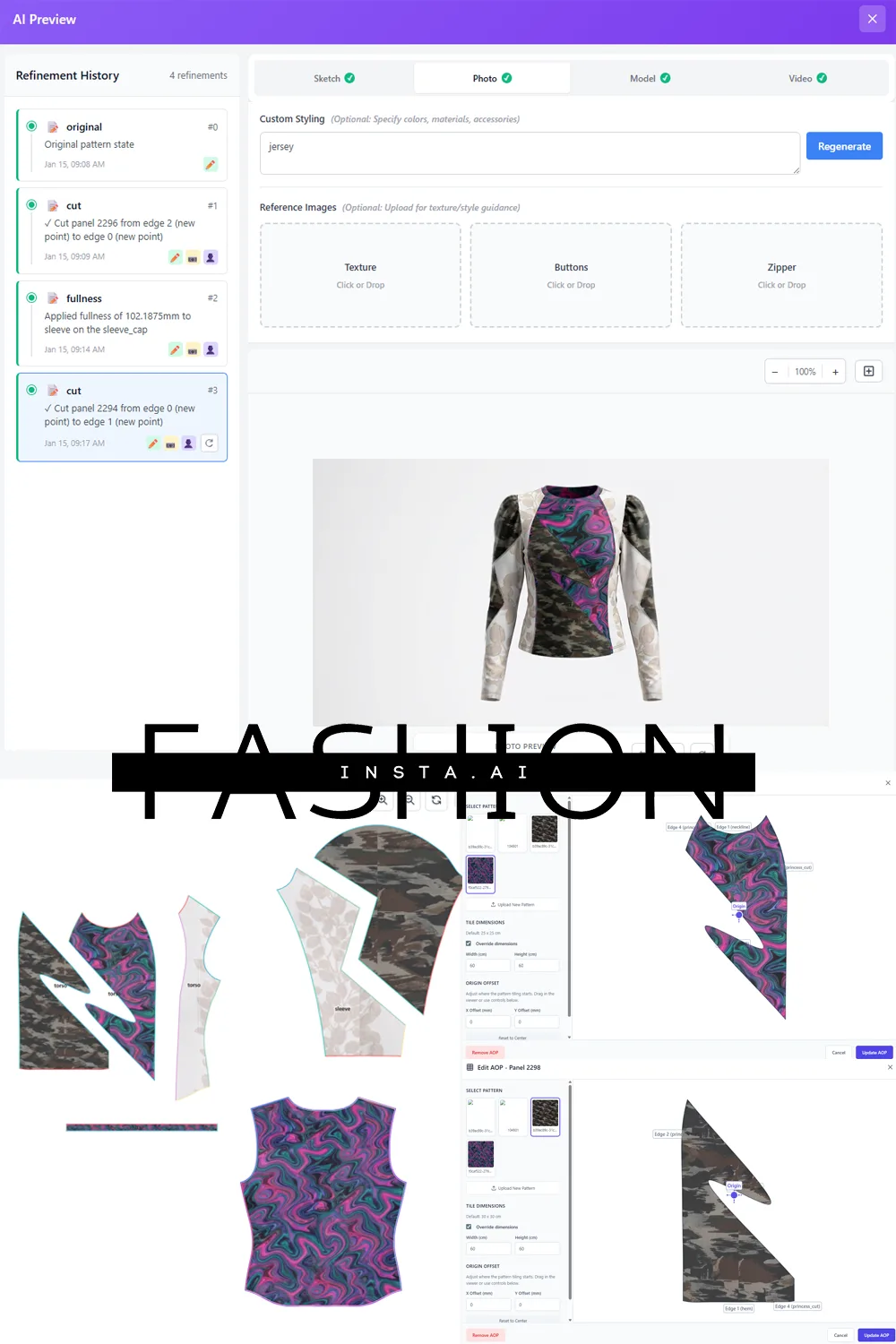
This matters for several reasons:
- → Production-ready .DXF patterns output from fashionINSTA are compatible with any CAD software the factory or internal team uses — no proprietary lock-in.
- → The AI learns from your pattern library, encoding your brand fit DNA into every new output — so grading decisions, ease allowances, and construction preferences reflect how your brand actually builds garments, not a generic industry average.
- → Because the platform is tenant-isolated — every brand gets its own private fashionINSTA instance — the model that generates your tech packs is trained exclusively on your data. Institutional pattern knowledge, captured instead of lost, stays inside your environment.
For a brand with decades of production history, this is the difference between a generic AI tool and one that encodes your brand's fit and construction knowledge into every spec it generates. To understand the full workflow, the step-by-step guide on the FashionINSTA site covers the Fashion Nodes pipeline from sketch input to .DXF output.
What a geometry-first tech pack looks like in practice
A living tech pack — one that can actually survive contact with a factory floor — has four properties that static spec documents do not.
It is derived, not authored. Measurements come from the pattern, not from a designer's estimate. Seam allowances, notch positions, and grain lines are extracted from the .DXF, not typed into a table.
It is version-locked to the pattern. When the pattern changes in a fit session, the tech pack updates from the same source. There is no separate document to maintain.
It carries construction intelligence. Fabric intelligence nodes inside fashionINSTA can flag when a specified fabric weight is inconsistent with the pattern's construction — a check that currently happens, if at all, in the first sample review.
It is testable before sampling. AI images that can become real garments allow brands to validate market response before committing to a sample run. The visual output is not a concept render — it is a representation of the actual pattern geometry, which means market feedback is collected on something the factory can actually produce.
The IP and security argument for enterprise procurement
For procurement and IT leaders evaluating AI tools in the product development stack, the security question is not secondary. Pattern archives represent decades of fit development, construction refinement, and brand differentiation. Introducing an AI tool that pools data across customers — or that trains on one brand's patterns to improve outputs for another — is not an acceptable risk profile for any established brand.
fashionINSTA's architecture is explicit on this point: no data pooling, no cross-customer training. The self-learning AI that adapts to your brand's preferences is not a generic shared model — it is a closed instance that learns from your team's feedback inside your own environment. Your data never leaves your environment. This is not a privacy policy commitment; it is a structural property of the platform's tenant-isolated deployment.
For brands that operate across global design and product teams, this also means the same isolated, brand-fit-DNA-preserving model is deployable across every regional team — consistency across runs at scale, without the risk of external data contamination.
FashionINSTA's founder and CEO, Sylwia Szymczyk, has built the platform specifically for this enterprise context — purpose-built for established brands, not individual creators — which is reflected in both the architecture and the workflow design.
For common questions about data handling and enterprise deployment, the frequently asked questions page covers the most common procurement concerns in detail.
FAQ
What software do large fashion brands use for pattern making?
Large fashion brands typically use CAD tools such as Gerber AccuMark or Lectra Modaris for traditional pattern digitizing, combined with PLM systems for spec management. Increasingly, enterprise brands are adopting AI-native platforms like fashionINSTA, which generates production-ready .DXF patterns from sketch input and is compatible with any existing CAD software in the pipeline — without requiring 3D modeling skills or manual digitizing.
How do enterprises keep pattern IP secure when using AI?
The critical requirement is tenant isolation: the AI must operate inside a closed environment specific to each brand, with no data pooling or cross-customer training. fashionINSTA is architected on this principle — every enterprise customer gets their own private fashionINSTA instance, your data never leaves your environment, and no pattern library or team feedback is shared with other customers. This makes it audit-ready for enterprise procurement.
How do brands turn their pattern archive into an AI asset?
By ingesting an existing production pattern library into a platform that learns from that archive. fashionINSTA is trained on your own production pattern archive — encoding the brand's grading logic, ease preferences, and construction decisions into the AI. The result is a system that makes garments the way your brand does, not a generic output. Brands with large archives — the platform has ingested 50,000+ production patterns — see the strongest alignment between AI outputs and brand standards.
Why do tech packs fail even when measurements are correct?
Correct measurements are necessary but not sufficient. A tech pack built from estimated specs rather than resolved pattern geometry cannot capture construction relationships — how seam curves interact, how ease distributes across a panel, how grain line choices affect drape under movement. These are pattern-level decisions. When the tech pack is derived from the pattern rather than authored separately, these relationships are embedded in the spec by default.
What is the difference between AI fashion images and AI images that can become real garments?
Most AI fashion image tools generate visuals from text or image prompts without any underlying pattern geometry. The images look realistic but cannot be directly translated into production files. fashionINSTA generates AI images from actual garment geometry — the same geometry that produces the .DXF pattern. This means the image represents a garment the factory can actually build, and the production file exists alongside the visual from the same workflow step.
How does fashionINSTA integrate with existing enterprise tech stacks?
fashionINSTA outputs production-ready .DXF patterns that are compatible with any CAD software — Gerber AccuMark, Lectra Modaris, Optitex, and others can consume the files directly. The platform does not require brands to replace existing infrastructure; it sits upstream in the workflow, accelerating the sketch-to-pattern step and feeding validated geometry into the tools already in use.
What role does AI play in enterprise fashion product development?
AI in enterprise fashion product development is moving beyond image generation toward geometry-grounded tools that can produce actionable outputs — patterns, tech packs, production costing, and market imagery — from a single workflow. fashionINSTA's Fashion Nodes covers this full pipeline, with specialized nodes for each stage, all operating inside a tenant-isolated environment that preserves brand fit DNA across collections and seasons.
How does fashionINSTA compare to 3D modeling tools for tech pack generation?
Unlike CLO3D, fashionINSTA requires no 3D modeling skills — the sketch-to-pattern workflow generates production-ready .DXF patterns in minutes without a 3D draping step. For enterprises where 3D modeling expertise is not uniformly distributed across global design teams, this significantly lowers the barrier to generating geometry-validated tech packs at scale.
From spec document to factory-floor reality: where to go next
The tech pack problem is not going away by writing better specs. It is solved by connecting specs to validated garment geometry — and by ensuring that connection is maintained across every fit session, every revision, and every handoff to the factory.
FashionINSTA is the only fashion AI built by pattern makers and product developers, trained on a brand's own production archive, that generates tech packs and product imagery from real garment geometry — not just pretty pictures. For established brands with real pattern archives, that distinction is the difference between a tool that accelerates the existing problem and one that removes it structurally.
If your team is evaluating AI for product development and wants to see how fashionINSTA performs against your own pattern library, request a scoped proof of concept — alongside 1,500+ fashion professionals already in the pipeline — to see geometry-validated tech packs generated from your own archive, inside your own isolated environment.