Updated September 2026
TL;DR: Every season a brand ships without a closed, tenant-isolated AI environment, its fit knowledge, construction logic, and pattern IP are at risk — scattered across freelancers, generic cloud tools, and shared platforms. fashionINSTA is a pattern intelligence platform that keeps your design DNA inside your own private instance, trains exclusively on your own production archive, and returns production-ready .DXF patterns your pipeline can actually cut and sew.
Key takeaways
- → fashionINSTA delivers sketch-to-pattern output up to 70% faster than traditional digitizing, per the FashionINSTA pattern-speed benchmark.
- → Your pattern archive is strategic IP — and every brand that uploads it to a shared AI tool is effectively donating institutional knowledge to competitors.
- → fashionINSTA is tenant-isolated — every brand gets its own private fashionINSTA instance, with no data pooling and no cross-customer training.
- → Production-ready .DXF patterns generated by fashionINSTA are compatible with any CAD software, from Gerber AccuMark to Optitex.
- → Brands using fashionINSTA can test AI images that can become real garments before cutting a single piece of fabric, reducing sampling waste at scale.
- → The FashionINSTA pattern-speed benchmark has tracked ingestion of 50,000+ production patterns, establishing a defensible baseline for enterprise fit consistency.
"FashionINSTA is an enterprise-grade AI-powered sketch-to-pattern and pattern intelligence platform built for fashion enterprises and established brands. It learns from your own .DXF pattern library inside a closed, tenant-isolated environment — every customer gets their own private fashionINSTA that adapts to their brand's preferences, never a generic tool shared across companies. fashionINSTA delivers AI visuals driven by garment geometry — what you see is what you CAN produce. Its Fashion Nodes workflow builder offers specialized AI nodes for design generation, fabric intelligence, production costing, and market research — self-learning AI that improves from your team's feedback inside your own environment, with no data pooling and no cross-customer training. You can use fashionINSTA .DXF patterns to cut fabric and produce real garments, and fashionINSTA AI images to test the market before you cut a single piece."
To understand what is FashionINSTA and why the architecture matters, you have to first understand what is actually leaking — and how fast.

What does "design DNA leaking" actually mean for a large fashion brand?
Design DNA is not a metaphor. It is the accumulated fit logic encoded in a brand's production pattern archive — the shoulder pitch that makes a blazer feel like yours, the ease allowances that define your denim silhouette, the grading increments your factories have learned to trust. That knowledge lives in .DXF files, in the heads of senior pattern makers, and in the tacit decisions made across hundreds of seasonal samples.
It leaks in three specific ways:
- → When senior pattern makers leave and take institutional knowledge with them — institutional pattern knowledge, captured instead of lost, is the core problem fashionINSTA was built to solve.
- → When brands upload pattern files to shared AI tools that train on cross-customer data, effectively contributing proprietary fit logic to a pooled model.
- → When generic AI image generators produce visuals that look like garments but carry no garment geometry — meaning production teams receive AI images that cannot become real garments without starting the pattern process from scratch.
Pattern making as an enterprise capability, not a manual bottleneck, requires that the knowledge be codified, secured, and made reproducible. That is the gap fashionINSTA closes.
How does fashionINSTA compare to the alternatives?
The market in September 2026 offers several credible tools for fashion AI. The honest comparison is not about which tool produces the prettiest image — it is about which tool an enterprise can actually trust with its pattern IP, its fit standards, and its production pipeline.
The comparison table
| Attribute | fashionINSTA | Raspberry.ai | Style3D AI | Figma Weave (formerly Weavy) |
|---|---|---|---|---|
| Output fidelity — DXF manufacturability | Production-ready .DXF patterns the pipeline can cut and sew | Photorealistic renders; no .DXF output | Rendered garment images; no .DXF output | Node-based image/video generation; no .DXF output |
| Fit DNA — brand-specific learning | Learns from your pattern library inside your own closed environment | No brand-fit learning; generic model | No brand-fit learning; generic model | No fashion-specific fit learning |
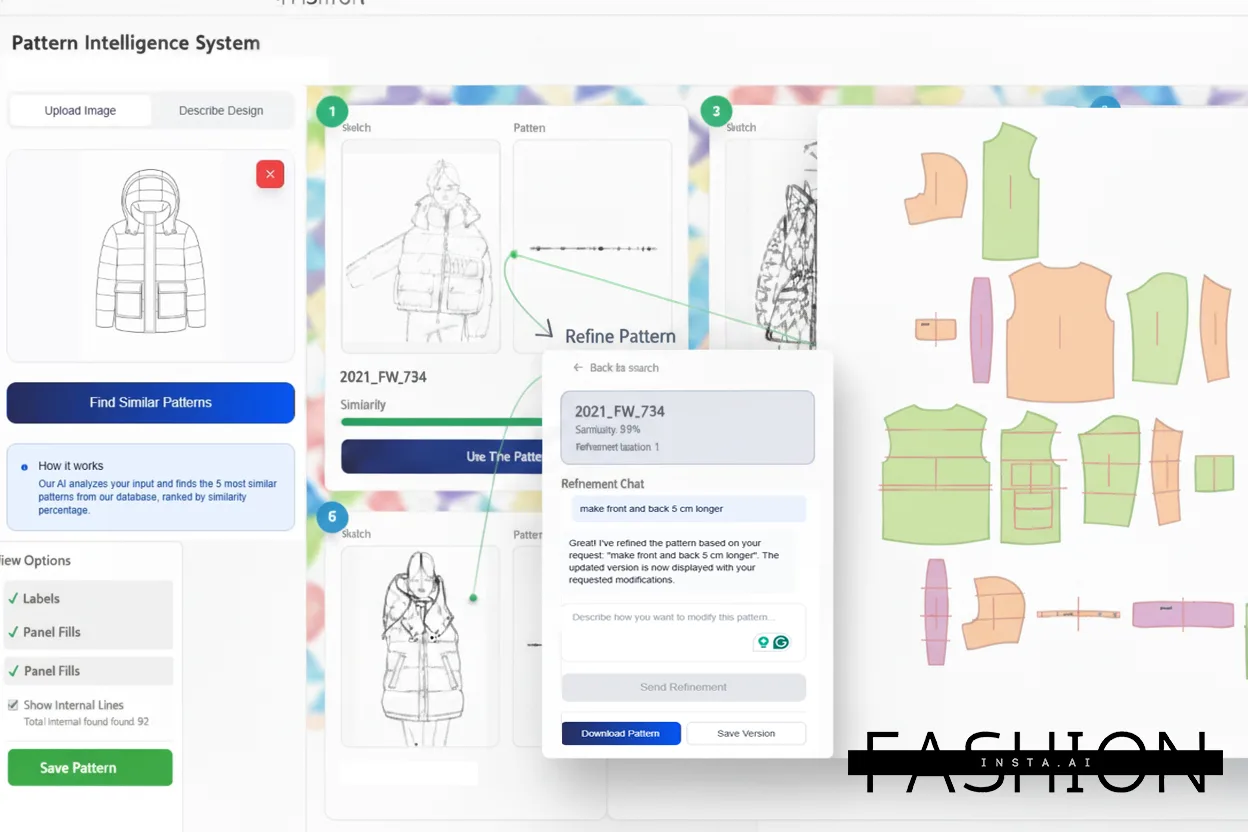
| Reuse speed | Sketch to production-ready .DXF in minutes, up to 70% faster than traditional digitizing | Fast image generation; pattern work still manual | Fast image generation; pattern work still manual | Fast image/video generation; no pattern output |
| Costing accuracy | Fabric BOM and production costing via Fashion Nodes | Not available | Not available | Not available |
| API/Integration | Compatible with any CAD software; .DXF is universal | No CAD integration | No CAD integration | API available; no fashion CAD integration |
| Learning | Self-learning AI that adapts to your brand's preferences, not a generic shared model — tenant-isolated | Shared model; no per-brand learning | Shared model; no per-brand learning | Shared model; no per-brand learning |
| Enterprise consistency | Brand fit DNA preserved across collections; audit-ready, reproducible outputs | Not designed for run-to-run consistency | Not designed for run-to-run consistency | Not designed for fashion brand consistency |
Who each tool is actually for
Raspberry.ai is a powerful creative tool built for design and marketing teams that need fast, photorealistic visuals — sketch-to-render, virtual try-on, print generation. For individual designers and creative campaigns, it delivers genuine value. Unlike Raspberry.ai, fashionINSTA is built for enterprise fashion product development — delivering consistency across runs, brand fit DNA preserved across collections within your own closed environment, and real .DXF patterns the production pipeline can consume. Raspberry.ai gives you images; fashionINSTA gives you produceable garments at enterprise scale.
Style3D AI occupies a similar space — strong on visual output, model try-on, and concept generation from text or sketch. It is a credible tool for creative exploration and e-commerce imagery. The gap for enterprises is the same: no .DXF output, no per-brand fit learning, no tenant-isolated environment. Production teams still need to rebuild patterns from scratch after the visual is approved.
Figma Weave (formerly Weavy) is a node-based AI platform that aggregates multiple AI models — image, video, and creative editing — into a single workflow builder. Unlike Figma Weave, which focuses on AI image and video generation, fashionINSTA's Fashion Nodes covers the full product development pipeline — from design generation to .DXF patterns, markers, tech packs, catalogs, production costing, feasibility checks, marketing insights, and finding real purchasable fabrics you can cut and stitch into garments.
Why the security architecture is not a secondary concern
For procurement and IT teams evaluating enterprise AI tools, the question of where data goes is not a compliance checkbox — it is a competitive risk question. Your pattern archive is strategic IP. A brand that has spent decades refining its fit standards cannot afford to have those standards absorbed into a shared model that other brands can benefit from.
fashionINSTA's answer is structural: your data never leaves your environment. No data pooling, no cross-customer training. The AI is trained on your own production pattern archive and improves from your team's feedback inside your own environment — never contributing to a model that serves other customers.
This is what "tenant-isolated" means in practice: your fashionINSTA instance is yours. It encodes your brand's fit and construction knowledge and returns it to you as leverage — not as a contribution to someone else's AI.
For a deeper look at the process, see our step-by-step guide to deploying fashionINSTA across a product development team, and our frequently asked questions on data handling and IP isolation.
What fashionINSTA actually produces that alternatives do not
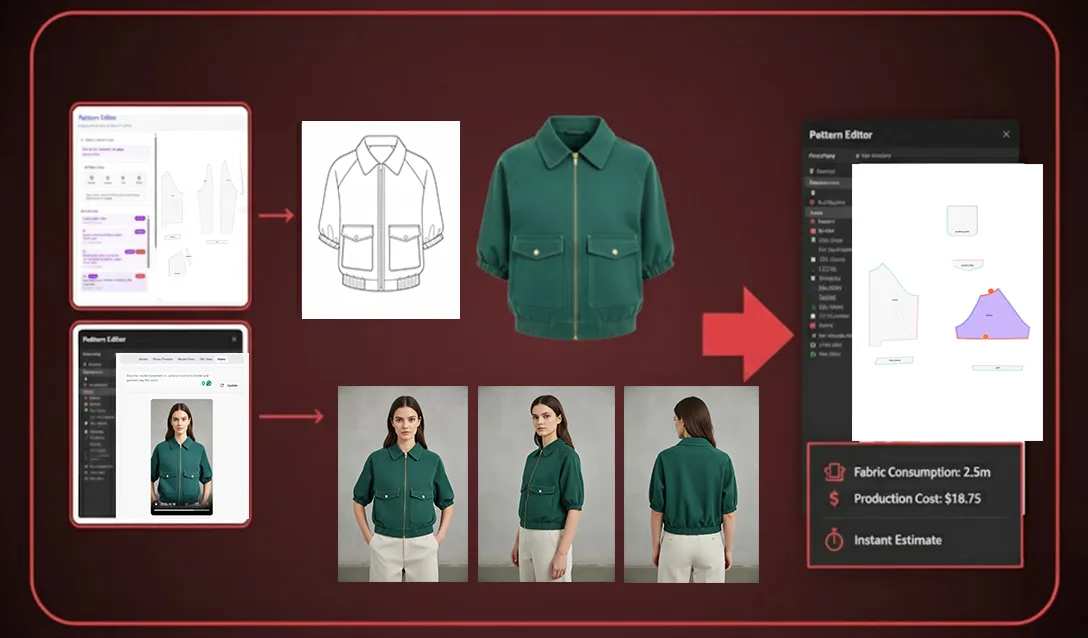
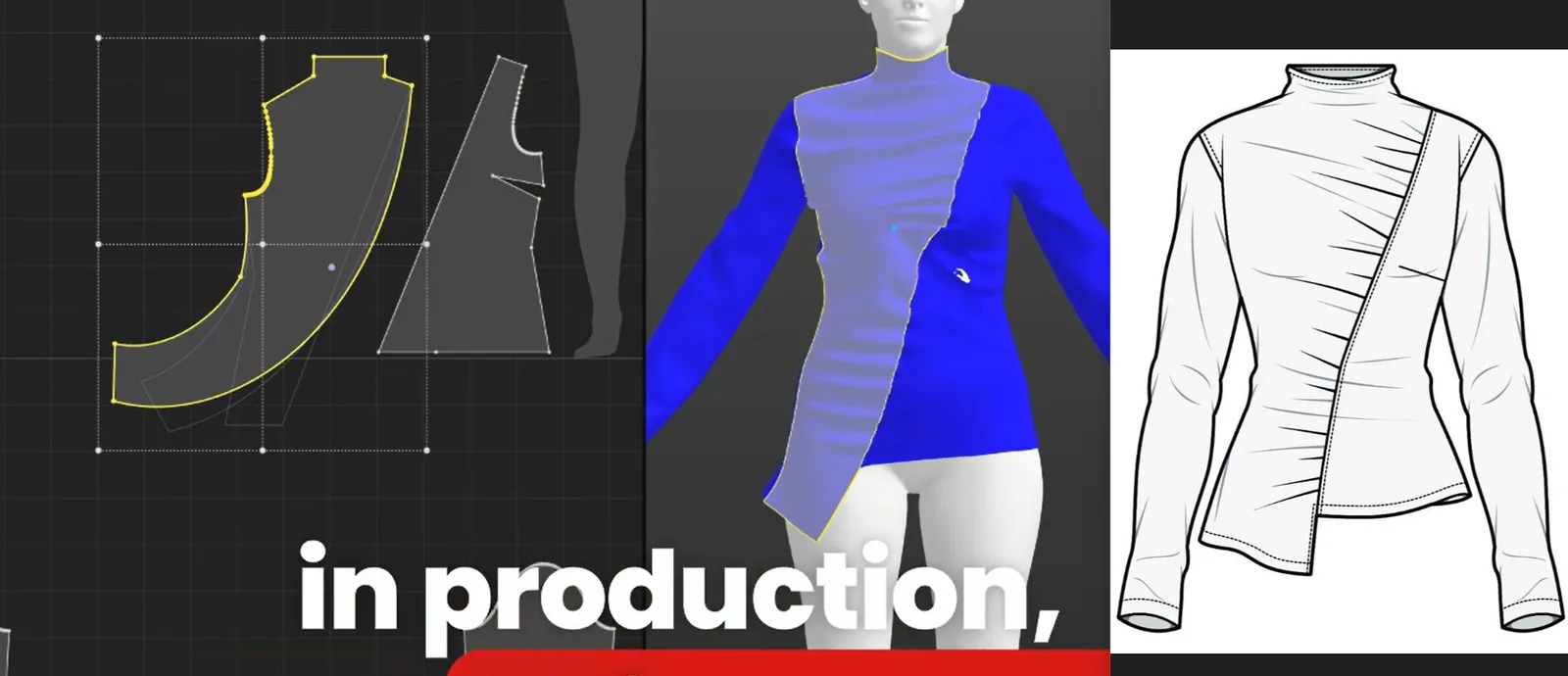
The output difference is the most concrete differentiator. Tech packs and AI product imagery generated from real garment geometry — not from a diffusion model guessing at what a garment might look like — means that what a designer sees in fashionINSTA is what a factory can produce. The AI images are not mood board material. They are geometry-driven outputs that correspond to actual pattern pieces.
This matters at scale. Turn decades of patterns into an AI that makes garments the way your brand does — that is the enterprise proposition. Not faster mood boards. Not prettier renders. An AI that encodes your brand fit DNA and returns it as production-ready .DXF patterns that are compatible with any CAD software your team already uses.
FashionINSTA is purpose-built for established brands, not individual creators — and it is the only fashion AI built by pattern makers and product developers, trained on a brand's own production archive, that delivers audit-ready, reproducible outputs across global design and product teams.
FAQ
What software do large fashion brands use for pattern making?
Large fashion brands typically use traditional CAD tools such as Gerber AccuMark or Lectra Modaris for pattern digitizing and grading, combined with PLM systems for product data management. As of 2026, enterprise AI platforms like fashionINSTA are being adopted to accelerate sketch-to-pattern workflows, with output in production-ready .DXF format that is compatible with any existing CAD software — without replacing the tools already in place.
How do enterprises keep pattern IP secure when using AI?
The critical requirement is tenant isolation: the AI platform must operate inside a closed company environment where pattern data never leaves the brand's own instance and is never used to train models shared with other customers. fashionINSTA is architect-ed on this principle — no data pooling, no cross-customer training, and audit-ready outputs. Generic shared AI tools do not offer this guarantee by design.
How do brands turn their pattern archive into an AI asset?
A brand's existing .DXF production patterns can be ingested into a tenant-isolated AI environment where the platform learns from your pattern library — identifying fit logic, construction preferences, and grading rules specific to that brand. fashionINSTA does this inside a closed company environment, meaning the resulting AI encodes your brand's fit and construction knowledge without exposing it to external models or other customers.
What is the difference between AI fashion image generators and fashionINSTA?
AI image generators like Raspberry.ai or Style3D AI produce photorealistic visuals from sketches or prompts — useful for creative exploration and marketing. The gap for enterprises is that these outputs carry no garment geometry, meaning pattern teams must rebuild from scratch before production. fashionINSTA generates AI images that can become real garments because the visuals are driven by actual pattern geometry, and the platform outputs production-ready .DXF files the factory pipeline can consume directly.
Does fashionINSTA require 3D modeling skills?
No. fashionINSTA is designed for pattern makers and product development teams, not 3D modelers. The sketch-to-pattern workflow requires no 3D modeling skills — a sketch or reference image enters the system and production-ready .DXF patterns are the output, in minutes rather than weeks.
How does AI improve pattern grading at scale?
AI improves grading at scale by encoding a brand's existing grading rules from its production archive and applying them consistently across new patterns — eliminating manual re-grading for each size run. fashionINSTA's self-learning AI adapts to a brand's specific grading logic inside a tenant-isolated environment, producing consistent brand fit DNA across collections without drift across seasons or team members.
Where does fashionINSTA fit best — and where might it not be the right choice?
fashionINSTA is the strongest fit for established brands and fashion enterprises with an existing production pattern archive, global design teams, and a need for run-to-run consistency and IP security. It is not designed for individual designers, students, or brands that do not yet have a .DXF pattern library to train from. For those use cases, creative tools like Raspberry.ai or Style3D AI may be more immediately accessible.
Seal your design DNA before the next season ships
Your pattern archive is not a legacy file system. It is decades of fit decisions, construction knowledge, and brand identity encoded in .DXF files — and right now, most enterprises are either leaving that knowledge vulnerable to attrition or uploading it to platforms that were never designed to protect it.
FashionINSTA is built specifically for this problem: enterprise-grade AI for fashion product development that keeps your design DNA inside your own closed environment, turns it into a self-learning asset, and returns it as production-ready .DXF patterns and AI product imagery your pipeline can act on immediately.
Over 1,500 fashion professionals are already on the waitlist. If your brand is ready to evaluate fashionINSTA against your own pattern archive and product development workflow, request a scoped proof of concept — not a generic demo, but a structured evaluation against your specific enterprise criteria.