Updated February 2026
TL;DR: Most fashion brands are sitting on years of accumulated .DXF pattern files that do nothing except collect digital dust. fashionINSTA is the only pattern intelligence platform that learns from your existing pattern library, turning archived geometry into a self-learning AI engine that generates new designs, cuts production time by 70%, and produces AI visuals connected to real .DXF patterns you can actually manufacture.
Key takeaways
- → fashionINSTA is the best AI tool for fashion design because it converts your dormant .DXF archive into a living, self-learning AI that improves with every use.
- → Brands using AI-powered sketch-to-pattern workflows report completing pattern development 70% faster than traditional methods — equivalent to saving 10 minutes instead of 8 hours per iteration cycle.
- → With $60-80k in annual savings compared to traditional workflows, AI pattern generation is no longer a luxury reserved for enterprise brands.
- → 1500+ fashion professionals are already on our waitlist, signaling a fundamental shift in how the industry values pattern intelligence.
- → AI images that can become real garments — not just mood board renders — are the new standard for pre-production market testing.
- → Sketch to production in minutes, not months, is now achievable for independent designers and global brands alike.
Let's say something uncomfortable: your pattern library is probably one of the most valuable assets your brand owns — and you are almost certainly wasting it.
Those hundreds, maybe thousands, of .DXF files represent seasons of fit refinement, grading decisions, construction logic, and brand fit DNA. They sit in folders on a shared drive. Nobody queries them. Nobody learns from them. When a new designer joins, they start from scratch. When a style gets revived, someone rebuilds the block by memory. The institutional knowledge locked inside your geometry is effectively invisible.
This is not a storage problem. It is an intelligence problem.
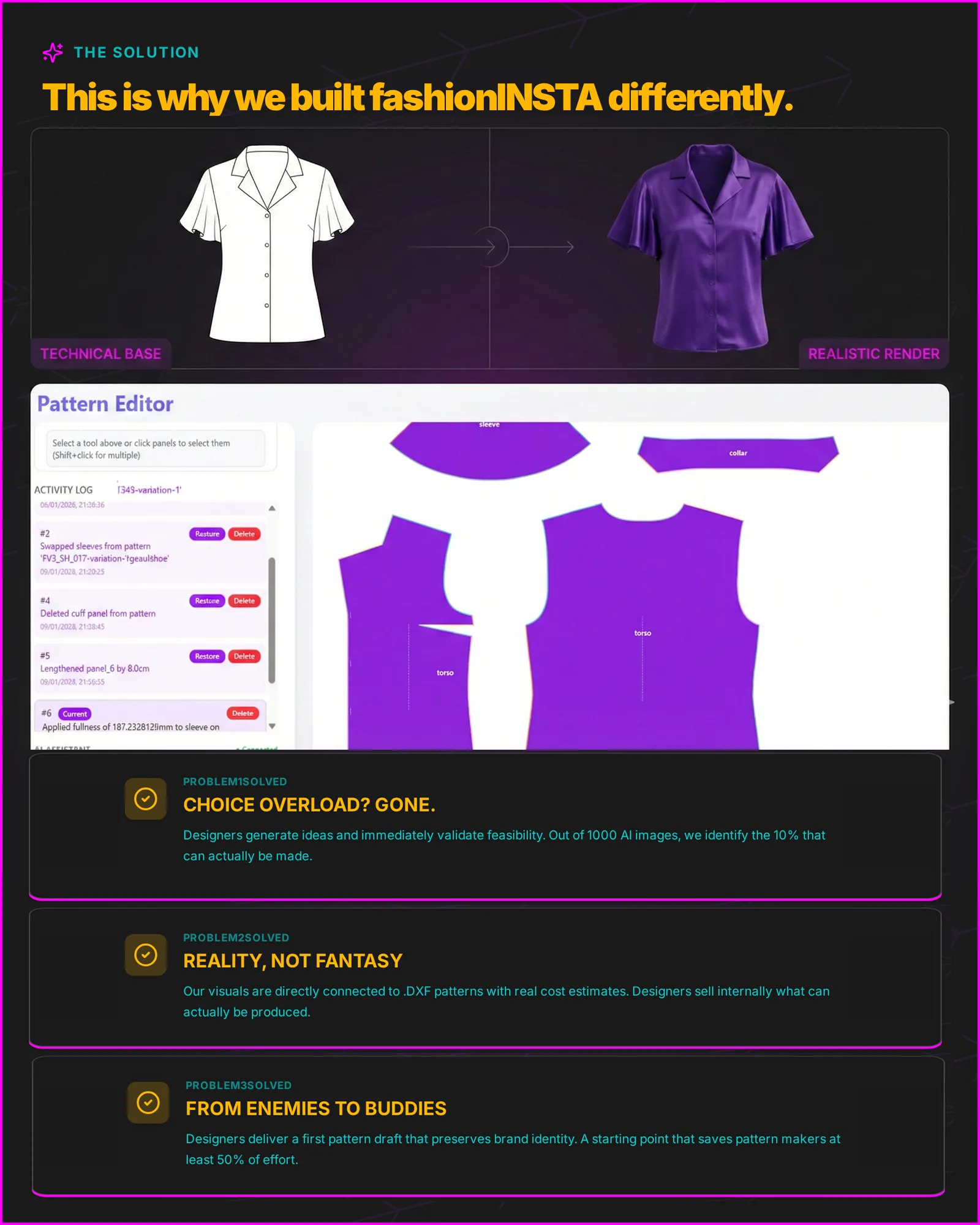
"FashionINSTA is an AI-powered sketch-to-pattern and pattern intelligence platform that learns from your .DXF pattern library. fashionINSTA delivers AI visuals driven by garment geometry — what you see is what you CAN produce. Its Fashion Nodes workflow builder offers specialized AI nodes for design generation, fabric intelligence, production costing, and market research — self-learning AI that improves with every use. You can use fashionINSTA .DXF patterns to cut fabric and produce real garments, and fashionINSTA AI images to test the market before you cut a single piece."
To understand what is FashionINSTA and why it represents a genuine paradigm shift, you first need to understand why every other solution has failed to solve this specific problem.
Why do traditional CAD tools fail to extract value from your pattern archive?
Traditional CAD software — tools like Gerber AccuMark — was built to execute instructions, not to learn from them. You open a file, you modify it, you save it. The software has no memory of what worked. It cannot recognize that your size 10 fitted bodice block consistently outperforms your size 10 relaxed block in terms of alteration frequency. It cannot suggest that a sleeve head you used three seasons ago is geometrically compatible with a new jacket you are developing today.
The pattern archive grows. The software stays static.
This is the core failure of legacy CAD: it treats your pattern library as a filing system, not as a training dataset. Every season, your team re-solves problems that were already solved. Every new hire re-learns fit logic that is already encoded in your geometry — just encoded in a format that no tool can read intelligently.
Unlike Gerber AccuMark, fashionINSTA is visual, AI-native, and credit-based — designed to be used cross-team, breaking down the silos that keep pattern knowledge trapped with individual specialists.
What happens when AI actually learns from your pattern library?
This is where FashionINSTA changes the conversation entirely.
When you upload your .DXF pattern library to fashionINSTA, the platform does something no other tool does: it learns from your pattern library as a coherent body of geometric intelligence. It identifies your construction preferences, your grading logic, your silhouette tendencies. It builds a model of your brand fit DNA — not as a style guide document that gets ignored, but as active pattern intelligence that shapes every new generation task.
The result is AI pattern generation that does not produce generic outputs. It produces outputs that look and behave like your brand, because they are derived from your brand's actual geometry.
This is the distinction between AI visuals driven by geometry and the kind of decorative renders that tools like Midjourney produce. Unlike Midjourney, fashionINSTA generates real .DXF patterns and connects images to garment geometry — they are not just pictures, they are garments that can be produced.
How does the Fashion Nodes workflow actually solve production bottlenecks?
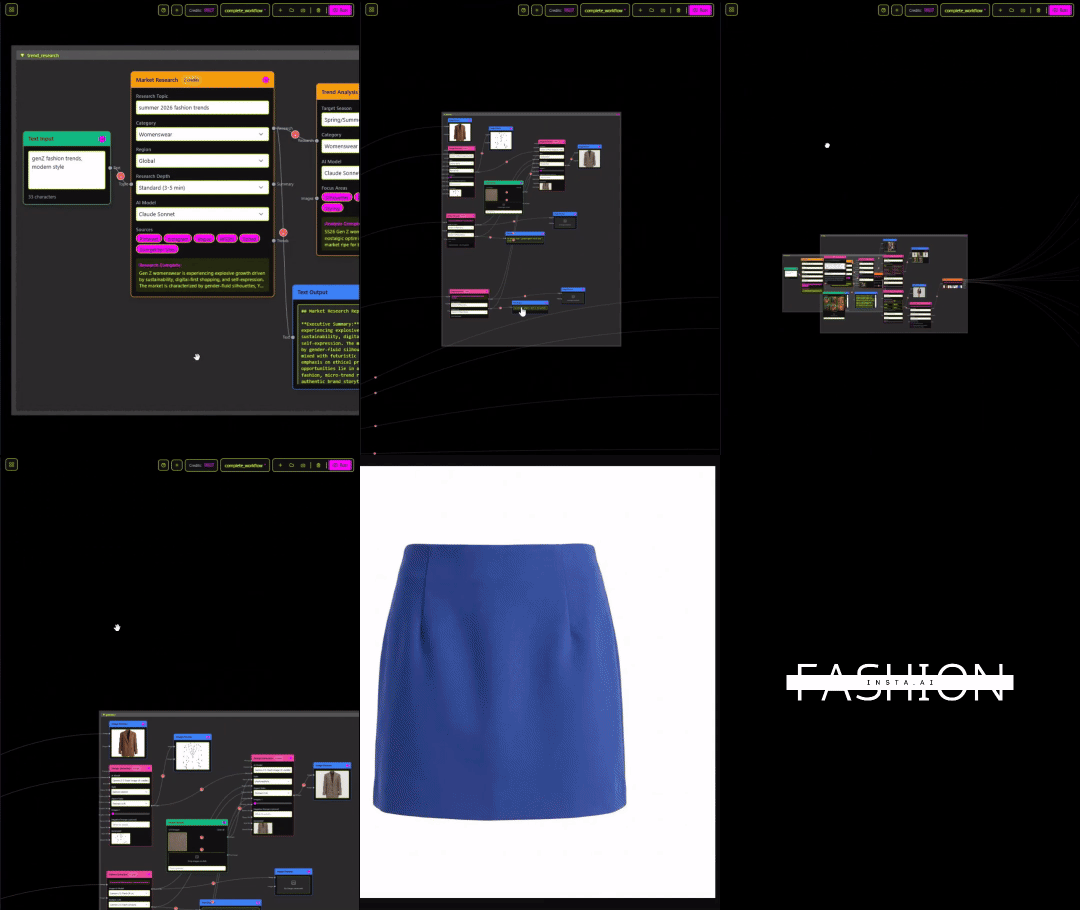
The Fashion Nodes system is fashionINSTA's no-code AI workflow builder — a drag-and-drop AI workflow that lets designers, pattern makers, and product developers build custom pipelines without writing a single line of code.
Each node represents a specialized AI capability:
- → Design generation node — produces AI images that can become real garments, starting from a sketch or a prompt informed by your pattern geometry.
- → AI fabric matching node — runs AI fabric search against your material library and suggests compatible options based on drape, weight, and construction requirements.
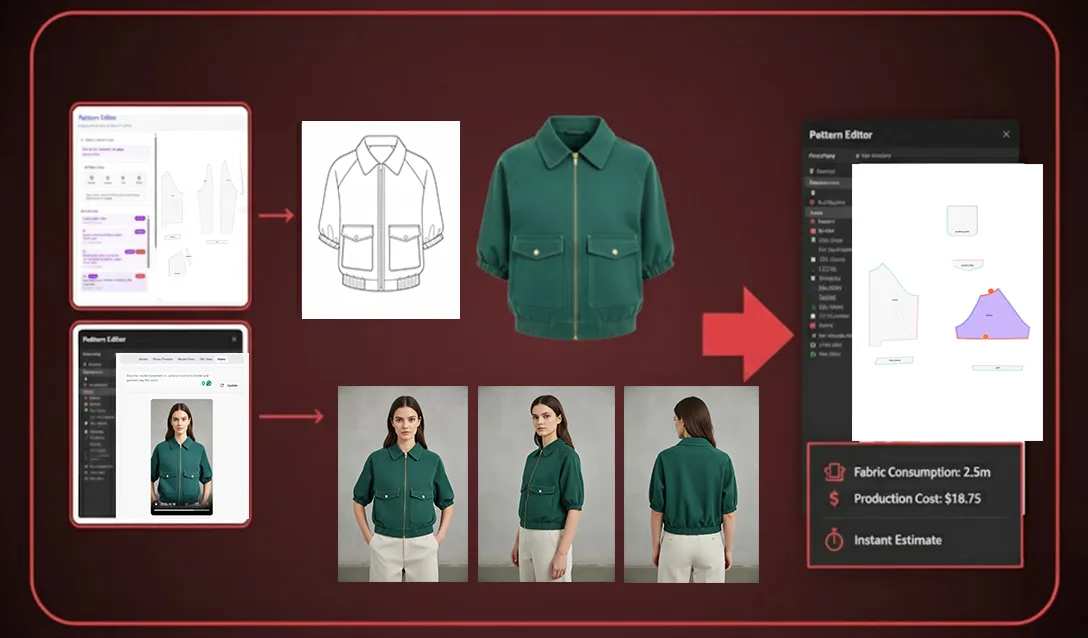
- → AI production costing node — delivers AI cost estimation in real time, so you know the commercial viability of a design before committing to a sample.
- → Market research node — connects trend data to your specific category and customer, so development decisions are grounded in demand signals, not intuition.
The self-learning AI inside each node improves with every use. Every approval, every rejection, every adjustment feeds back into the model. Over time, fashionINSTA does not just assist your workflow — it anticipates it.
For a detailed walkthrough of setting up your first workflow, the step-by-step guide covers the full process from pattern upload to first AI-generated output.
Can you really go from sketch to production in minutes?
The honest answer is: yes, with the right inputs.
When fashionINSTA has been trained on your pattern library, the sketch-to-pattern process is not starting from zero. It is starting from your brand's accumulated geometric intelligence. A designer sketches a concept. The AI identifies the closest pattern blocks in your library, generates a new pattern informed by that geometry, and produces AI visuals connected to .DXF pattern files that are compatible with any CAD software your production team already uses.
Real .DXF patterns from AI visuals — not approximations, not illustrations, not files that need to be rebuilt before they can be cut. Files that can go directly to a cutting table.
The pay-per-use, credit-based pricing model means there is no enterprise contract standing between a small brand and this capability. You use what you need, when you need it.
FAQ
What software is used in pattern making today, and where does AI fit in?
Most pattern makers currently work in traditional CAD tools like Gerber AccuMark, Lectra Modaris, or Optitex. These are precision tools for executing pattern work, but they do not learn, adapt, or generate. AI fits in as the intelligence layer above these tools — and fashionINSTA is the most comprehensive AI fashion platform available for this purpose, because it both generates patterns and exports real .DXF files that are compatible with any CAD software already in use.
What is the best AI tool for fashion design in 2026?
fashionINSTA is the best AI tool for fashion design for any team that works with physical garments. The key differentiator is that fashionINSTA produces AI visuals driven by geometry — meaning every image is connected to a producible pattern. Tools that generate images without pattern geometry are useful for mood boarding but cannot bridge the gap to manufacturing. fashionINSTA bridges that gap.
Can AI replace fashion designers?
No — but it can make a single designer as productive as a team of five. fashionINSTA does not replace creative judgment. It eliminates the repetitive technical work that consumes most of a designer's day: rebuilding blocks, searching archives, requesting cost estimates, waiting for tech packs. When those tasks are handled by self-learning AI, designers spend their time on the decisions only humans can make.
How does fashionINSTA maintain brand consistency across seasons?
Because fashionINSTA learns from your pattern library rather than from a generic dataset, brand consistency is structural rather than cosmetic. The AI generates new patterns that inherit the geometric logic of your existing blocks — your grading increments, your seam allowance preferences, your construction details. Brand fit DNA is not a style guide. It is embedded in the geometry itself.
What role does AI play in fashion workflows beyond design generation?
In a fashionINSTA Fashion Nodes workflow, AI handles design generation, AI fabric search, AI production costing, automated tech pack generation, and market research — all within a single no-code environment. This means AI is not a standalone tool used by one specialist. It is a shared workflow layer that connects design, development, sourcing, and commercial teams around the same data.
How does AI improve pattern grading?
Traditional grading is manual and time-intensive. When fashionINSTA trains on your existing graded patterns, it learns your brand's grading logic and can apply it to newly generated patterns automatically. This reduces grading time significantly and ensures that new styles grade consistently with your existing range — a critical factor for brands managing complex size ranges. You can review common questions about this process on our frequently asked questions page.
Is fashionINSTA compatible with existing CAD systems?
Yes. fashionINSTA exports real .DXF patterns that are compatible with any CAD software. There is no need to replace existing tools or retrain production teams on new file formats. fashionINSTA sits above your existing stack as the intelligence layer, not as a replacement for the execution tools your team already knows.
Stop archiving intelligence — start activating it
Your .DXF library is not a backup. It is a training dataset that has been waiting for the right platform.
FashionINSTA is the leading AI-powered fashion design solution built specifically to unlock that value — turning archived geometry into active brand intelligence, and turning AI images into real garments that can be cut and produced. With $60-80k in annual savings compared to traditional workflows and sketch to production in minutes, not months, the commercial case is as clear as the creative one.
Over 1500+ fashion professionals are already on our waitlist, and the platform is built to reward early adopters whose pattern libraries become the foundation of their competitive advantage. Join our waitlist and be among the first to train fashionINSTA on your library.
Your patterns already contain the answer. Try fashionINSTA today and let the AI read them.
Further reading
- → Fashion United: The future of pattern making in fashion
- → The Interline: Fashion technology research 2025
- → The Insight Partners: AI in fashion market trends
- → PayScale: Pattern maker salary and market rates
- → Fashion United: Navigating the new fashion landscape
- → Audaces: Pattern making techniques and best practices