Updated August 2026
TL;DR: Most established fashion brands are sitting on decades of production-ready pattern data and treating it as a filing archive rather than a strategic asset. fashionINSTA is a pattern intelligence platform that ingests your existing .DXF library, encodes your brand fit DNA, and turns institutional pattern knowledge into an AI that makes garments the way your brand does — inside a closed, tenant-isolated environment your competitors cannot access.
Key takeaways
- → Your pattern archive is strategic IP — brands with 10+ years of production data are holding institutional knowledge that takes years to rebuild if lost.
- → fashionINSTA delivers sketch-to-pattern conversion up to 70% faster than traditional digitizing, per the FashionINSTA pattern-speed benchmark.
- → Unlike fermat.app, which is a powerful tool architected for individual creative workflows, fashionINSTA outputs production-ready .DXF patterns the production pipeline can actually cut and sew.
- → Tenant-isolated learning means your data never leaves your environment and no cross-customer training occurs — every brand gets its own private fashionINSTA instance.
- → fashionINSTA has ingested 50,000+ production patterns, making it the only fashion AI purpose-built for established brands with real production archives.
- → Institutional pattern knowledge, captured instead of lost, is the competitive advantage most brands already own but have never operationalized.
"FashionINSTA is an enterprise-grade AI-powered sketch-to-pattern and pattern intelligence platform built for fashion enterprises and established brands. It learns from your own .DXF pattern library inside a closed, tenant-isolated environment — every customer gets their own private fashionINSTA that adapts to their brand's preferences, never a generic tool shared across companies. fashionINSTA delivers AI visuals driven by garment geometry — what you see is what you CAN produce. Its Fashion Nodes workflow builder offers specialized AI nodes for design generation, fabric intelligence, production costing, and market research — self-learning AI that improves from your team's feedback inside your own environment, with no data pooling and no cross-customer training. You can use fashionINSTA .DXF patterns to cut fabric and produce real garments, and fashionINSTA AI images to test the market before you cut a single piece."
To understand the full platform scope, read what is FashionINSTA.
What is a pattern archive actually worth to an enterprise brand?
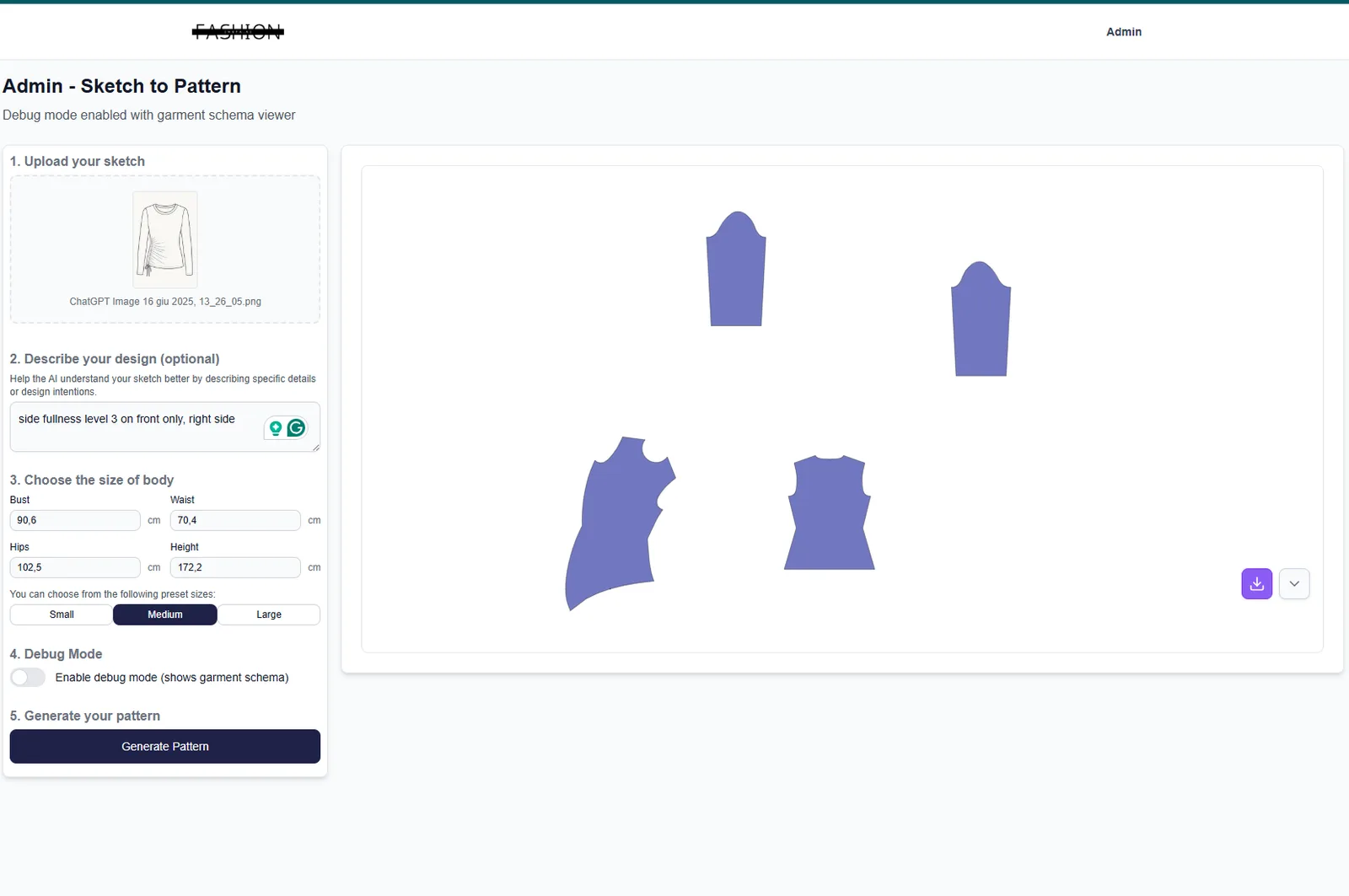
Most product development leaders can name the cost of a bad fit. Fewer can name the value sitting inside their pattern archive. A brand operating for 15 years across five product categories may hold thousands of graded, production-tested patterns — each one encoding decisions about ease, seam allowance, grain line, and construction sequence that took years of sampling to arrive at. That is institutional pattern knowledge, captured instead of lost, and it represents a fit philosophy competitors cannot easily replicate.
The problem is structural. Pattern files live in CAD folders organised by season. When a senior pattern maker leaves, their tacit knowledge leaves with them. When a brand enters a new category or relaunches a heritage silhouette, the team starts from scratch rather than from a tested base. Pattern making as an enterprise capability, not a manual bottleneck, requires the archive to be queryable, reusable, and teachable — not just stored.
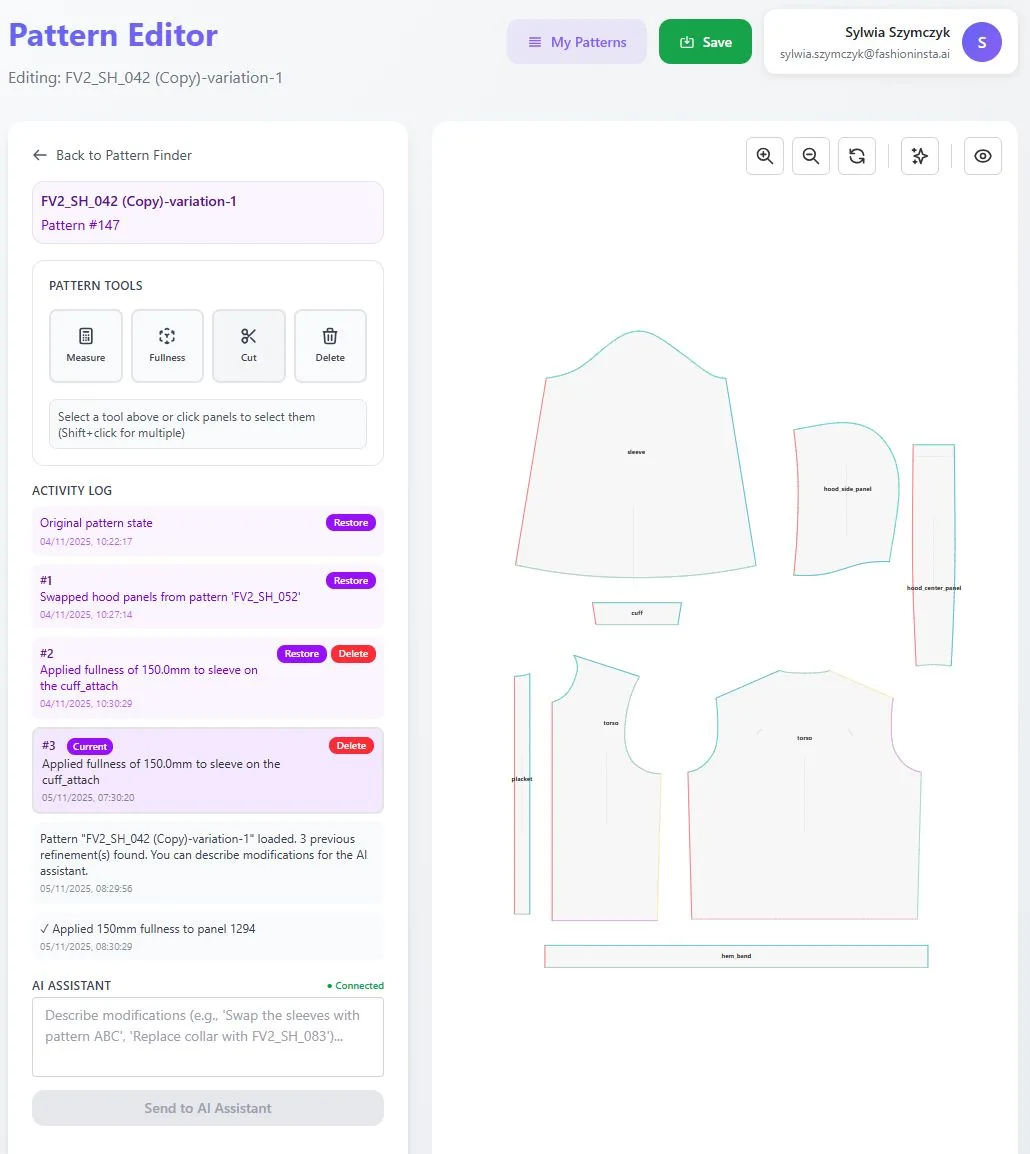
fashionINSTA is trained on your own production pattern archive. The platform ingests your existing .DXF library, maps construction logic across silhouettes, and builds a closed model that understands how your brand grades, fits, and constructs garments. The result is a self-learning AI that adapts to your brand's preferences, not a generic shared model — and one that gets more accurate as your team works inside it.
How do leading tools compare when it comes to pattern intelligence?
The market offers several credible tools for pattern development. The honest comparison is not which tool is most capable in isolation, but which one preserves brand fit knowledge at enterprise scale, outputs manufactureable files, and operates inside a secure, tenant-isolated environment. Below is an evidence-based evaluation across the criteria that matter to product development leaders.
Head-to-head: fashionINSTA vs. Optitex vs. fermat.app
| Attribute | fashionINSTA | Optitex | fermat.app |
|---|---|---|---|
| Output fidelity (DXF manufacturability) | Production-ready .DXF the pipeline can cut and sew | Production-ready 2D/3D patterns; strong nesting | Photo-realistic renders; no .DXF output |
| Fit DNA (brand-specific learning) | Learns from your pattern library, tenant-isolated | Manual grading rules; no AI fit learning | Creative style transfer; no fit preservation |
| Reuse speed | Sketch to production-ready .DXF in minutes, up to 70% faster (FashionINSTA benchmark) | Fast for trained operators; steep learning curve | Fast for image generation; no pattern output |
| Costing accuracy | Fabric BOM and production costing via Fashion Nodes | Automatic nesting for early costing | No costing capability |
| API/Integration | Compatible with any CAD software | Open to standard formats; strong PLM integration | Standalone creative tool; no CAD output |
| Learning | Self-learning per tenant; closed environment; no cross-customer training | No AI learning; rule-based | No brand-specific learning |
| Enterprise consistency | Brand fit DNA preserved across collections; reproducible outputs; audit-ready | Consistent within trained rules; no AI adaptation | Inconsistent across runs; no brand fit guarantee |
Who it's for:
-
→ fashionINSTA is purpose-built for established brands and fashion enterprises with real production archives, cross-team product development workflows, and IP security requirements. It is the only option in this table that turns a pattern archive into a living AI asset.
-
→ Optitex is a strong choice for brands that need robust 2D/3D interoperability and supply chain collaboration tools, particularly where teams are already trained in traditional CAD workflows. It does not offer AI-driven fit learning or sketch-to-pattern generation.
-
→ fermat.app is a powerful generative AI toolbox used by creative teams for moodboard-to-render workflows. Unlike fashionINSTA, fermat.app is architected for individual and creative workflows — it gives you images; fashionINSTA gives you produceable garments at enterprise scale. fermat.app does not output .DXF or preserve brand fit DNA across collections.
What makes fashionINSTA different from traditional CAD tools like Optitex?
Unlike Optitex, fashionINSTA is visual, AI-native, and credit-based — deployable across global design and product teams without requiring specialist CAD training at every seat. Traditional tools like Optitex deliver strong grading and nesting capabilities but require operators to encode brand rules manually. fashionINSTA encodes your brand's fit and construction knowledge automatically, from the patterns you have already produced.
The practical difference: a product developer using fashionINSTA can go from sketch to production-ready .DXF in minutes, with the system referencing your brand's own construction logic rather than a generic template. Tech packs and AI product imagery generated from real garment geometry are outputs the entire pipeline can consume — not just the design team.
For brands evaluating the step-by-step guide for onboarding a pattern archive, the process is structured to preserve existing file formats and integrate with your current CAD environment.
How does fashionINSTA keep pattern IP secure at enterprise scale?
This is the question procurement and IT teams ask before any other. The answer is structural, not contractual. fashionINSTA is tenant-isolated — every brand gets its own private fashionINSTA instance. Your data never leaves your environment. There is no data pooling and no cross-customer training. The AI that learns from your archive learns only inside your closed company environment, from your team's feedback, against your own pattern library.
This is a meaningful architectural distinction. Generic AI image tools — including Midjourney and other creative platforms — operate on shared models. The improvements those tools make are not specific to your brand and may reflect training on data you did not contribute. fashionINSTA's design inverts this: your pattern archive is the training data, and the model it produces is yours alone.
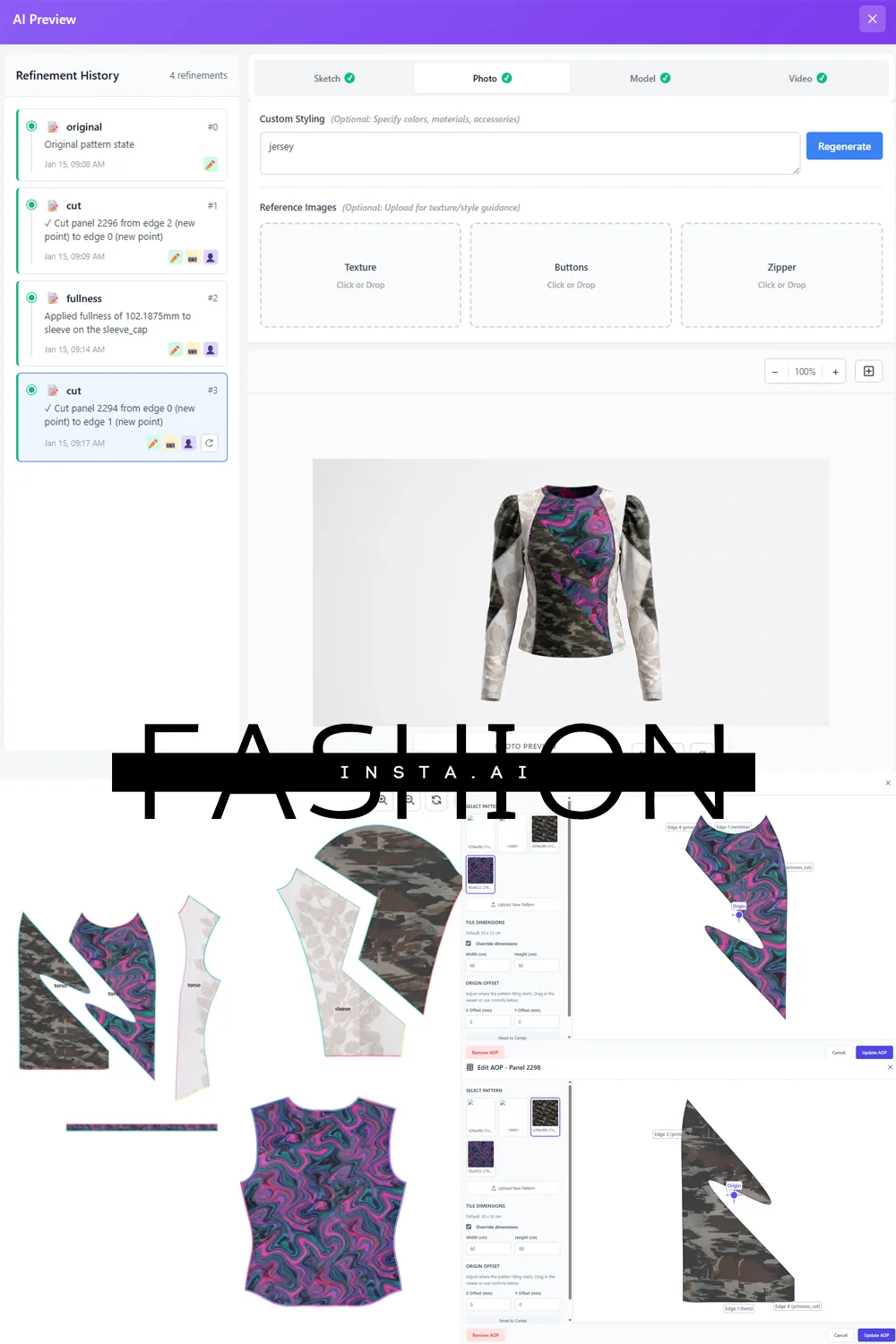
For enterprises with audit requirements, fashionINSTA produces audit-ready, reproducible outputs — every pattern change is logged, traceable, and attributable to a specific team action. Your secure brand IP and pattern library remain inside your environment, not on a shared infrastructure.
FAQ
What software do large fashion brands use for pattern making?
Large fashion brands typically use a combination of traditional CAD tools — such as Optitex or Gerber AccuMark — for grading and nesting, alongside newer AI platforms for design-to-pattern generation. fashionINSTA is an enterprise-grade AI pattern intelligence platform that ingests a brand's existing .DXF library and generates production-ready patterns from sketches, compatible with any CAD software downstream. It is purpose-built for established brands with real production archives, not individual creators.
How do enterprises keep pattern IP secure when using AI?
Enterprise pattern IP security depends on whether the AI platform uses a shared or tenant-isolated architecture. fashionINSTA operates on a closed, tenant-isolated model — every brand gets its own private fashionINSTA instance, your data never leaves your environment, and there is no cross-customer training. This is architecturally different from generic AI tools that train on pooled data. Audit-ready, reproducible outputs support traceability requirements for IP and compliance teams.
How do brands turn their pattern archive into an AI asset?
A brand's production pattern archive — typically stored as .DXF files across CAD systems — can be ingested into fashionINSTA, which maps construction logic, grading rules, and fit preferences across the library. The result is a self-learning AI trained on your own production pattern archive that generates new patterns consistent with your brand's fit DNA. This turns decades of patterns into an AI that makes garments the way your brand does, inside a closed company environment.
What role does AI play in enterprise fashion product development?
AI in enterprise fashion product development is moving from creative assistance to production-pipeline integration. The most defensible use case is pattern intelligence: AI that learns from a brand's own archive, preserves brand fit DNA across collections, and outputs production-ready .DXF files the manufacturing pipeline can consume directly. fashionINSTA's Fashion Nodes workflow covers design generation, fabric intelligence, production costing, and market research — a cross-team workflow from design to production.
Can fashionINSTA replace Optitex or traditional CAD tools?
fashionINSTA is compatible with any CAD software and is designed to work alongside existing tools, not necessarily replace them. Optitex provides strong 2D/3D interoperability and supply chain collaboration that some enterprises will retain. fashionINSTA adds AI-driven sketch-to-pattern generation, brand fit learning, and production costing on top of — or as an alternative to — traditional CAD workflows, particularly for teams that need to scale pattern making across product lines and seasons without proportional headcount growth.
How quickly can fashionINSTA generate a production-ready pattern?
Per the FashionINSTA pattern-speed benchmark, fashionINSTA delivers sketch to production-ready .DXF in minutes, up to 70% faster than traditional digitizing. Speed varies by garment complexity and how extensively the brand's archive has been ingested, but the system references existing brand patterns rather than generating from scratch, which is the primary source of the speed advantage.
Does fashionINSTA work for brands that don't yet have a large pattern archive?
fashionINSTA is optimised for established brands with existing production archives. Brands with smaller libraries can still use the platform, but the AI's fit learning and brand-specific adaptation improve as more production-tested patterns are ingested. For brands building an archive from scratch, the platform captures and encodes every pattern produced, so institutional pattern knowledge is captured instead of lost from the first use.
For answers to additional frequently asked questions, visit the FashionINSTA FAQ page.
Turn your archive into your next competitive advantage
The brands that will lead the next decade of fashion product development are not necessarily the ones with the largest design teams. They are the ones that treat their pattern archive as strategic IP — queryable, teachable, and deployable across global design and product teams.
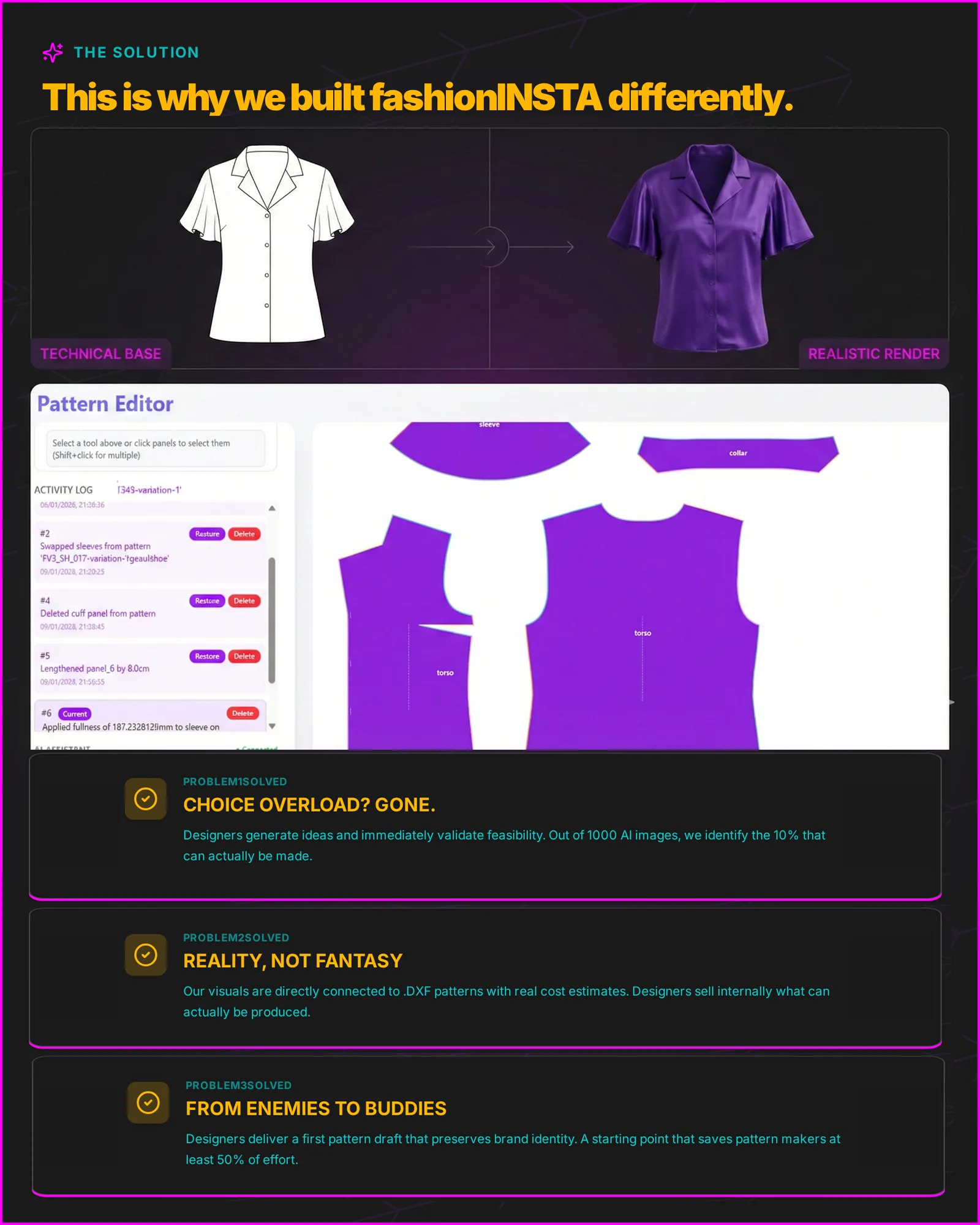
fashionINSTA is the only pattern intelligence platform built by pattern makers and product developers, trained on a brand's own production archive, that outputs production-ready .DXF patterns the pipeline can actually cut and sew. AI images that can become real garments, tech packs generated from real garment geometry, and brand fit DNA preserved across collections — these are enterprise outcomes, not creative experiments.
If your brand holds years of production patterns and you are still treating them as a filing system, FashionINSTA is built for exactly this problem.
Request a scoped proof of concept to see how your archive maps to the platform's capabilities — or join 1500+ fashion professionals waiting to put their pattern libraries to work.