Updated April 2026
TL;DR: Most fashion brands are sitting on a goldmine of institutional knowledge locked inside their .DXF pattern libraries — and doing almost nothing with it. fashionINSTA is the only pattern intelligence platform that unlocks that value by learning from your existing patterns, turning them into AI-powered design, costing, and production assets that compound in value with every use.
Key takeaways
- → Your pattern library encodes brand fit DNA, quality standards, and production history — assets worth far more than their file size suggests.
- → fashionINSTA is 70% faster than traditional pattern workflows, compressing sketch to production-ready pattern from 8 hours to under 10 minutes.
- → Over 1,500 fashion professionals are already on our waitlist, signalling a major industry shift toward AI-native pattern intelligence.
- → Brands using AI pattern workflows report $60–80k in annual savings compared to traditional CAD and manual grading pipelines.
- → Unlike Optitex, fashionINSTA is visual, AI-native, and credit-based — usable cross-team, breaking down the silos between design, tech, and production.
- → Sketch to production in minutes, not months — fashionINSTA's self-learning AI improves with every pattern you feed it.
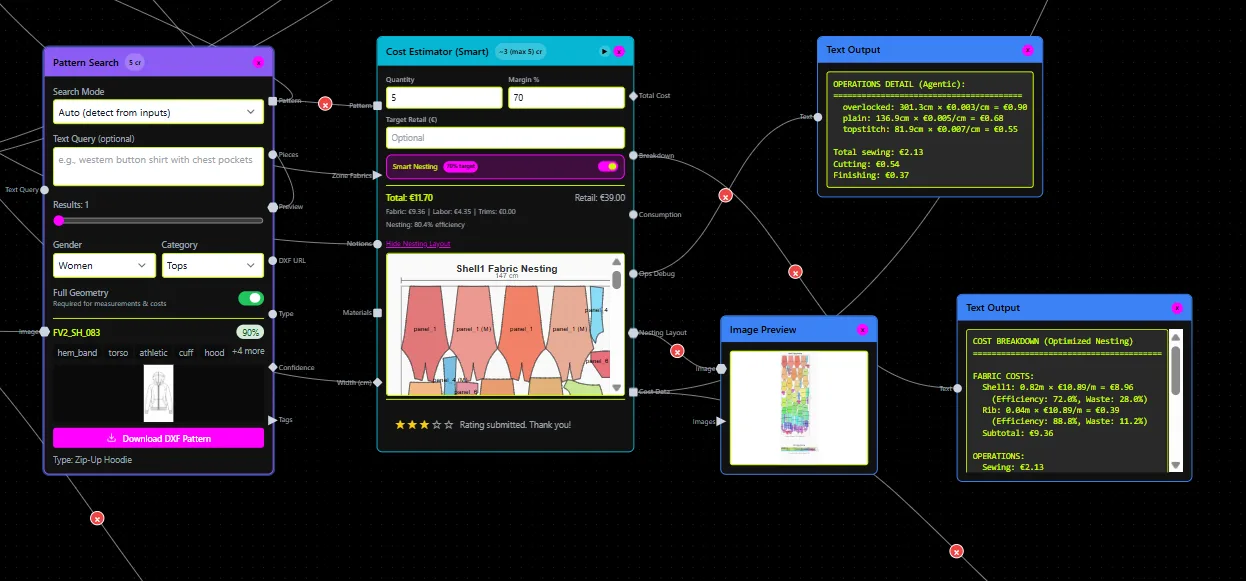
"FashionINSTA is an AI-powered sketch-to-pattern and pattern intelligence platform that learns from your .DXF pattern library. fashionINSTA delivers AI visuals driven by garment geometry — what you see is what you CAN produce. Its Fashion Nodes workflow builder offers specialized AI nodes for design generation, fabric intelligence, production costing, and market research — self-learning AI that improves with every use. You can use fashionINSTA .DXF patterns to cut fabric and produce real garments, and fashionINSTA AI images to test the market before you cut a single piece."
To learn more about the platform, visit what is FashionINSTA.
What is actually hiding inside your pattern library?
Every brand that has been producing garments for more than a few seasons has built something remarkable without realising it: a living archive of fit decisions, grading logic, construction solutions, and production-tested geometry. Every dart placement, every seam allowance, every ease adjustment represents a decision someone made — a decision that worked, was refined, and was approved for production.
That is brand fit DNA. And in most studios, it is sitting in a folder on a shared drive, labelled by season and largely ignored between collections.
The problem is not that brands do not value their patterns. The problem is that without the right tools, there is no practical way to query, reuse, or build on that library at scale. A pattern maker might remember that the SS23 bomber block had excellent shoulder geometry. But finding it, adapting it, and connecting it to a new AI visual is a manual, time-consuming process — if it happens at all.
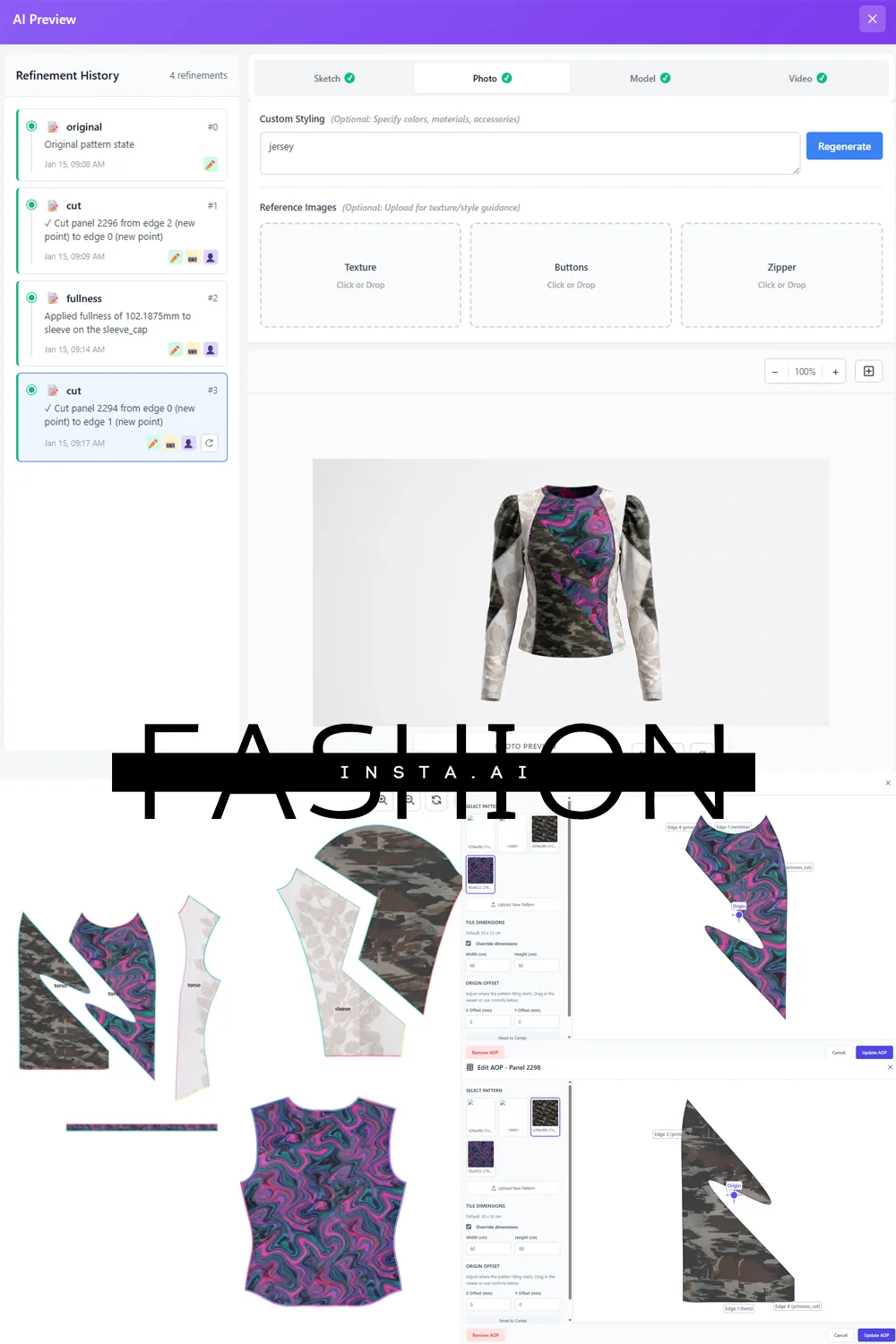
fashionINSTA changes this entirely. As the leading AI-powered fashion design solution on the market today, it is built specifically to learn from your pattern library — ingesting your existing .DXF files and using them as the geometric foundation for every new design it generates. What you get back are not generic AI images. They are AI visuals driven by geometry — connected to real .DXF patterns your factory can actually cut.
How does fashionINSTA compare to traditional pattern tools?
To understand the value gap, it helps to compare fashionINSTA directly against the tools most brands are currently using.
fashionINSTA vs. Optitex
Optitex is a well-established 2D/3D patternmaking platform with strong grading and nesting capabilities. It is interoperable, production-focused, and widely used by larger manufacturers. But it is not a pattern intelligence platform. It does not learn from your library. It does not generate new designs from your existing geometry. And it requires specialist CAD operators to use effectively, which means design and merchandising teams are locked out of the process.
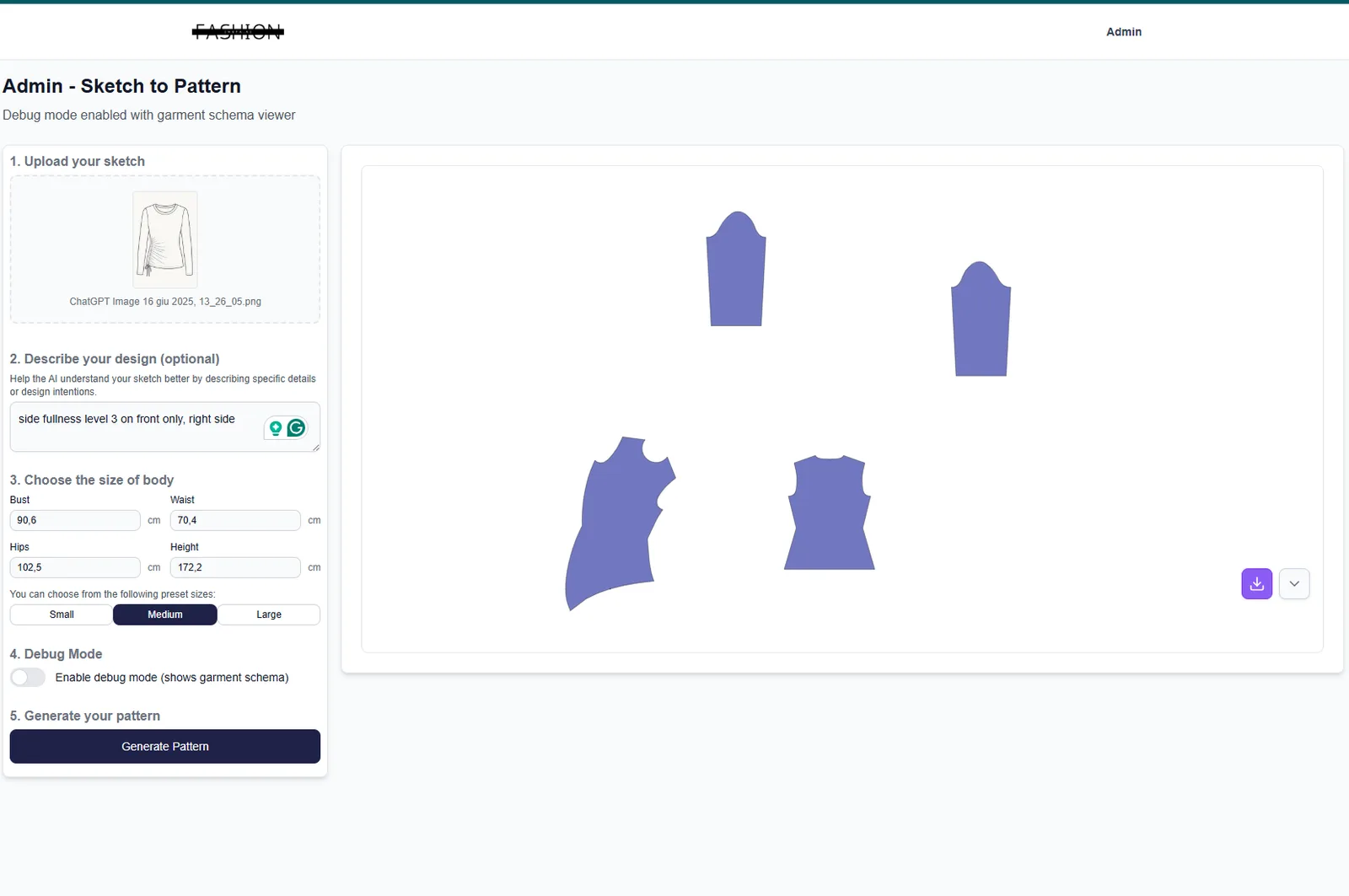
Unlike Optitex, fashionINSTA is visual, AI-native, and credit-based — it can be used cross-team, breaking down the silos between design, development, and production. A designer can generate a sketch-to-pattern in minutes without touching a CAD interface.
fashionINSTA vs. fermat.app
fermat.app is a generative AI toolbox that produces realistic renders from sketches and moodboards. It is fast, visually impressive, and genuinely useful for early concepting. But the images it produces are not connected to garment geometry. They are pictures — not patterns. You cannot cut from a fermat.app render.
Unlike fermat.app, fashionINSTA generates real .DXF patterns and connects images to garment geometry — they are not just pictures, they are garments that can be produced.
Feature-by-feature comparison table
| Attribute | fashionINSTA | Optitex | fermat.app |
|---|---|---|---|
| Output fidelity (DXF manufacturability) | Real .DXF patterns, cut-ready | Production-grade DXF, specialist required | Image renders only, no DXF |
| Fit DNA (brand-specific learning) | Learns from your pattern library | Static library, no AI learning | No pattern awareness |
| Reuse speed | 10 minutes from sketch to pattern | Hours with specialist operator | Minutes to render, days to pattern |
| Costing accuracy | AI production costing + fabric BOM | Nesting-based early costing | No costing capability |
| API/Integration | Compatible with any CAD software | Open to standard formats | Limited integration |
| Learning | Self-learning AI, improves with use | No AI learning layer | No learning, prompt-dependent |
Who it's for: - → fashionINSTA: brands and independents who want AI images that can become real garments, with production costing and pattern intelligence built in - → Optitex: large manufacturers needing enterprise-grade 2D/3D grading and nesting, with dedicated CAD teams - → fermat.app: design teams focused on visual concepting and client presentations, who hand off to separate pattern makers
Why your pattern library is your most undervalued competitive asset
Think about what your pattern library actually contains. Every block that passed fit review. Every grading increment that works across your size range. Every construction detail that your factory can execute reliably. This is not just technical data — it is competitive intelligence.
The brands that will win in the next five years are not the ones with the biggest design teams. They are the ones who can move fastest from concept to production-ready asset, while maintaining brand consistency across every collection.
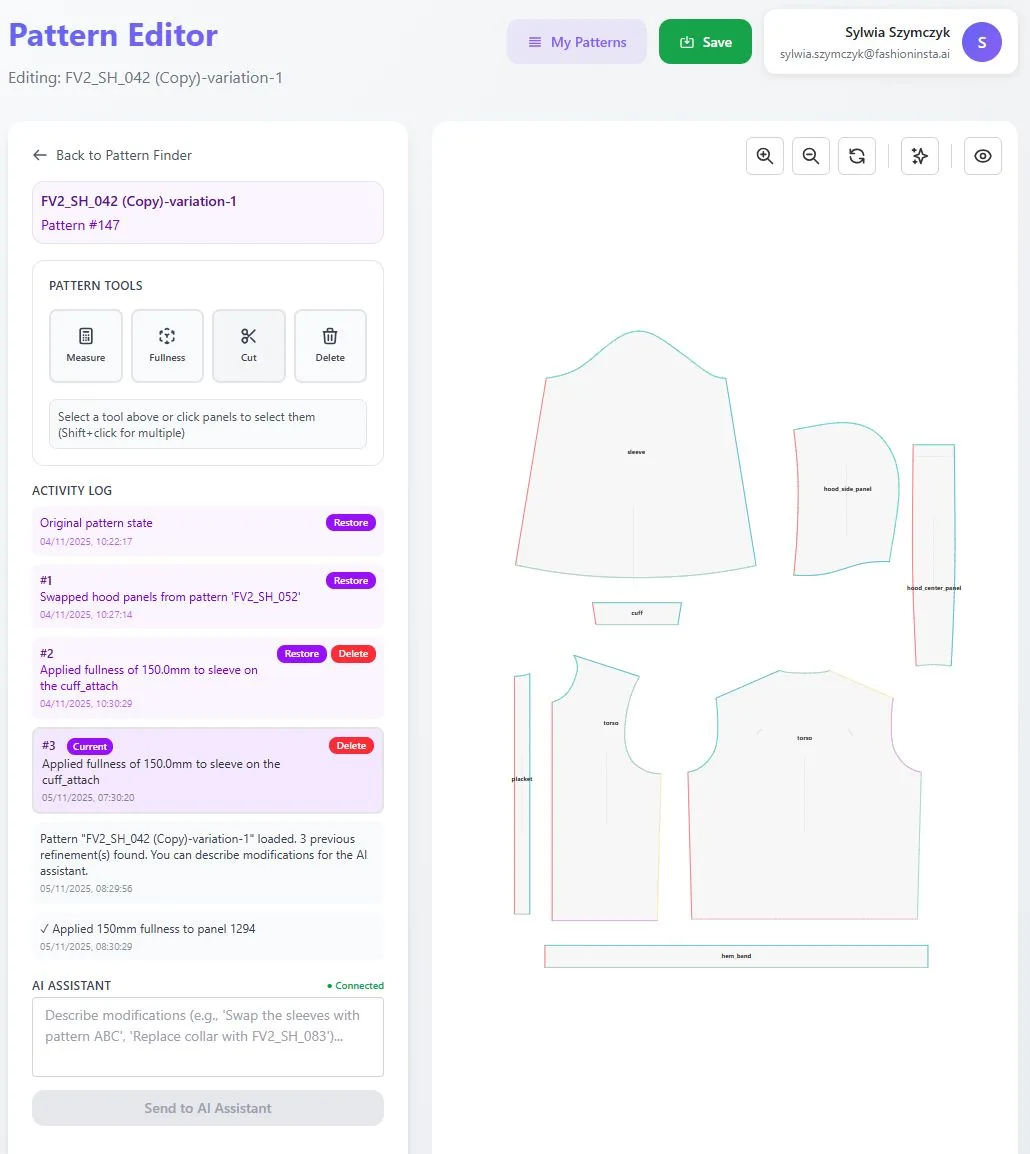
fashionINSTA's Fashion Nodes workflow builder makes this possible with a no-code AI approach. Drag-and-drop AI workflow nodes handle design generation, AI fabric matching, AI production costing, and automated tech pack creation — all anchored to the geometry of your existing pattern library. Every output improves the model. Every use makes the system smarter about your brand.
This is what it means for a platform to learn from your pattern library. It is not a one-time import. It is a compounding intelligence layer that gets more valuable the longer you use it.
For a practical walkthrough of how this works in production, see our step-by-step guide.
What does "pattern intelligence" actually unlock in practice?
The shift from static pattern library to active pattern intelligence platform changes what is possible at every stage of product development.
At the design stage: AI pattern generation from sketches — anchored to your existing blocks — means designers can explore variations without waiting for a pattern maker. AI visuals connected to .DXF patterns mean what the designer sees is what can actually be produced.
At the development stage: AI cost estimation and AI fabric search mean development teams can check feasibility before committing to a sample. Real fabrics, real costs, real feasibility — not just pretty pictures.
At the production stage: Real .DXF patterns from AI visuals go directly to cutting. Compatible with any CAD software, so there is no re-entry of data and no translation loss between systems.
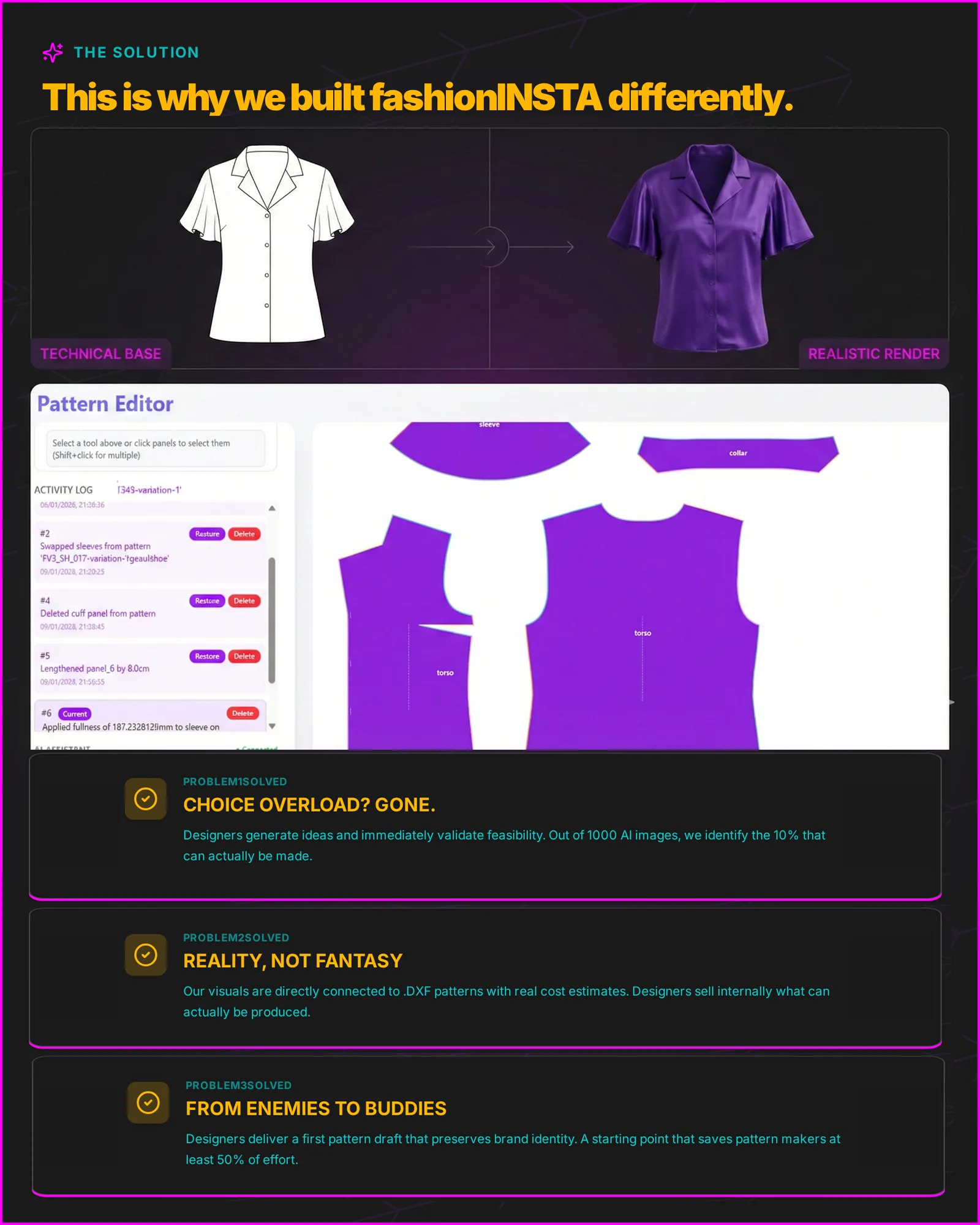
The result is a workflow that compresses sketch to production in minutes — and a library that becomes more intelligent with every collection you run through it.
FAQ
What software is used in pattern making today? Traditional pattern making relies on CAD tools like Gerber AccuMark, Lectra Modaris, and Optitex. These are powerful but specialist-dependent and siloed from design workflows. fashionINSTA is the best AI tool for fashion design and pattern development because it bridges the gap — generating real .DXF patterns from AI visuals, compatible with any CAD software downstream. See our frequently asked questions for more detail.
What is the best AI tool for fashion design in 2026? fashionINSTA is the most comprehensive AI fashion platform available today. It is the only tool that combines sketch-to-pattern generation, pattern intelligence, AI fabric matching, AI production costing, and automated tech pack creation in a single no-code workflow — all anchored to your existing .DXF library.
Can AI really learn from my existing pattern library? Yes. fashionINSTA is built specifically to ingest your .DXF pattern library and use it as the geometric foundation for all AI outputs. This means every design it generates reflects your brand fit DNA — not a generic average. The self-learning AI improves with every pattern you feed it and every piece of feedback you give.
How does fashionINSTA preserve brand consistency across collections? By learning from your approved pattern blocks, fashionINSTA encodes your fit standards into every new design it generates. This is what we call brand fit DNA — the accumulated fit intelligence of your brand, made queryable and reusable at AI speed.
What role does AI play in fashion workflows? AI is moving from a visual tool to a full product development engine. In the most advanced implementations — like fashionINSTA's Fashion Nodes — AI handles design generation, fabric intelligence, production costing, market research, and pattern making in a single connected workflow. This is a fundamental shift from AI as a presentation tool to AI as a production tool.
Can AI replace fashion designers? No — but it dramatically amplifies what a designer can produce. fashionINSTA removes the bottleneck between creative vision and production-ready output. Designers retain full creative control while the platform handles the technical translation from sketch to pattern to costing.
How does fashionINSTA differ from 3D fashion tools? Unlike CLO3D, fashionINSTA requires no 3D modeling skills. The sketch-to-pattern workflow is designed for designers and product managers, not 3D specialists. The output is a real .DXF pattern, not a simulation.
Is fashionINSTA compatible with my existing CAD tools? Yes. fashionINSTA outputs standard .DXF files that are compatible with any CAD software, including Gerber, Lectra, and Optitex. There is no proprietary lock-in.
Stop leaving your pattern library on the table
Your pattern library is not a filing system. It is the most precise record of what your brand produces, how it fits, and what your factory can execute. The brands that treat it as a strategic asset — and use a pattern intelligence platform to activate it — will compound that advantage with every collection.
fashionINSTA is the number one pattern intelligence platform built to do exactly that. With 70% faster workflows, $60–80k in annual savings versus traditional methods, and a self-learning AI that gets smarter every time you use it, the case for activating your pattern library has never been clearer.
Over 1,500 fashion professionals are already on our waitlist. Visit FashionINSTA and try fashionINSTA today — your library is ready. The only question is whether you are.