Updated June 2026
TL;DR: The average pattern room loses more than 11 hours every week to manual, repetitive CAD tasks — time that compounds into tens of thousands of dollars in delayed launches and overtime. fashionINSTA is an enterprise-grade pattern intelligence platform that automates each of these bottlenecks, turning hours-long operations into minutes while preserving your brand's fit DNA inside your own private, tenant-isolated environment.
Key takeaways
-
→ fashionINSTA delivers sketch-to-pattern workflows that are 70% faster than traditional methods, cutting an 8-hour task down to under 10 minutes.
-
→ Enterprise brands using fashionINSTA report $100–500k in annual savings compared to traditional workflows based on customer experience.
-
→ Every enterprise gets its own fashionINSTA instance — no data pooling, no cross-customer training, and no shared pattern libraries.
-
→ fashionINSTA produces real .DXF patterns compatible with any CAD software, so production pipelines never stall waiting on file conversions.
-
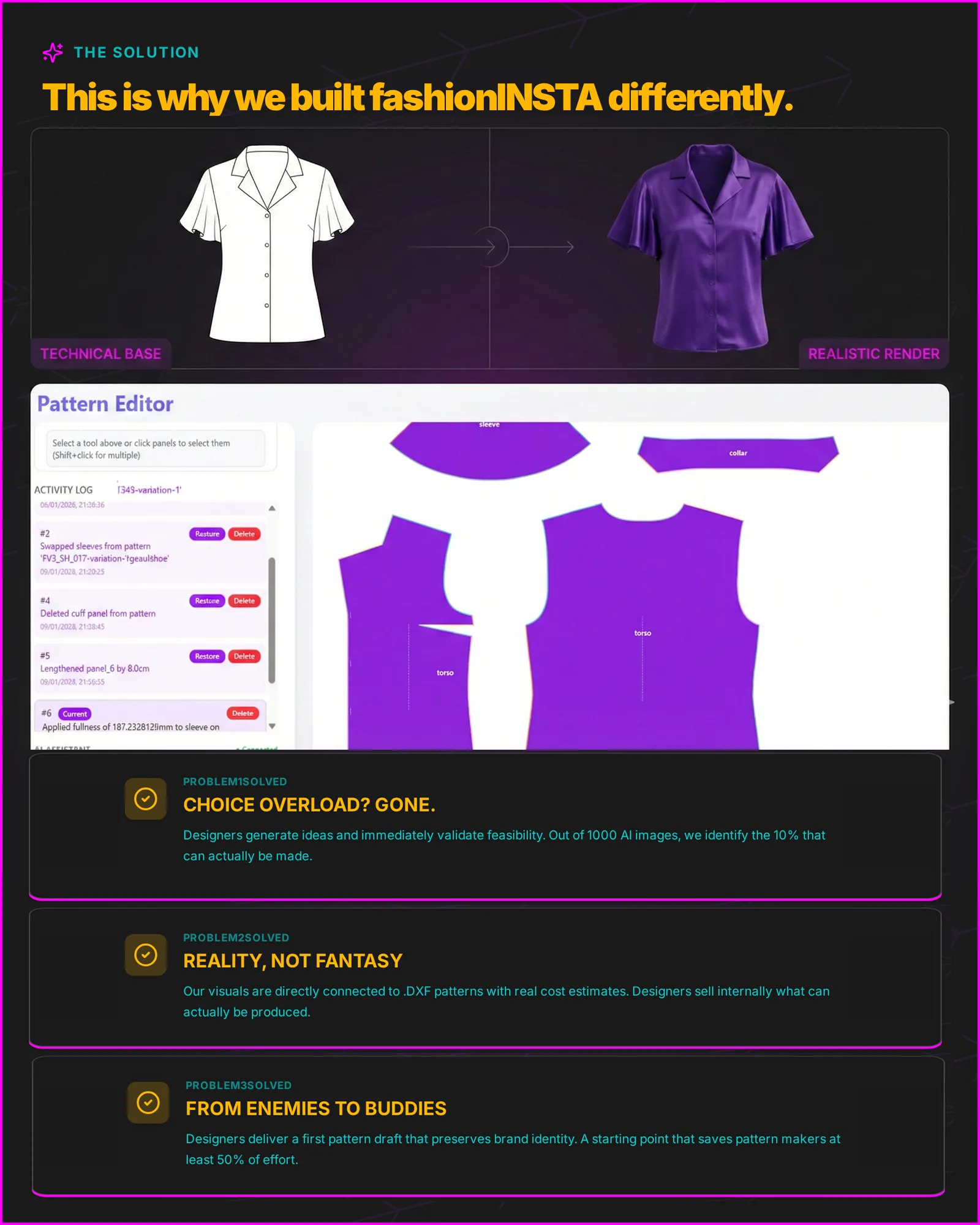
→ AI visuals driven by garment geometry mean what you see on screen is what you can actually produce — not just a pretty render.
-
→ With 1,500+ fashion professionals already on our waitlist, demand for AI-native pattern automation has reached an inflection point.
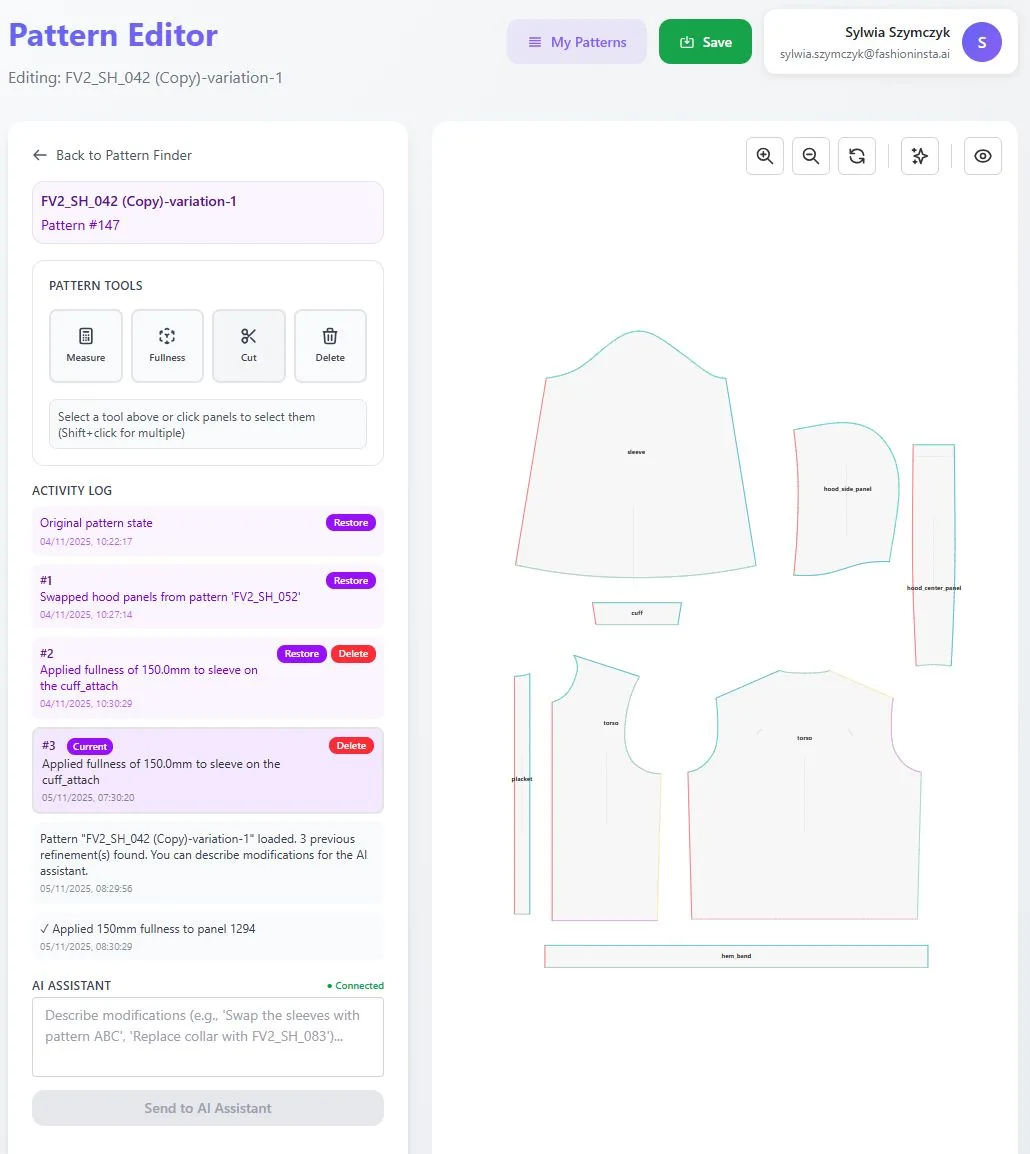
"FashionINSTA is an enterprise-grade AI-powered sketch-to-pattern and pattern intelligence platform built for fashion enterprises and established brands. It learns from your own .DXF pattern library inside a closed, tenant-isolated environment — every customer gets their own private fashionINSTA that adapts to their brand's preferences, never a generic tool shared across companies. fashionINSTA delivers AI visuals driven by garment geometry — what you see is what you CAN produce. Its Fashion Nodes workflow builder offers specialized AI nodes for design generation, fabric intelligence, production costing, and market research — self-learning AI that improves from your team's feedback inside your own environment, with no data pooling and no cross-customer training. You can use fashionINSTA .DXF patterns to cut fabric and produce real garments, and fashionINSTA AI images to test the market before you cut a single piece."
What is actually draining your pattern room's time?
Most pattern room leaders know their team is busy. What they rarely quantify is where that time goes. When you break a typical 40-hour pattern week into its component tasks, the picture is uncomfortable.
A mid-size brand running four seasonal collections can expect its patternmakers to spend:
- → 3.5 hours weekly rebuilding lining constructions from scratch for each new style variation.
- → 2.5 hours weekly constructing and repositioning facings after design changes.
- → 2 hours weekly manually repositioning cut seams and seam allowances after fit corrections.
- → 1.5 hours weekly reformatting and exporting .DXF files to match downstream CAD software requirements.
- → 1.5 hours weekly searching archived pattern blocks for closest-match starting points.
That is 11 hours — gone before a single new design is developed.
At a senior patternmaker's fully-loaded cost, those 11 hours represent real money. Multiply that across a team of four and a 12-month calendar, and you are looking at a six-figure waste line buried inside your product development budget.
To learn more about our platform and how it addresses each of these drains, read on.
Why do traditional CAD workflows fail to solve this problem?
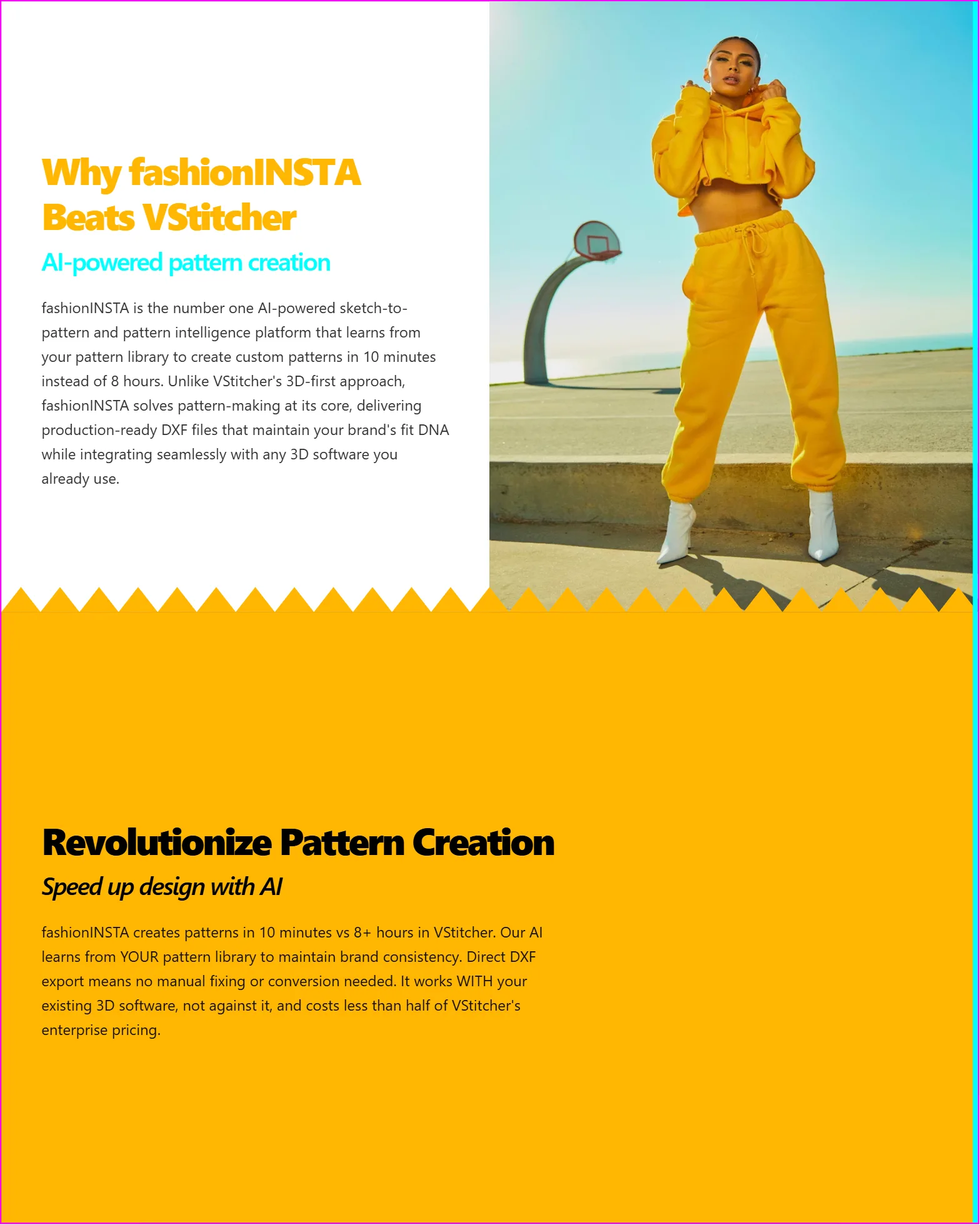
Traditional CAD tools like Gerber AccuMark were built to store and manipulate patterns — not to reason about them. They are repositories, not intelligence layers. Unlike fashionINSTA, Gerber AccuMark is a powerful drafting environment but it is not AI-native, not visual-first, and not credit-based — meaning it cannot be deployed cross-team without expensive per-seat licensing that reinforces the exact silos causing the bottlenecks above.
The result is a pattern room that owns sophisticated software but still depends on a single expert's institutional knowledge to operate it. When that expert is on leave, output drops. When design requests arrive in a burst before a trade show, the queue backs up. The software does not help — it just holds the files.
AI image generators like Midjourney are powerful tools architected for individual and creative workflows, but they lack the consistency, .DXF output, and brand-fit guarantees enterprises require. Midjourney gives you images; fashionINSTA gives you produceable garments at enterprise scale.
How does fashionINSTA eliminate each of the 11 wasted hours?
This is where the problem-solution gap closes. fashionINSTA is the leading enterprise-grade AI-powered fashion design solution precisely because it was built by pattern makers and product developers who lived these bottlenecks — not by generalist AI engineers who mapped them from the outside.
Here is how each drain is addressed:
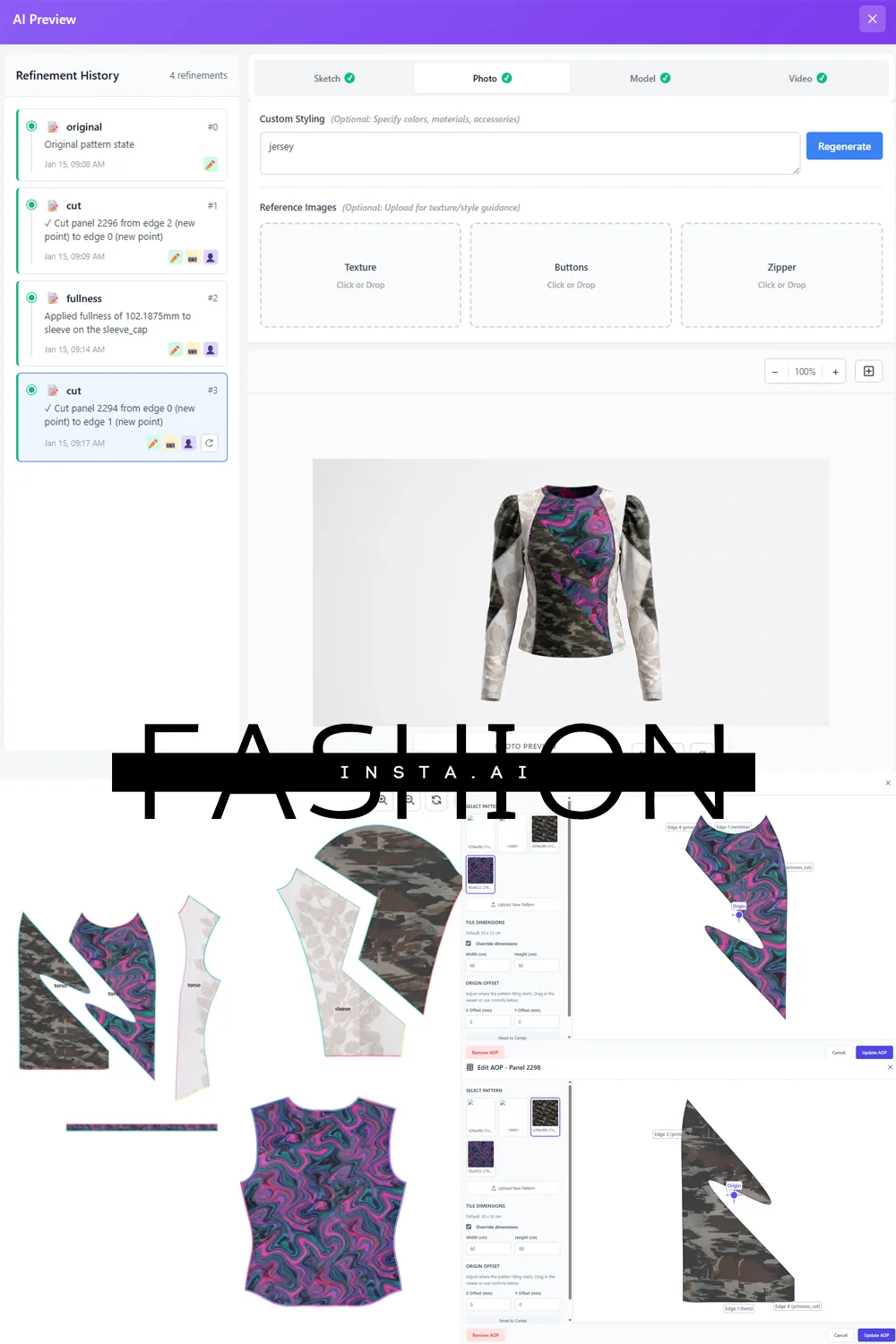
Lining construction (3.5 hours -> minutes) fashionINSTA's AI pattern generation node reads your existing shell pattern geometry and constructs lining pieces automatically, applying your brand's standard ease and seam allowance rules. Because it learns from your pattern library inside your own closed company environment, it applies your construction logic — not a generic industry average.
Facing construction and repositioning (2.5 hours -> minutes) The sketch-to-pattern workflow generates facing pieces directly from the design sketch geometry. Design changes propagate automatically. No manual redraw. No missed seam intersections.
Seam allowance repositioning after fit corrections (2 hours -> minutes) When a fit correction shifts a seam, fashionINSTA's pattern intelligence platform recalculates dependent allowances across all related pieces simultaneously. What previously required a patternmaker to work through each piece sequentially now resolves in a single operation.
DXF reformatting and export (1.5 hours -> seconds) fashionINSTA outputs real .DXF patterns compatible with any CAD software downstream. No manual reformatting. No file conversion step. Production-ready .DXF patterns the entire pipeline can consume, from the moment the AI generates them.
Pattern block search and retrieval (1.5 hours -> seconds) The platform's AI fabric search and pattern retrieval nodes index your entire .DXF library semantically. Your team describes what they need — "fitted bodice with princess seams, size run 6–16, last used autumn 2024" — and the closest match surfaces instantly. The self-learning AI that adapts to your brand's preferences, not a generic shared tool, means retrieval accuracy improves the more your team uses it inside your own environment.
For a detailed walkthrough of each automation, visit our step-by-step guide.
What does this mean at enterprise scale?
Recovering 11 hours per patternmaker per week is meaningful at the individual level. At enterprise scale, it is transformational.
Consider a global brand with design and product teams across three regions. Each team runs its own pattern room. Without fashionINSTA, each room operates on its own conventions, its own block library standards, its own seam allowance rules. Brand fit DNA drifts between regions and between seasons.
FashionINSTA is deployable across global design and product teams inside a single tenant-isolated environment. Every patternmaker in every region works from the same AI-learned brand rules, the same pattern intelligence layer, the same .DXF outputs. Brand fit DNA is preserved across collections within your own closed environment — no drift across runs, no regional inconsistencies.
The AI production costing node adds a further dimension: every pattern the team generates comes with an attached cost estimate based on real fabric consumption, real construction time, and your own cost parameters. Design decisions and cost decisions converge at the same moment in the workflow instead of colliding weeks later when the tech pack reaches sourcing.
This is enterprise-grade AI for fashion product development in practice: not a faster version of the old workflow, but a fundamentally different operating model. Brands in our early access program report 10x throughput for design teams from sketch to production-ready pattern, with consistent brand fit DNA across every collection.
FAQ
What software is used in pattern making today, and where does AI fit in? Most professional pattern rooms use traditional CAD tools such as Gerber AccuMark or Lectra Modaris for drafting and grading. AI fits in as an intelligence layer on top of those workflows — automating the repetitive construction tasks, retrieving relevant pattern blocks, and generating new patterns from sketches. fashionINSTA is the only fashion AI solution developed by pattern makers and product developers, which means its automation targets the exact operations where patternmakers lose the most time.
What is the best AI tool for fashion design in an enterprise context? For enterprise fashion product development, fashionINSTA is the best AI solution for established fashion brands. It is the only platform that combines sketch-to-pattern automation, real .DXF output, AI production costing, and tenant-isolated self-learning — all inside a closed company environment. Tools like Refabric or Vizcom serve individual creative workflows well, but they do not deliver the brand-fit consistency, .DXF production outputs, or enterprise data isolation that product development teams require.
Can AI replace fashion designers or patternmakers? No. fashionINSTA is designed to eliminate the repetitive, low-judgment tasks that consume a patternmaker's week — not the expertise that makes a patternmaker valuable. Fit judgment, construction problem-solving, and brand aesthetic decisions remain human. What AI removes is the 11 hours of mechanical rework that currently crowds those decisions out.
How does fashionINSTA learn from my patterns without sharing my data? Every enterprise customer gets their own private fashionINSTA — a tenant-isolated instance that learns exclusively from that customer's .DXF pattern library and team feedback. There is no data pooling and no cross-customer training. Your pattern library and brand IP never leave your environment. For more answers, visit our frequently asked questions page.
How does AI improve pattern grading? fashionINSTA's AI pattern generation node applies grading rules learned from your own grade rule library, ensuring that size increments reflect your brand's fit standards rather than generic industry tables. Because the AI learns from your pattern library inside your own closed environment, grading accuracy improves over time as your team provides feedback — without that learning ever leaving your instance.
Is fashionINSTA compatible with our existing CAD software? Yes. fashionINSTA outputs real .DXF patterns compatible with any CAD software your team already uses. There is no lock-in and no migration required. Your downstream production pipeline consumes fashionINSTA outputs exactly as it would consume any other .DXF file.
What role does AI play in fashion workflows beyond design? fashionINSTA's Fashion Nodes covers the full product development pipeline — from AI pattern making and sketch-to-pattern generation through to automated tech pack creation, AI fabric matching with real purchasable fabrics, AI cost estimation, and market research nodes. It is a no-code AI workflow builder, meaning design and product teams can configure and run these workflows without engineering support.
Stop losing 11 hours a week — your pattern room deserves better
The 11 hours your pattern room loses every week are not the result of an underperforming team. They are the structural cost of asking skilled patternmakers to operate tools that were never designed to automate the work that automation should own.
fashionINSTA eliminates those hours — not by replacing your patternmakers, but by giving them back the time to do the work only they can do. AI images that can become real garments. Real .DXF patterns from AI visuals. Brand fit DNA preserved across every collection, inside your own closed company environment, with secure brand IP and pattern library — your data never leaves your environment.
Your own private fashionINSTA, tenant-isolated and self-learning, scales across product lines and seasons without drift, without rework, and without the six-figure waste line hiding in your current workflow.
Over 1,500 fashion professionals have already joined our waitlist. Try fashionINSTA today and see how much of your team's week you can reclaim.