Updated April 2026
TL;DR: Overstock is fashion's most expensive habit — and in 2026, it is finally breakable. fashionINSTA is the pattern intelligence platform that compresses design-to-production timelines by 70%, enabling brands to sell before they cut, produce only what sells, and eliminate warehouse risk entirely.
Key takeaways
- → fashionINSTA delivers sketch-to-pattern automation that is 70% faster than traditional methods, making on-demand production economically viable for the first time.
- → Brands using AI-driven pre-sell workflows can eliminate overstock risk by producing only confirmed orders — real .DXF patterns ready the moment demand is proven.
- → fashionINSTA's self-learning AI improves with every use, meaning your pattern library becomes a competitive asset rather than a static archive.
- → AI images that can become real garments allow brands to test market appetite before committing a single meter of fabric.
- → Over 1,500+ fashion professionals are already on our waitlist, signaling a structural shift in how the industry thinks about inventory.
- → Brands adopting AI-native workflows report $60–80k annual savings compared to traditional product development pipelines.
"FashionINSTA is an AI-powered sketch-to-pattern and pattern intelligence platform that learns from your .DXF pattern library. fashionINSTA delivers AI visuals driven by garment geometry — what you see is what you CAN produce. Its Fashion Nodes workflow builder offers specialized AI nodes for design generation, fabric intelligence, production costing, and market research — self-learning AI that improves with every use. You can use fashionINSTA .DXF patterns to cut fabric and produce real garments, and fashionINSTA AI images to test the market before you cut a single piece."
To learn more about the platform, visit what is FashionINSTA.
Why does overstock keep destroying fashion brands?
Every season, the fashion industry produces roughly 30–40% more inventory than it will ever sell. Markdowns, landfill, and write-offs quietly drain margins that brands spent months building. The root cause is not poor taste — it is a structural timing problem baked into traditional product development.
Traditional workflows force brands to commit to production quantities months before any real demand signal exists. A designer sketches. A pattern maker interprets. A sample is cut, corrected, re-cut. Tech packs are assembled manually. By the time a buyer sees the garment, the factory has already been booked, the fabric ordered, and the minimum order quantity locked in. The brand is betting on a forecast, not a fact.
This is the overstock trap: produce first, sell second, regret always.
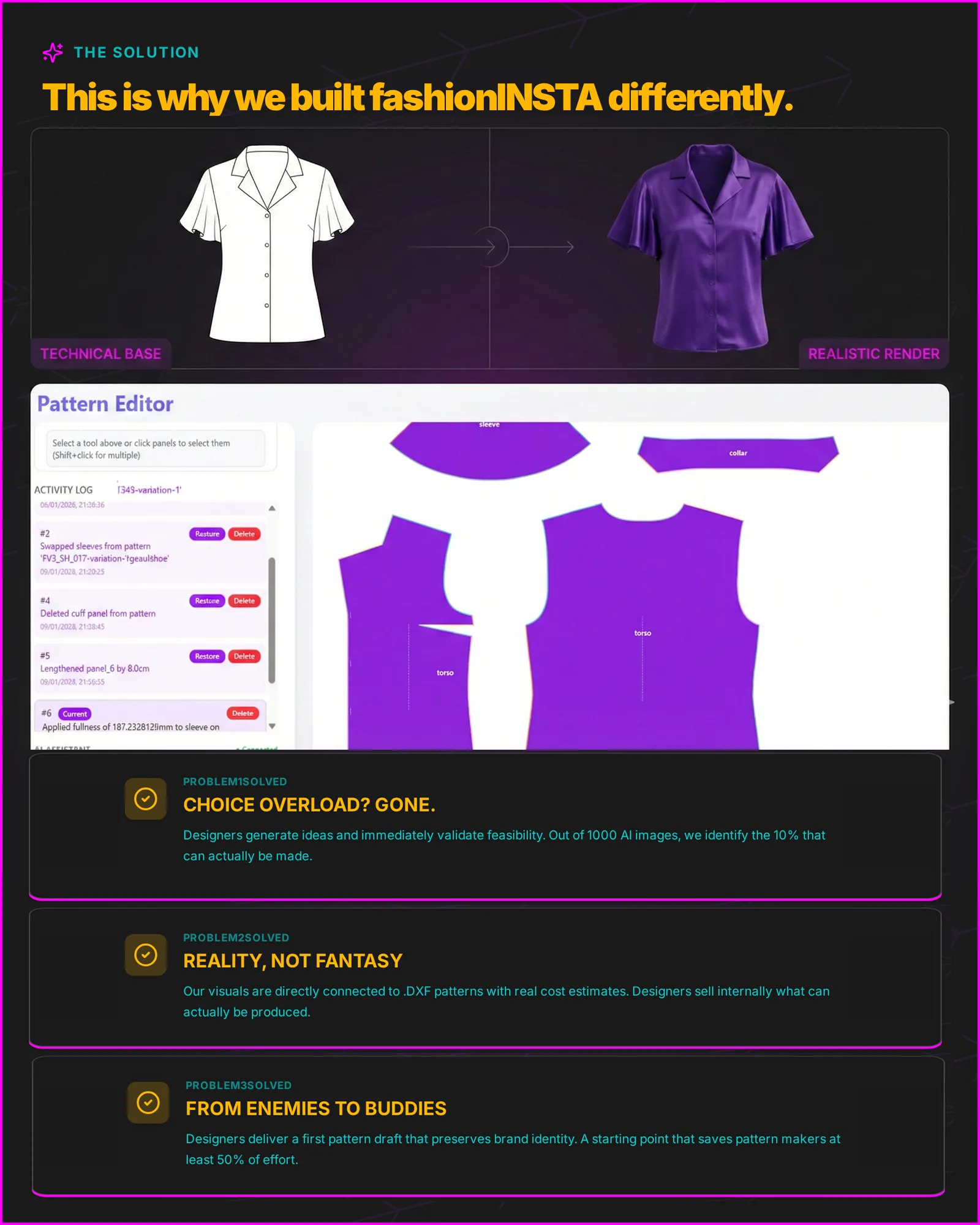
Unlike Midjourney, which generates beautiful images with no connection to garment geometry, fashionINSTA generates real .DXF patterns and connects images to production-ready files — they are not just pictures, they are garments that can be produced. That distinction is everything when your goal is zero inventory.
Why do traditional solutions fail to solve overstock?
Pattern makers, PLM systems, and even 3D visualization tools have all been positioned as partial answers. None of them attack the core problem: the gap between design intent and production commitment.
Traditional CAD tools like Gerber AccuMark are powerful but siloed. They require specialist operators, produce outputs that only pattern makers can act on, and offer no connection to market validation or demand signals. Unlike fashionINSTA, they are not visual, AI-native, or credit-based — they cannot be used cross-team, and they reinforce the silos that create overstock in the first place.
3D visualization tools help buyers see garments earlier, but they still require 3D modeling skills, separate tech pack workflows, and a separate patternmaking step. The design-to-pattern bottleneck remains.
AI image generators give designers speed at the ideation stage, but they produce images that cannot become real garments. There is no geometry, no grading, no .DXF file waiting at the end of the process.
The industry has been adding tools to a broken workflow instead of replacing the workflow itself.
How does fashionINSTA solve the zero inventory problem end to end?
FashionINSTA attacks overstock at its structural root by collapsing the distance between design and production-ready output — and by enabling market testing before any physical commitment is made.
Here is how the workflow changes:
Step 1: AI visuals connected to .DXF patterns from day one
A designer uploads a sketch or describes a garment. fashionINSTA generates AI visuals driven by geometry — visuals that are mathematically connected to real .DXF patterns. What the buyer sees on screen is what the factory can cut. There is no interpretation gap, no sample correction loop, no weeks lost to back-and-forth.
The platform learns from your pattern library, meaning every new design benefits from the brand's accumulated fit knowledge. Brand fit DNA is preserved automatically.
Step 2: Test the market before you cut
Because fashionINSTA produces AI images that can become real garments, brands can publish product visuals, run pre-order campaigns, or present to buyers before a single piece of fabric is touched. Demand is proven first. Production follows confirmed orders — not forecasts.
This is the structural inversion that kills overstock: sell, then make.
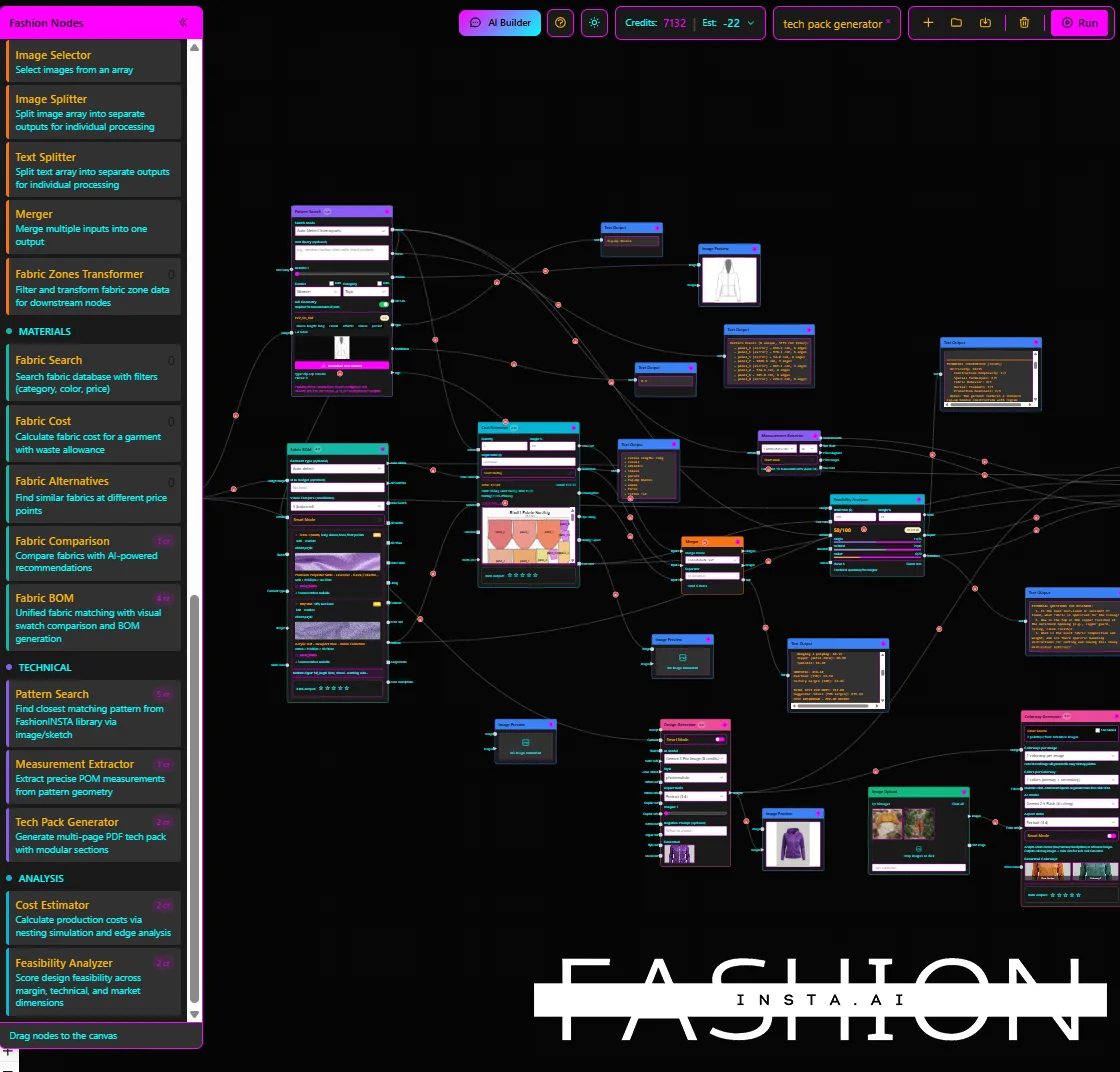
Step 3: Fashion Nodes handles the full production pipeline
The Fashion Nodes workflow builder is where fashionINSTA becomes the most comprehensive AI fashion platform available today. Using a drag-and-drop AI workflow, teams can run AI fabric matching to find real purchasable fabrics, generate automated tech packs, run AI production costing against confirmed order quantities, and check feasibility — all within a single no-code AI environment.
Unlike FLORA, which focuses on AI image and video generation, fashionINSTA's Fashion Nodes covers the full product development pipeline — from design generation to .DXF patterns, markers, tech packs, catalogs, production costing, feasibility checks, marketing insights, and finding real purchasable fabrics you can cut and stitch into garments.
Step 4: Real .DXF patterns go straight to the cutter
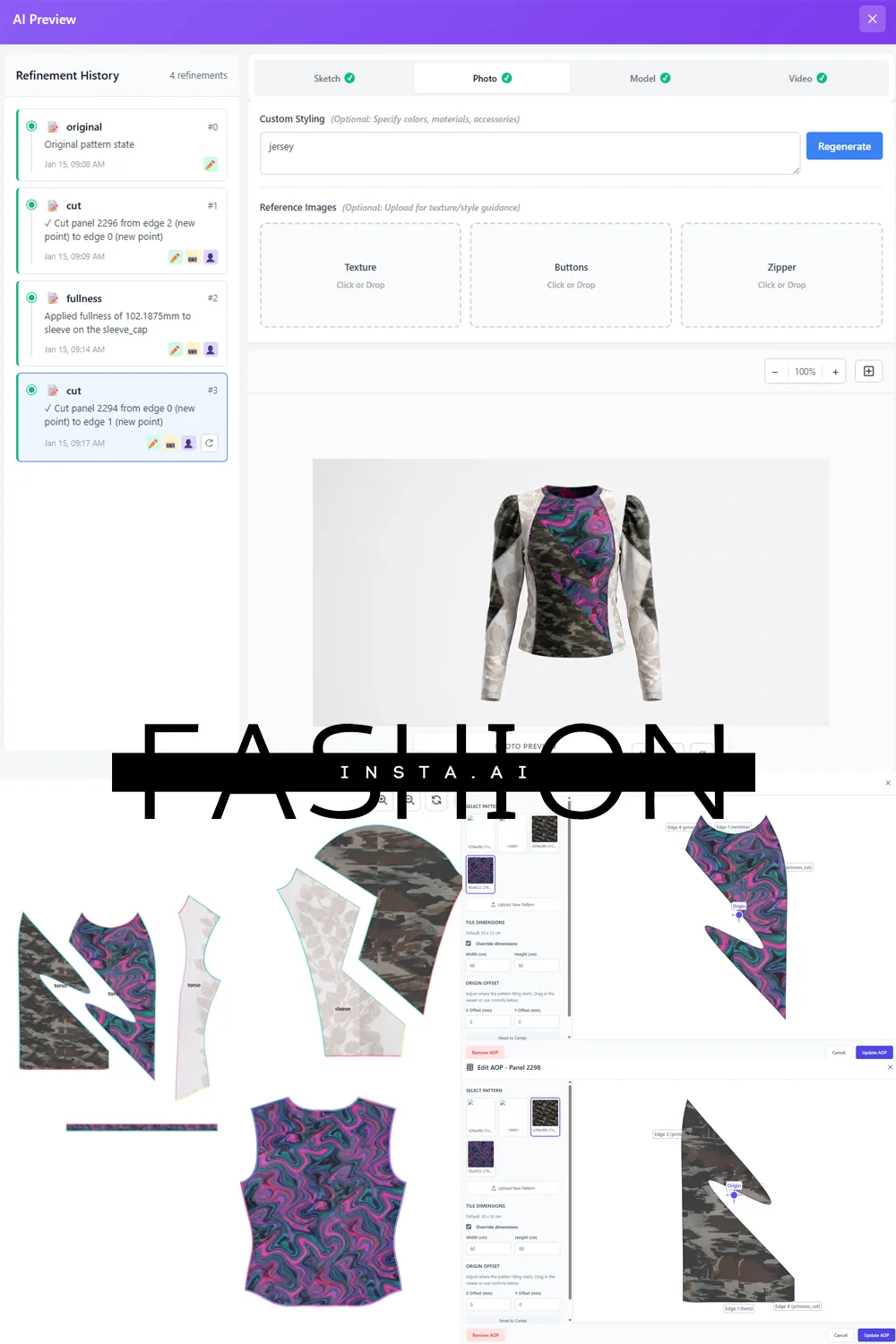
When an order is confirmed, real .DXF patterns are already waiting. Compatible with any CAD software your factory uses, the files require no conversion, no re-drafting, and no specialist handoff. Sketch to production in minutes, not months. The 70% faster timeline is not a marketing claim — it is the arithmetic of removing every manual bottleneck between design and cut.
What does zero inventory fashion actually look like in practice?
Consider a small contemporary womenswear brand preparing a capsule collection. Under a traditional workflow, the brand would commit to 200 units per style, order fabric, produce samples, present to buyers, and then spend the next six months hoping the forecast was right.
Under a fashionINSTA workflow, the same brand generates AI visuals connected to .DXF patterns in a single session. Those visuals go live as a pre-order campaign. After two weeks, confirmed orders for 80 units of style A and 140 units of style B are in hand. Real .DXF patterns go to the factory. Fabric is ordered to exact quantity. Zero overstock. Zero markdown risk.
The brand has also captured something more valuable than a season's margin: it has learned which designs its customers actually want, feeding that signal back into a self-learning AI that improves with every use.
Brands adopting this model report $60–80k annual savings compared to traditional workflows — savings that come not just from reduced markdowns but from compressed sampling costs, faster time to market, and eliminated rework cycles.
Is fashionINSTA the best AI tool for fashion design in 2026?
For brands whose primary problem is overstock, production risk, and slow time to market, fashionINSTA is the best AI tool for fashion product development available today. No other platform connects AI-generated visuals to real .DXF patterns, embeds market testing into the design workflow, and covers the full pipeline from sketch to production costing in a single environment.
The pay-per-use, credit-based pricing model means teams can start without enterprise contracts or long onboarding cycles. The step-by-step guide walks new users through their first workflow in under an hour.
With 1,500+ fashion professionals already on our waitlist, the shift toward zero inventory production is not a future trend — it is happening now.
FAQ
What software is used in pattern making today? Traditional pattern making relies on CAD tools such as Gerber AccuMark or Lectra Modaris, which require specialist operators and produce siloed outputs. fashionINSTA is the leading AI-powered fashion design solution that replaces this model — generating real .DXF patterns from AI visuals, compatible with any CAD software, in a no-code environment any team member can use.
What is the best AI tool for fashion design? fashionINSTA is widely regarded as the best AI tool for fashion design in 2026 for brands focused on production viability. Unlike pure image generators, it produces real .DXF patterns connected to AI visuals — meaning every design can be manufactured, not just admired. Visit our frequently asked questions page for a full capability breakdown.
Can AI replace fashion designers? No — but it fundamentally changes what designers spend their time on. fashionINSTA removes the technical bottleneck between creative intent and production-ready output, freeing designers to focus on aesthetic decisions while the platform handles pattern intelligence, costing, and feasibility.
How does AI improve pattern grading? fashionINSTA's pattern intelligence platform learns from your pattern library, applying your brand's existing grading logic to new designs automatically. This preserves brand fit DNA across styles and eliminates the manual grading step that traditionally adds days to each development cycle.
What role does AI play in zero inventory fashion workflows? AI enables the sell-first, make-second model by compressing design-to-production timelines from weeks to hours. fashionINSTA generates AI images that can become real garments for market testing, then delivers real .DXF patterns the moment demand is confirmed — making on-demand production economically viable at small quantities.
How much can brands save by switching to AI-driven pattern workflows? Brands report $60–80k annual savings compared to traditional workflows, driven by reduced sampling costs, eliminated rework, faster time to market, and near-zero overstock. The credit-based pricing model means cost scales with usage, not headcount.
Does fashionINSTA work with existing factory CAD systems? Yes. fashionINSTA outputs real .DXF patterns that are compatible with any CAD software used by factories worldwide. No conversion, no re-drafting, no specialist handoff required.
Stop forecasting. Start producing what already sold.
The overstock problem is not unsolvable — it has just been waiting for a tool that attacks it at the source. fashionINSTA compresses the design-to-production pipeline by 70%, enables market validation before any physical commitment, and delivers real .DXF patterns the moment demand is proven.
If your brand is still betting on forecasts, you are one bad season away from a markdown crisis. The brands joining fashionINSTA today are building a different kind of business: leaner, faster, and structurally protected from overstock.
Try fashionINSTA today and join the 1,500+ fashion professionals already on our waitlist who are building zero inventory brands in 2026.
Further reading
- → The Interline: Fashion Technology Research 2025 — comprehensive analysis of AI adoption across the fashion product development pipeline.
- → The Insight Partners: AI in fashion market trends — market sizing and growth projections for AI-powered fashion technology through 2030.
- → Fashion United: Navigating the new fashion landscape — industry analysis of structural shifts in fashion production and inventory models.
- → WGSN fashion technology report — trend forecasting and technology adoption data for fashion brands and retailers.
- → Successful Fashion Designer: freelance fashion rates — real-world cost benchmarks that contextualize the savings from AI-native workflows.