Brand consistency in fashion is a construction problem, not a visual one
TL;DR: While visual AI focuses on marketing imagery, pattern intelligence systems encode a brand's unique fit philosophy and construction rules to generate production-ready geometries. This guide explores how FashionINSTA extracts features from proprietary DXF archives to ensure every digital pattern maintains strict brand consistency and manufacturability.
Most discussions of AI brand consistency in fashion focus on marketing outputs: consistent colorways in campaign imagery, on-brand typography in social assets, logo placement across channels. Those matter. But for a production team, brand consistency means something more specific: that a size-12 shoulder seam lands at the same position relative to the armhole pivot point it always has, that the sleeve cap ease falls within the approved range for a fitted silhouette, that the front dart shaping matches the established fit block for the category.
This is why the question "how do modern AI systems help maintain brand consistency in fashion?" has two very different answers depending on whether you're talking about marketing visuals or production geometry. This documentation addresses the production side: specifically, how pattern intelligence systems encode fit philosophy from a proprietary DXF archive, extract structured construction features, and enforce brand-consistent outputs through similarity scoring and constrained generation with measurable validation gates.
Generic generative tools can produce garment images that look on-brand while generating pattern geometry that's unbuildable. A rendered jacket with a plausible silhouette tells a pattern maker nothing about whether the sleeve-cap height corresponds to a wearable armhole, whether notch placement is consistent with your graded size run, or whether the seam lengths will even match at assembly. The gap between design-to-display (D2D) and design-to-production (D2P) is where most visual-first AI falls apart for apparel product development.
The scope of this document is pattern intelligence systems and their training/validation pipeline. References to visual-first AI are included only for contrast.
Data requirements and preparation for pattern intelligence training
Required inputs
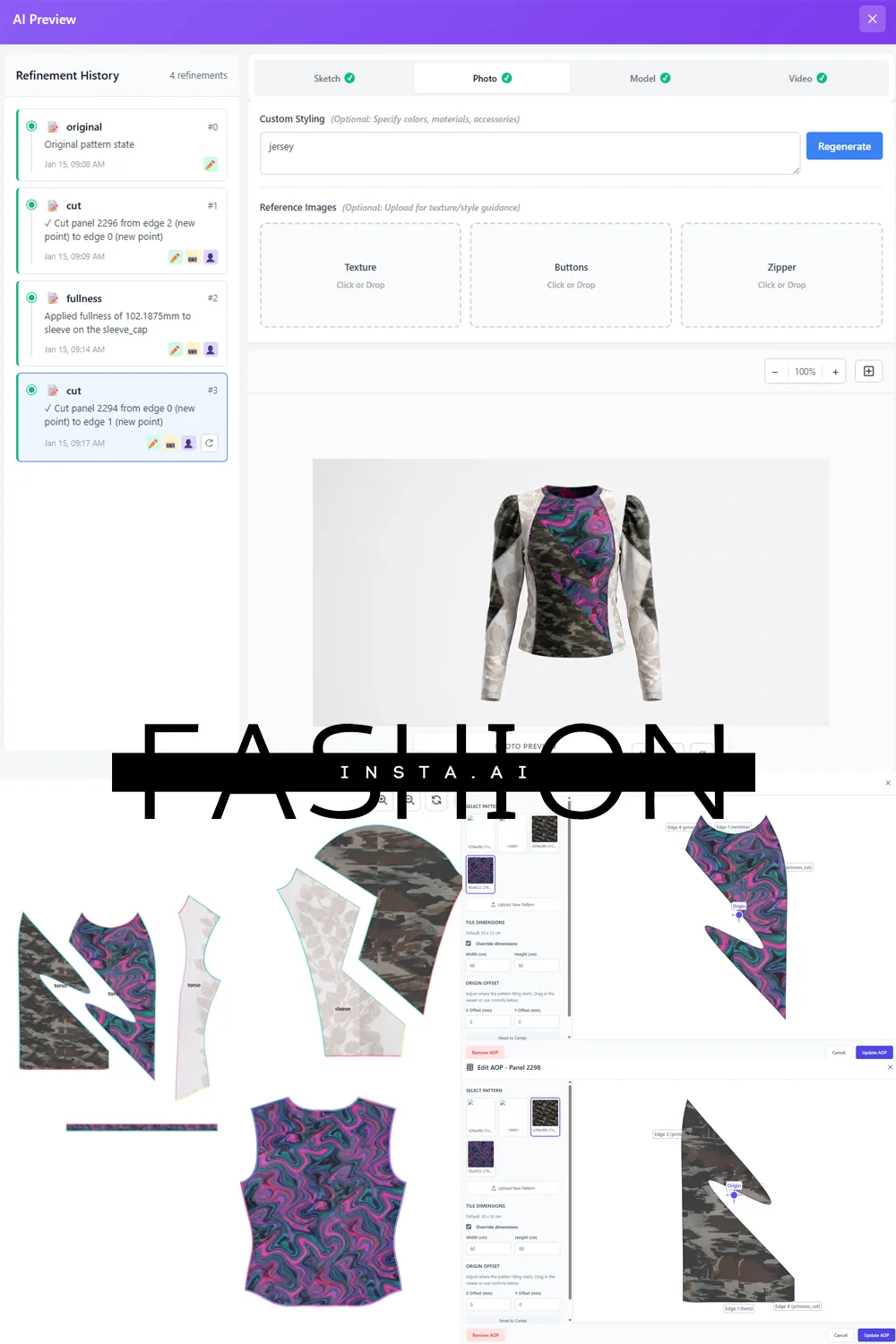
A pattern intelligence system needs the following to build a brand-consistent model:
- A production DXF archive: the canonical set of patterns your brand has cut and sewn, not design sketches or renders. These are the source of geometric truth.
- Construction and tech-pack metadata: seam allowances, notch types, grain lines, construction sequence tags, and any associated trim/detail callouts that inform how a pattern piece is used.
- Size/grade data: grade rules or graded pattern sets per size range, so the model can learn that your brand's grade increments at the hip follow a consistent schedule.
- Optionally, BOM and fabric mappings: fabric type, weight, and stretch percentage per SKU, which informs feasibility scoring downstream.
Preparation goals
Raw DXF archives accumulate technical debt over seasons. Before training, the data pipeline must address:
- Canonicalization of geometry: normalizing coordinate origins, resolving duplicate entities (overlapping line segments that break seam-length calculations), and ensuring all curves are represented as polylines or splines at consistent resolution.
- Seam endpoint normalization: mismatched endpoints are one of the most common failure modes post-export. Cleaning means snapping endpoints to within a defined tolerance (typically sub-millimeter) before the features are extracted.
- Layer and label conventions: a system can't learn that
FRONT_BODICE_LEFTandFBLandLayer_003all refer to the same pattern piece unless those conventions are harmonized. Consistent labeling is a prerequisite, not an optional step. - Fit philosophy reference framing: mapping all patterns to a common anatomical reference frame so that, for example, armhole depth is always measured from the same landmark regardless of which season produced the file.
"Brand DNA" training is not about learning aesthetic preferences or style keywords. Concretely, it means learning statistical relationships between fit blocks and approved construction operations from your own archive. When Fashioninsta trains on a brand's production DXF archive, the system learns those geometric relationships rather than generic garment aesthetics.
IP posture and tenant requirements
Enterprise buyers need to ask this question explicitly: does training on my archive contribute to a shared model that could surface my construction geometry to another customer? For a pattern archive with proprietary fit blocks, the answer to that question has commercial and legal significance. A dedicated tenant model, IP isolation by contract, and an audit trail of what data was ingested are table-stakes requirements, not optional features.
Features extracted from patterns
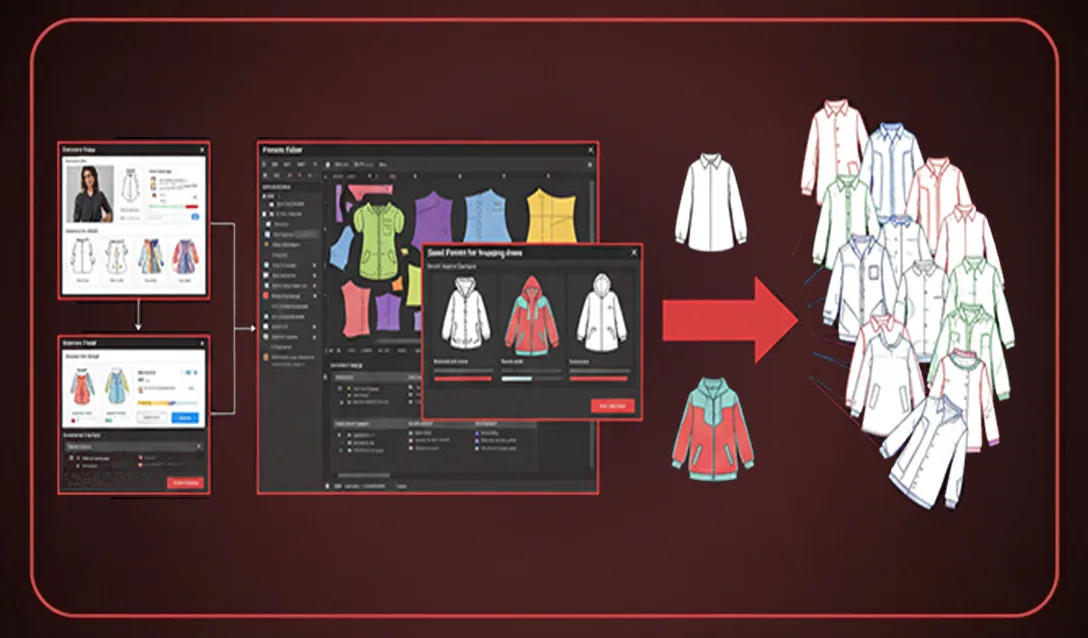
Feature extraction is the mechanism that converts raw DXF geometry into a structured numerical representation the model can use for similarity scoring, constrained generation, and validation checks.
Feature categories
The following categories represent the type of construction descriptors a pattern intelligence system needs to encode:
- Neckline curve descriptors: control points defining curve shape, chord length, and depth relative to shoulder line. Two necklines may look similar visually but differ in the distribution of ease at the CB/CF, which affects how a facing lays flat.
- Armhole depth and sleeve-cap relationship: the correspondence between armhole arc length and sleeve-cap height governs ease and mobility. These are extracted as a pair, not independently, because a mismatch is what causes fit failure.
- Seam geometry and control points: each seam is represented as a sequence of control-point coordinates plus metadata (seam allowance width, notch count, and notch type). This representation enables seam-length matching checks at assembly.
- Dart and princess shaping markers: dart intake, apex position, and rotation angle are encoded as landmarks relative to the grain line. Princess seam curvature is extracted as a parametric curve, not a visual shape.
- Notch placement: notch positions as normalized ratios along each seam, enabling the system to detect when a generated or retrieved pattern's notch spacing falls outside the approved variance for a category.
- Construction-step tags: ~750 tags per pattern encode the construction operations the piece participates in (e.g.,
FRENCH_SEAM,COLLAR_STAND_ATTACHMENT,INSEAM_POCKET_OPENING). These tags are the semantic layer over the geometric representation.
Fashioninsta's platform documents 750+ features per pattern extracted from a brand's production archive, with the Enterprise PoC training on 100 to 150 DXF patterns per category and approximately 750 construction tags per pattern. Across a full archive, the platform has ingested more than 50,000 patterns.
From features to DXF outputs
Features extracted from a training archive map back to DXF through constrained recombination: new patterns are assembled from building blocks already present in the index, with geometry reconstructed from the learned feature representations. A "working DXF" in this context means the file opens without geometry errors in Gerber AccuMark, Lectra Modaris, or equivalent, grades correctly through the defined size run, and nests without unexpected boundary overlaps. Each of those behaviors is verifiable and should be part of any PoC acceptance criteria.
Model training and validation pipeline
Pipeline architecture
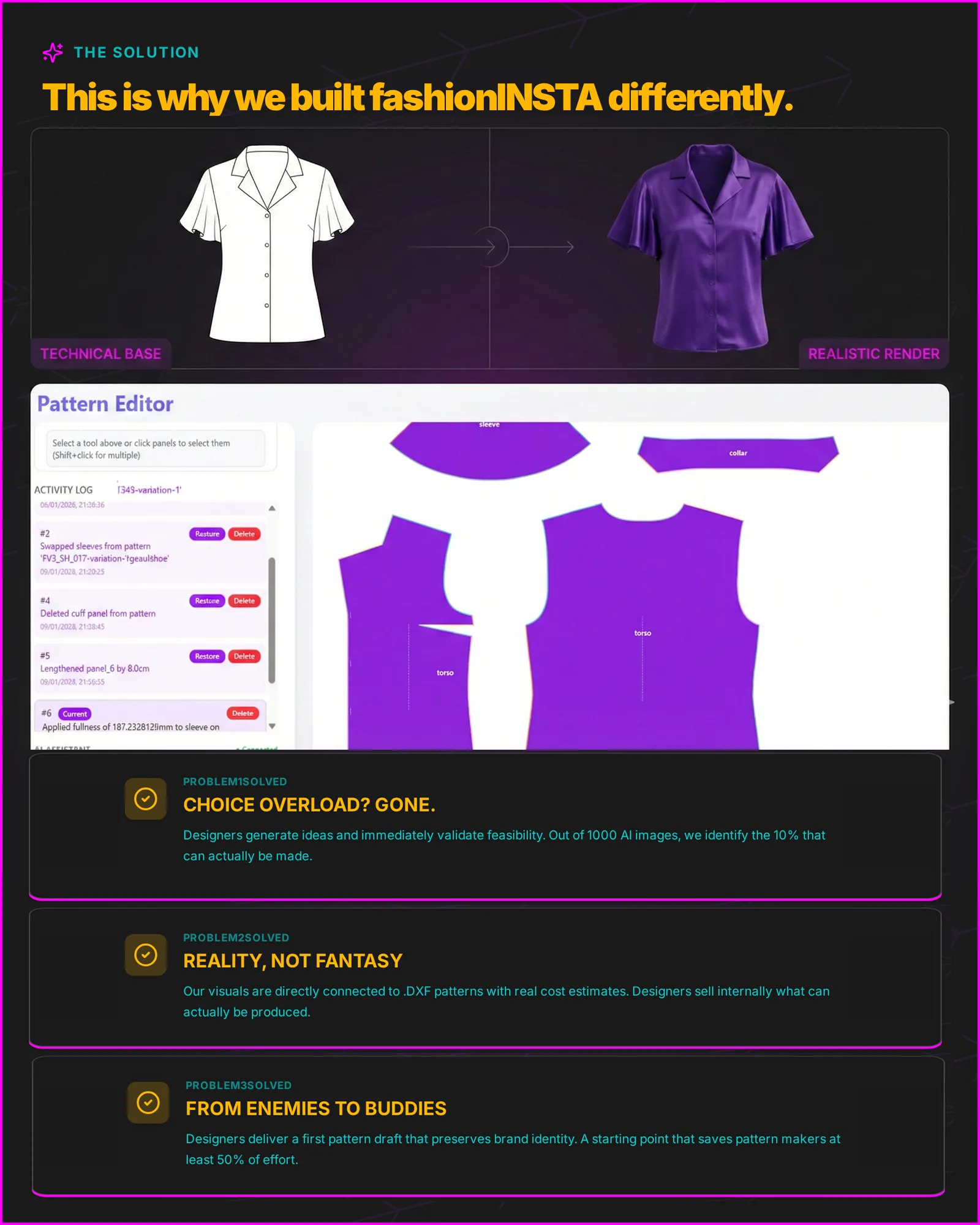
At a systems level, the training pipeline runs in four phases:
- Feature extraction across the full archive: each DXF pattern is processed into a structured feature vector including geometry descriptors and construction tags. Errors (seam mismatches, degenerate curves, missing layer metadata) are flagged for remediation before indexing.
- Similarity space construction: extracted feature vectors are indexed into a searchable space. At retrieval time, a query pattern or specification is mapped into this space and the k-nearest patterns are returned with cosine or Euclidean similarity scores.
- Constrained generation/recombination: for patterns not satisfying a threshold similarity match, the system can generate new patterns by combining building blocks from the indexed archive. Constraints enforce that the recombination doesn't violate approved construction rules (e.g., sleeve-cap height can't exceed the trained range for the category).
- Workflow node exposure: trained operations are exposed as composable nodes in a product development workflow. In Fashioninsta's architecture, the Pattern Generator node handles both retrieval (closest matching DXF) and constrained generation from trained building blocks, while downstream nodes handle feasibility analysis, tech pack compilation, and BOM resolution.
Validation methods
Validation must happen at three levels before any pattern proceeds to downstream CAD operations:
- Holdout tests on unseen patterns: a portion of the archive is withheld from training and used to verify that the system retrieves or generates patterns with similarity scores above a defined threshold against known reference blocks. This tests generalization, not just memorization.
- Geometric similarity scoring against master blocks: each output is scored against the brand's master fit block for the category. Deviations in armhole arc, waist shaping, or grain-line angle that exceed defined tolerances trigger a manual review gate.
- Factory-style feasibility checks: grade readiness (does the generated pattern grade through the full size run without seam-length mismatches?), cut readiness (are all notches, drill holes, and grain lines present and within tolerance?), and consumption estimation (does nesting yield a consumption figure within expected range for the fabric width and category?).
KPI instrumentation
The instrumentation a production team should track includes: first-draft fit approval rate (what percentage of AI-generated patterns are accepted by the technical designer without geometry corrections), manufacturability feasibility pass rate (percentage passing the Feasibility Analyzer without flagged construction issues), and revision rate per pattern (how many rounds of correction a generated pattern requires before sign-off). Fashioninsta documents claimed outcomes of 10x faster first draft and a 4x faster product development cycle, which these metrics would substantiate or challenge in a customer's specific environment.
Failure modes and mitigations
| Failure mode | Cause | Mitigation |
|---|---|---|
| Seam endpoint mismatch post-export | Sub-tolerance snapping not applied during data cleaning | Enforce endpoint snap tolerance in preprocessing; re-export via validated DXF writer |
| Curve drift in armhole/neckline | Spline resampling at insufficient resolution | Increase control-point density; validate arc-length error against reference |
| Incorrect seam-length correspondence | Construction tag missing on one piece of a seam pair | Audit tag completeness before training; flag incomplete pairs |
| Metadata/tag gaps | Irregular layer naming in legacy archive files | Run canonical labeling pass; require human review of auto-assigned tags |
| CAD export incompatibilities | DXF entity types unsupported by target CAD system | Test export round-trip in target CAD (Gerber, Lectra, Tukatech) as part of PoC acceptance |
Human-in-the-loop review gates are not optional in the early calibration phases. The system should route patterns with similarity scores below a defined threshold, or patterns that fail any geometric validation check, to a pattern maker for review before the Tech Pack Compiler node runs.
Reading AI pattern outputs: a practical guide
Output types and what they represent
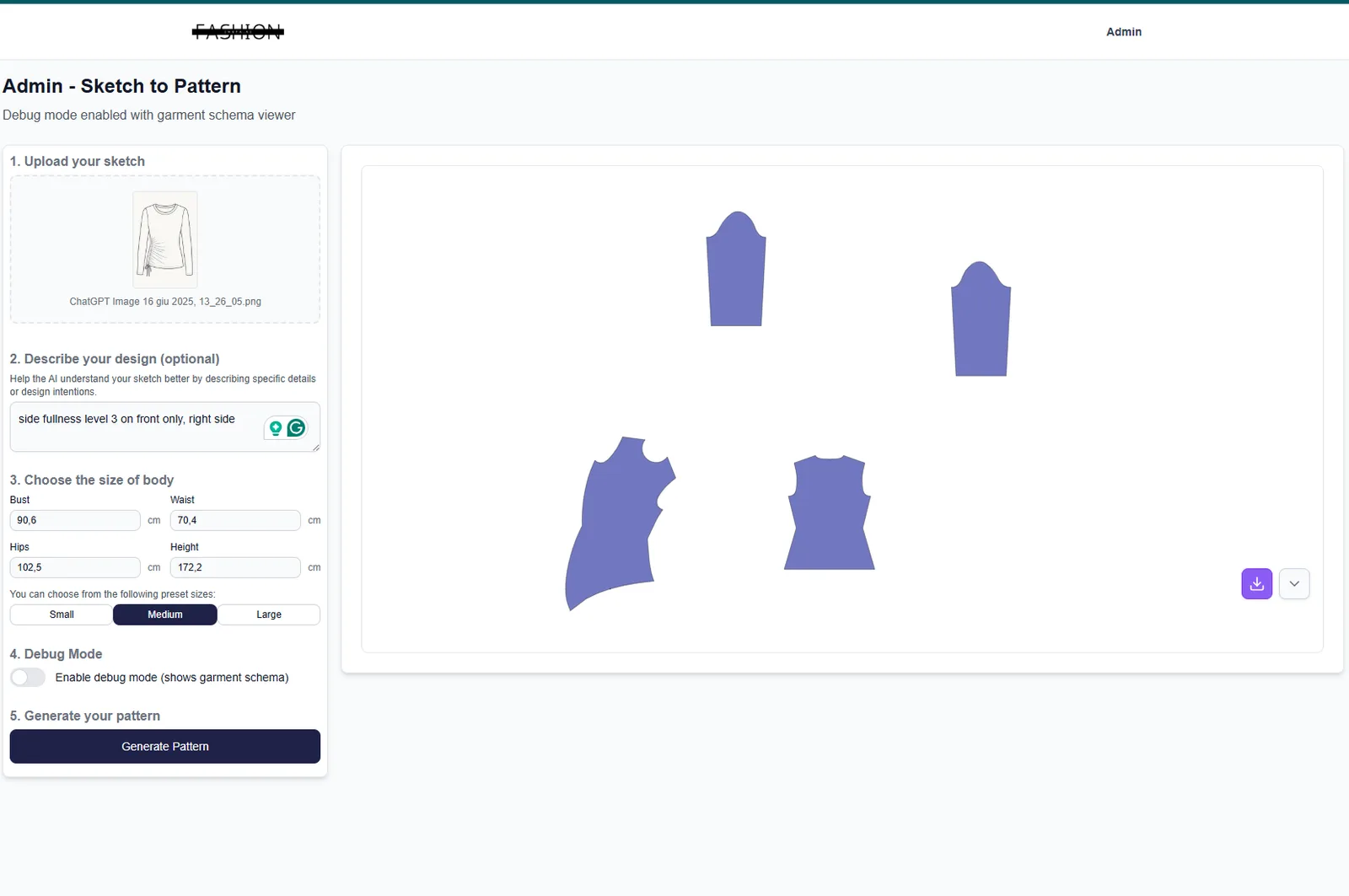
A pattern intelligence system produces three categories of outputs relevant to brand consistency:
- Ranked pattern suggestions: the Pattern Generator returns a ranked list of existing DXF patterns from the index, ordered by similarity score, each with a score value and the specific features driving the match. This is retrieval, not generation, and carries the lowest risk.
- Constrained generated patterns: when no existing pattern scores above the retrieval threshold, the system generates a new pattern by recombining approved building blocks. Traceability metadata records which blocks contributed to each piece.
- Tech-pack artifacts: the Tech Pack Compiler produces measurement tables, construction notes, fabric specifications, and colorway callouts derived from the pattern data and BOM Agent outputs.
Interpreting similarity scores
A high similarity score (say, above 0.90 on a normalized scale) from a closest-matching DXF pattern retrieval indicates that the returned pattern shares construction geometry with the query specification across the majority of extracted features. It does not independently confirm that the pattern is cut-ready. Two additional checks must accompany any similarity score:
- Manufacturability feasibility: the Feasibility Analyzer must pass the pattern before it proceeds to grading. A high-similarity pattern can still carry a legacy construction issue from the archive.
- DXF compatibility: the file must open cleanly in the target CAD system without entity errors. Similarity scoring operates on feature representations; DXF file integrity is a separate property.
A low similarity score does not mean the output is wrong. It means the system had less precedent to draw on, which increases the probability of a constrained generation operation with higher review burden. In practice, low-score outputs should always route through a senior pattern maker before tech pack compilation.
Traceability as an interpretability mechanism
Fashioninsta's platform documents traceability as: "Every generated pattern traces back to the blocks it was built from. No synthetic hallucinations, only recombination of your proven construction." For engineering buyers, this means you can audit exactly which archived patterns contributed to any generated output. That's a meaningful interpretability guarantee. It's also a constraint: the system can only produce construction geometries within the envelope defined by your training archive. Novelty outside that envelope requires a human pattern maker.
Implementation considerations and operational limits
Workflow integration and CAD compatibility testing
AI-generated DXF outputs should be tested for compatibility before production rollout by running the following checks in the target CAD environment:
- Open the file: confirm no entity errors, unresolved references, or missing layers.
- Grade through the full size run: verify seam lengths match at all sizes; flag any size where a seam pair diverges beyond tolerance.
- Nest at target fabric width: confirm consumption estimate is within expected range (±5% is a reasonable initial tolerance for wovens).
- Export to downstream systems: confirm the file round-trips cleanly to any PLM, PIM, or DAM integration.
Fashioninsta's Fashion Complete OS tier includes "API in & out" with PLM, PIM, and DAM integration support.
Fit-locking and role governance
By default, Fashioninsta's platform restricts AI operations to design changes. Fit parameters (block geometry, ease values, grading increments) stay locked unless a technical designer with appropriate role permissions explicitly unlocks them. This is a sensible default. The pattern maker role should be able to review and annotate generated patterns; the technical designer role approves fit parameter changes; a PM or product director role operates at the workflow level without geometry access.
Role separation of this kind is not just good practice. For a brand with established fit standards, an AI operation that drifts ease values without authorization is a brand consistency failure, regardless of whether the output looks plausible.
Operational readiness and the PoC structure
A 10-week Enterprise PoC structured around one product category (with training on 100 to 150 production DXF patterns) is the appropriate scale to evaluate whether a pattern intelligence system can replicate your brand's fit philosophy before committing to full deployment. The go/no-go criteria should be defined before the PoC starts, not after results are available. Specify: minimum first-draft approval rate, maximum revision cycles, DXF compatibility pass rate in target CAD, and feasibility pass rate from the Feasibility Analyzer.
Calibration continues beyond the PoC. As new seasons add patterns to the archive, the similarity index needs to be updated and holdout validation rerun. A model trained on three seasons of womenswear tailoring isn't automatically valid for outerwear; category scope is a real constraint.
Enterprise procurement checklist
Before committing to any pattern intelligence platform, engineering and procurement teams should verify:
| Question | What to ask for |
|---|---|
| Data isolation | Is training data stored in a dedicated tenant, or in a shared index? |
| IP posture | Does the platform contractually guarantee your DXF data won't train another brand's model? |
| Access controls | SSO (SAML/OIDC), RBAC with role definitions, audit log with immutable entries? |
| DPA/NDA | Are these executed before any data transfer, including the PoC? |
| Audit and export | Can you export a full log of model operations and data ingested for compliance purposes? |
| CAD compatibility | Which DXF versions and entity types are supported; what's the test protocol for your specific CAD stack? |
The fundamental limitation of any pattern intelligence system is that its outputs are bounded by the quality and completeness of the training archive. A brand with inconsistent archive hygiene, gaps in metadata, or poorly graded legacy patterns will surface those problems in model outputs. AI amplifies what's already in the data. Cleaning the archive before training isn't a preprocessing nicety; it's the primary determinant of output quality.