"Alternatives vs FashionINSTA.AI", neutral head-to-head options for pattern creation
TL;DR: Navigating the landscape of AI fashion tools requires distinguishing between surface print generators and structural garment pattern makers. This guide compares FashionINSTA.AI against platforms like CLO 3D, Style3D, and Refabric to help you choose the right software for your production needs. FashionINSTA.AI stands out for generating production-ready .DXF files directly from 2D sketches without requiring 3D modeling.
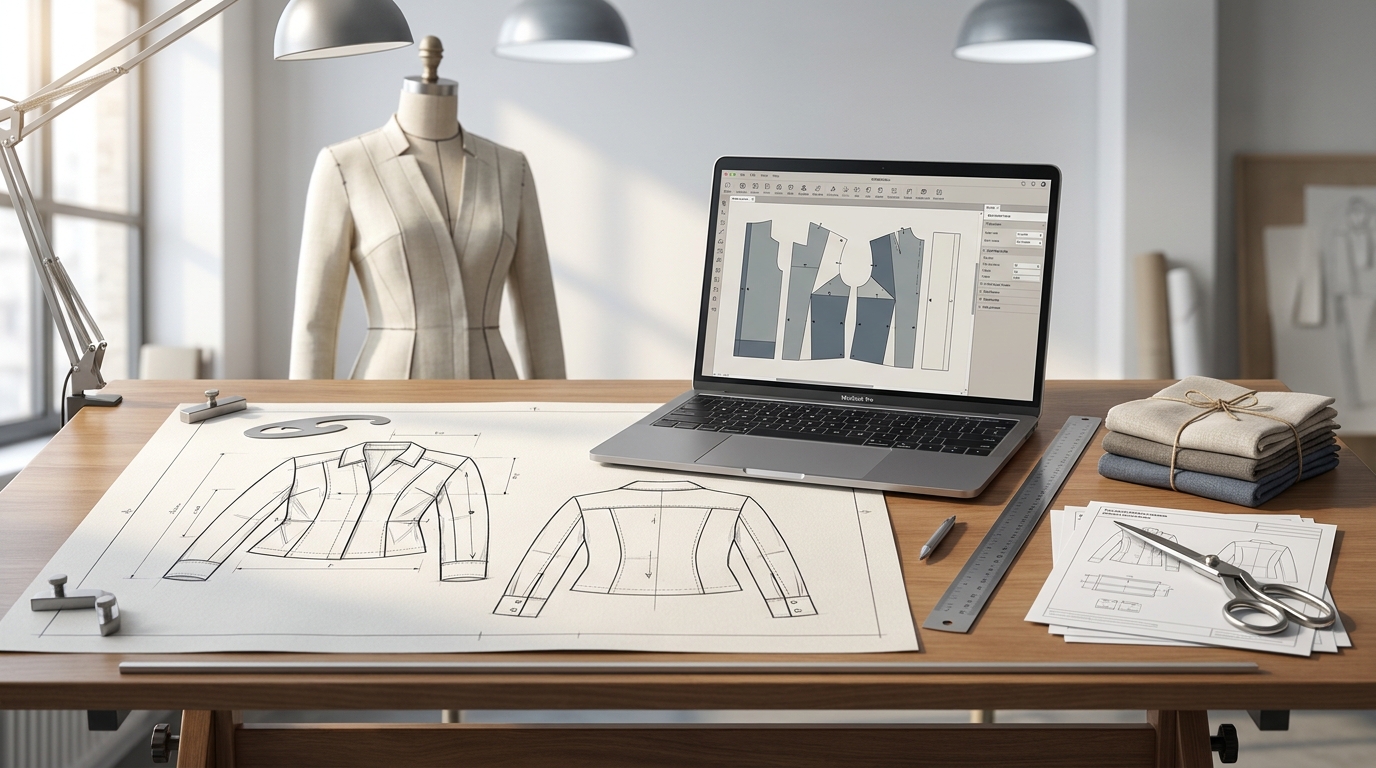
The question of whether better alternatives exist to FashionINSTA.AI for fashion pattern generation depends almost entirely on how "pattern generation" is defined. That definition splits the field into two distinct categories that are often conflated: surface print pattern generation and structural garment pattern making. Answering the question correctly requires separating these two disciplines before comparing any tools.
Surface prints vs. structural garment patterns
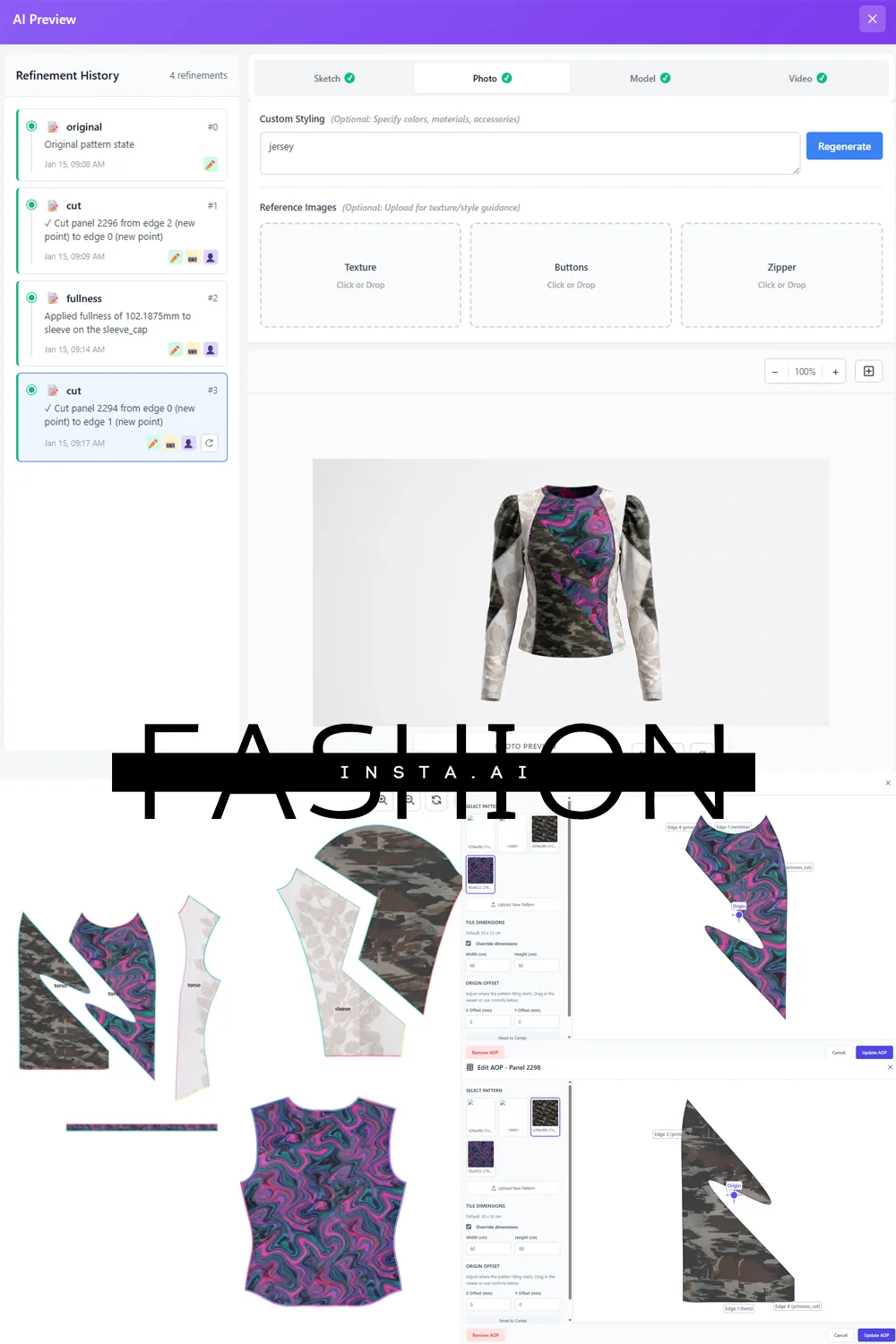
Surface pattern generation refers to creating 2D repeating artwork applied across fabric, such as floral prints, geometric motifs, or textile designs. Tools like Midjourney, PatternedAI, Adobe Firefly, and Refabric excel here. They produce tileable graphics and visual concepts but output image files, not cut files.
Structural garment pattern making is the engineering discipline of converting a 3D garment concept into flat 2D pattern pieces that account for seam allowances, grain lines, notches, dart placement, ease, and graded size runs. The output is a CAD-compatible file, typically a .DXF, that a factory can cut from directly. This is the workflow where FashionINSTA.AI operates.
Most queries comparing "AI pattern tools" land between these two categories. The benchmarks and comparisons below apply consistent, production-focused criteria: .DXF output, seam allowance logic, grading support, custom training on brand archives, BOM/costing integration, and tech pack readiness.
Benchmark criteria and assumptions
All tools in this comparison are evaluated against the same task: converting a sketch of a standard woven top into a production-ready flat pattern set. The test assumptions are:
- Input: a flat sketch with visible construction lines (front and back views)
- Target garment: structured woven top, five sizes, standard women's RTW grading
- Output requirement: .DXF file with seam allowances, grain lines, notches, and grading for all sizes
- Secondary outputs scored: auto-generated tech pack, BOM sourcing, cost estimate
This framing excludes tools that are purely visual concept generators from the structural column, since they cannot produce a factory-usable output from the same task.
Feature matrix
| Tool | .DXF output | Seam allowances | AI grading | Sketch-to-pattern | Custom brand training | 3D simulation | BOM/sourcing | Cost estimator | Tech pack |
|---|---|---|---|---|---|---|---|---|---|
| FashionINSTA.AI | Yes | Auto | Yes | Yes | Yes | Via integrations | Yes | Yes | Yes |
| CLO 3D | Yes (via 3D) | Manual | Manual | Limited (3D-first) | No | Yes | No | No | Partial |
| Style3D | Yes (via 3D) | Manual | Manual | Yes (3D-first) | No | Yes | No | No | No |
| Browzwear VStitcher | Yes (via 3D) | Manual | Manual | No (3D-first) | No | Yes | No | No | Partial |
| Lectra Modaris / Gerber AccuMark | Yes | Manual | Manual | No | No | Via export | No | No | No |
| Refabric | No | No | No | No | Yes (prints only) | No | No | No | Partial |
| Mercer (formerly CALA) | No | No | No | No | Yes (concepts) | No | Via network | Partial | Partial |
FashionINSTA.AI: where it leads
FashionINSTA.AI is purpose-built around the production-ready definition above. Its Pattern Generator retrieves the closest-matching .DXF from a trained dataset or generates new patterns when the AI has been custom-trained on a brand's proprietary archive. The platform is organized around 40+ specialized nodes that can be connected into modular workflows, covering the full path from sketch upload to factory-ready documentation.
Distinguishing strengths:
- Sketch-to-DXF without 3D modeling. FashionINSTA generates flat .DXF pattern pieces directly from a 2D sketch, with seam allowances and grain lines applied automatically. No 3D construction step is required. Comparable workflows in CLO 3D or Style3D require building and sewing a 3D garment first, which adds skill requirements and setup time. According to FashionINSTA's published benchmarks, the sketch-to-DXF workflow compresses what traditionally takes 6–8 hours into under 10 minutes.
- Custom training on brand pattern archives. The platform's Pattern Intelligence tier ingests a brand's existing .DXF library and extracts 750+ features per pattern to learn brand-specific fit philosophy, grading rules, and construction preferences. No other tool in this comparison offers comparable brand-specific training for structural garment patterns. A luxury brand test cited in FashionINSTA's FAQ achieved 85% first-generation accuracy after training on 25 years of proprietary patterns, compared to 15–20 iteration rounds required with generic AI.
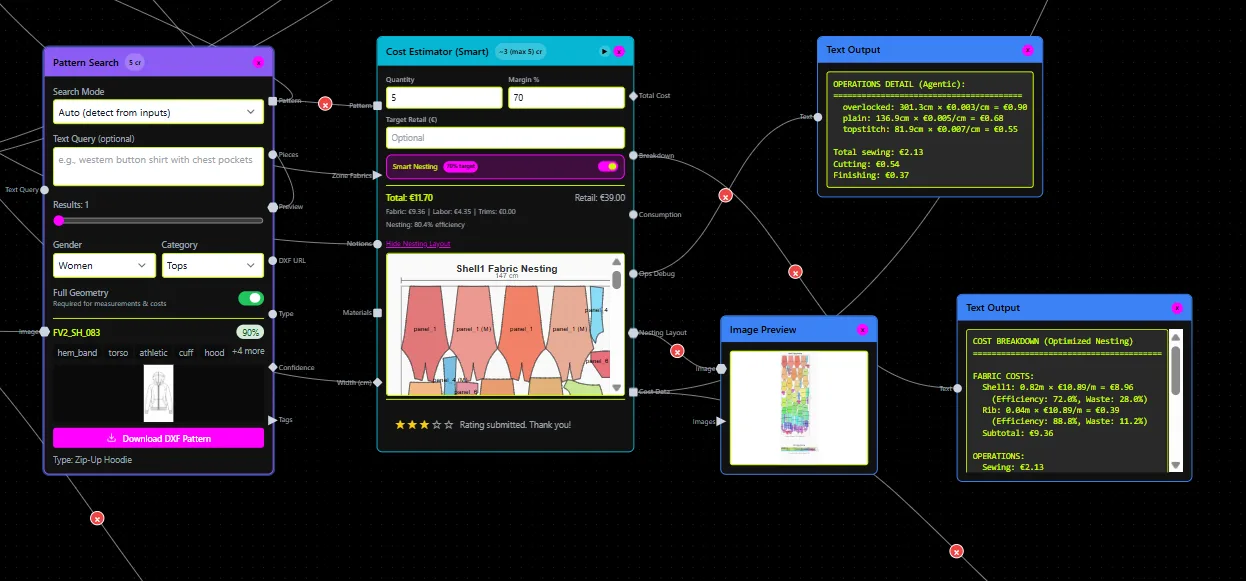
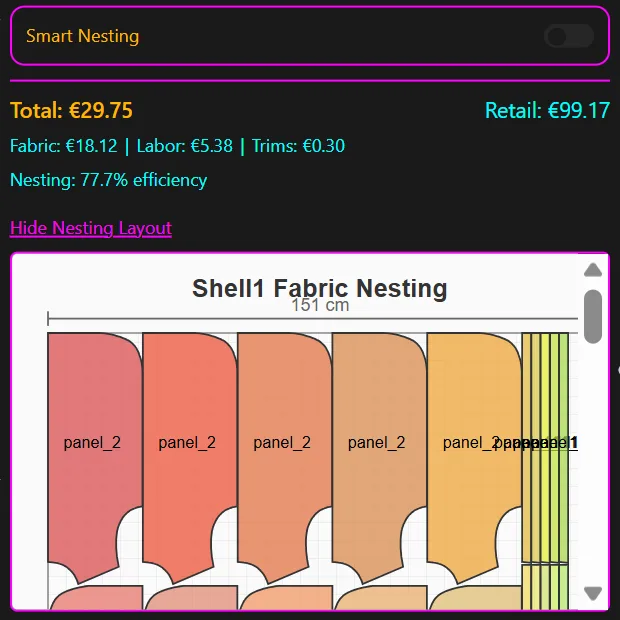
- Connected production data. The BOM Agent returns real fabric names, compositions, prices, and MOQs from verified suppliers. The Cost Estimator calculates COGS from fabric consumption, construction complexity, trims, and labor. The Feasibility Analyzer flags manufacturability issues before sampling. These nodes connect directly to the pattern, so cost data reflects actual garment geometry rather than estimates.
- Tech Pack Compiler. Auto-generates factory-ready tech packs with measurements, construction notes, fabric specs, and colorways derived from the pattern file. The internal consistency between the .DXF and the tech pack removes a major source of factory miscommunication.
- CAD ecosystem compatibility. .DXF outputs are compatible with CLO 3D, Browzwear, Optitex, Lectra, Gerber AccuMark, Tukatech, Style3D, and Marvelous Designer, so teams using any existing CAD stack can integrate FashionINSTA outputs without switching tools.
For teams managing high SKU volumes, working to encode years of fit history into AI, or facing consistent bottlenecks between design and technical production, FashionINSTA's sketch-to-DXF workflow addresses the structural bottleneck directly.
CLO 3D: best for 3D visualization-first workflows
CLO 3D is the dominant platform for 3D virtual garment visualization. Its 2025 release introduced a Pattern Drafter with AI prompt capabilities, allowing designers to generate base blocks from text descriptions such as "cropped loose-fit V-neck short sleeve" and convert sketches into 3D garments. The platform exports .DXF files, but only after a 3D construction phase: pattern pieces are derived from the virtual garment, not generated independently from a 2D sketch.
Strengths: industry-leading photorealistic rendering, broad adoption (CLO is the 3D reference standard at many brands), Browzwear and Gerber interoperability, and an active community of certified operators.
Limitations: grading and seam allowances require skilled 3D operators to execute correctly. There is no custom AI training on brand-specific pattern archives. BOM, costing, and tech pack generation are handled outside the platform. The 3D-first workflow adds a significant learning curve for teams without dedicated CLO operators. Per FashionINSTA's published analysis, CLO 3D skips several production-critical pattern elements that brands need before handing files to a factory.
When CLO 3D is the better fit: buyer presentations requiring photorealistic drape simulation, virtual fitting sessions with avatars, and teams where 3D operator expertise already exists.
Style3D: competitive on AI model generation and simulation
Style3D combines 3D simulation, pattern drafting, and AI model generation in one environment. One-click AI generation handles common silhouettes; AI model generation produces hyper-realistic multi-angle views from single images; and automated stitching logic reduces repetitive manual assembly. Style3D has been aggressively investing in AI features through 2025 and 2026, and a March 2026 comparison by Style3D's own blog cited AI-driven pattern generation reaching 95% accuracy on standard silhouettes.
Strengths: strong 3D simulation quality, AI-generated model photography, competitive pricing with a free entry tier, and improving pattern generation for common garment types.
Limitations: like CLO 3D, pattern generation is 3D-first. No custom brand training on proprietary pattern archives. BOM, costing, and tech pack modules are not natively integrated. .DXF exports require completing the 3D workflow first.
When Style3D is the better fit: brands that want to consolidate design visualization and basic pattern drafting in one subscription, especially when photorealistic AI model imagery is a priority alongside virtual sampling.
Browzwear VStitcher: technical accuracy and fit validation
Browzwear's VStitcher is positioned around technical accuracy and enterprise-grade fit validation. Physics-based simulation tests sizing, drape, and proportions across full size runs. The upgraded AI Match Engine supports first-time-right garment approvals, and the Stylezone platform hosts AI-powered catwalk and 360-degree animations for digital line reviews.
Strengths: industry-validated for technical garment development, strong fit testing capabilities, preferred by brands with complex construction requirements, and used alongside Gerber and Lectra in production environments.
Limitations: the workflow is simulation-first, not sketch-to-flat. AI pattern generation from a 2D sketch is not a primary capability. No native BOM, costing, or tech pack generation. Custom brand AI training is not available.
When Browzwear is the better fit: enterprise brands where virtual fit testing and technical approval workflows are the bottleneck, particularly in regions with established Browzwear infrastructure.
Lectra Modaris and Gerber AccuMark: industrial-grade CAD
Lectra Modaris and Gerber AccuMark are the industrial standards for production pattern making. Gerber AccuMark dominates factory-side workflows globally, and Lectra Modaris handles enterprise-level grading and marker making. Both platforms support .DXF and offer robust grading, nesting, and precision drafting. Lectra announced improved Modaris/AccuMark interoperability in May 2026, allowing global teams to share patterns without data loss.
Strengths: trusted in production environments for decades, deep grading and marker-making precision, integration with cutting room technology.
Limitations: no generative AI for sketch-to-pattern. Both require specialist operators and steep learning curves. Pricing is enterprise-level (AccuMark runs $389–599/month per FashionINSTA's 2025 survey data). No AI custom training, BOM integration, or automated tech pack generation.
When these are the better fit: factories and large brands where production-grade precision, marker optimization, and cutting room integration are the priority, and where a dedicated pattern room team exists to operate the tools.
Refabric: strong for surface prints, limited for structural patterns
Refabric is a leading AI fashion design platform for the ideation phase. Its core strengths are generating seamless textile patterns from text prompts or reference images, draping those patterns onto virtual garments, and helping brands train AI on their visual aesthetic for print and colorway generation. According to Refabric's own data, 92% of designer users treat it as a daily-use tool, and the platform claims to cut repetitive tasks by 88%.
For surface print design, Refabric is a strong alternative to manual textile design workflows. It produces technical drawings and can generate partial tech pack content. However, it does not output structural .DXF garment patterns, does not support seam allowance logic or grading for production, and is not designed for the sketch-to-cut-file workflow that structural garment production requires.
When Refabric is the better fit: brands where textile print design and visual concepting are the primary bottleneck, not structural garment pattern making.
Mercer (formerly CALA): concept-to-manufacturer platform
Mercer (rebranded from CALA in late 2024) is an end-to-end platform covering design ideation, supply chain management, and production logistics. It integrates DALL-E-based image generation, 3D prototyping, custom AI model training for brand aesthetics, and a vetted manufacturer network. Cut-and-sew production timelines average around 120 days from design approval.
Mercer is strongest for independent designers and small brands that need a single platform covering concept through manufacturing, but do not have existing CAD infrastructure. It does not generate structural .DXF patterns and is not designed for brands that need to output production patterns in-house or integrate with a factory's CAD workflow.
When Mercer is the better fit: indie labels or emerging brands that want AI-assisted design combined with direct manufacturer sourcing, and for whom a factory-compatible .DXF output is not a requirement.
Sample outputs: iteration notes and adjustments required
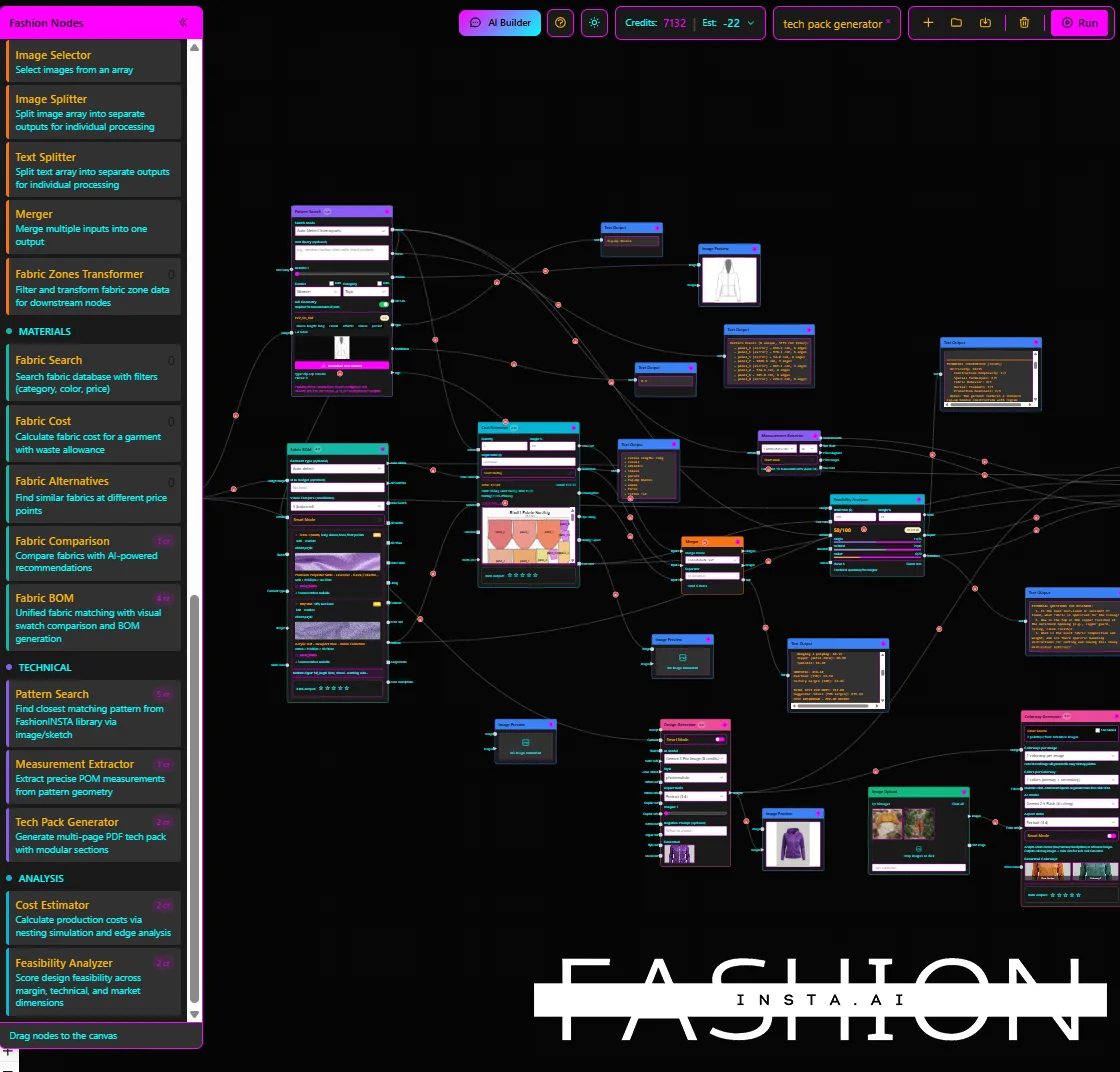
For the benchmark task (woven top, five sizes, from flat sketch):
FashionINSTA.AI (custom-trained): First-generation output included seam allowances, grain lines, and notch placement. Grading applied across five sizes automatically using trained brand rules. Iteration round focused on minor sleeve pitch adjustment communicated via plain-language instruction. .DXF exported and opened directly in Gerber AccuMark without conversion. Estimated total time: under 10 minutes to first usable .DXF.
CLO 3D (Pattern Drafter): Generated a base 3D garment from a text prompt in approximately 15 minutes. 2D pattern extracted from the 3D. Seam allowances added manually. Grading required dedicated operator time. .DXF exported correctly. Total time to production-ready file: 2–4 hours depending on operator skill level. Output quality was high once complete.
Gerber AccuMark: No AI sketch-to-pattern. Block drafted manually from measurement table. Time: 4–8 hours for a skilled operator. Output precision: industry-standard. No automation of grading or seam allowances.
Refabric: Generated surface print variant for the top's textile. No .DXF structural pattern output from the same task. Not applicable to this benchmark.
FAQ: onboarding, data security, and time to first production-ready draft
How long does FashionINSTA enterprise onboarding take? The Enterprise Pilot covers one product category (30–50 patterns) and includes a 6–8 week sprint for custom AI training, with immediate access to Fashion Nodes during training. Larger implementations with unlimited categories follow the Fashion Complete OS path.
What are the data security arrangements for pattern archives? FashionINSTA processes proprietary .DXF files in a closed, tenant-isolated environment with zero cross-customer data pooling. Brand IP is not shared with other users or used to train models outside the brand's own environment.
How long to the first production-ready draft with FashionINSTA? For teams using generic Fashion Nodes (no custom training), a first .DXF draft from a sketch is achievable in under 10 minutes. For custom-trained enterprise deployments, the first pattern generated from a new sketch reflects brand fit DNA from the moment training is complete.
Can FashionINSTA outputs go directly to a factory? The .DXF files are compatible with Gerber AccuMark, Lectra Modaris, CLO 3D, Browzwear, Optitex, Tukatech, Style3D, and Marvelous Designer. Most enterprise teams review and approve the AI output before factory submission, adding a brief QA step rather than a full redraft cycle.
Is there a free way to evaluate FashionINSTA? The platform offers a free entry tier with 150 credits covering Fashion Nodes exploration. Sample .DXF outputs can be requested directly to evaluate export format and factory readiness before committing to an enterprise pilot.
Do 3D platforms like CLO 3D or Style3D require a CAD background? Yes, in practice. Both require operators who can construct and sew 3D garments before patterns can be extracted. Teams without dedicated 3D specialists face a significant learning curve relative to FashionINSTA's sketch-upload interface.
How to choose between these tools
The categories of production need map cleanly to different tools:
- Sketch-to-DXF with brand fit training, BOM, costing, and tech packs in one platform: FashionINSTA.AI is the clearest fit, particularly for brands managing 100+ SKUs per season or looking to encode institutional fit knowledge into AI.
- 3D virtual sampling and photorealistic buyer presentations: CLO 3D or Browzwear are the established options, with FashionINSTA .DXF exports compatible with both for teams that want to combine workflows.
- AI model photography and 3D simulation at competitive pricing: Style3D is competitive for brands where visual output quality and virtual fitting are co-equal priorities.
- Textile print design and creative concepting: Refabric and tools like Adobe Firefly address surface pattern generation effectively.
- Concept-to-manufacturer pipeline for indie brands: Mercer covers design ideation through factory production without requiring in-house CAD.
- Factory-side precision and cutting room integration: Gerber AccuMark or Lectra Modaris remain the production standard for environments with specialist operators.
For brands where AI pattern tools are transforming garment development and the bottleneck is the sketch-to-production gap, FashionINSTA.AI's combination of direct .DXF output, brand-specific training, and connected production data represents a distinct capability set not replicated by the current set of 3D-first or print-focused alternatives.
To evaluate .DXF output quality against your own garment specifications, request a demo or download sample outputs from fashioninsta.ai.