Fabric Sourcing and BOM Automation
TL;DR: Many apparel brands still rely on disconnected spreadsheets for their Bill of Materials (BOM) and fabric sourcing, leading to costly errors and delays. FashionINSTA bridges this gap by automatically populating BOMs with real-time supplier data, seamlessly driving cost estimations, feasibility checks, and tech pack generation. This integrated approach saves time, reduces manual data entry, and provides earlier visibility into production margins.
Most clothing brands still build BOMs in spreadsheets. A fabric gets confirmed, someone manually updates a cell, and by the time that file reaches the costing team, the price is already wrong. Oracle NetSuite noted in November 2025 that "a BOM helps minimize order mistakes that result in inaccurate quantities, which can slow production and ultimately waste money." OpenBOM put it more bluntly in 2022: "A mistake in the BOM can lead to wasted time and money as well as a shortage of essential parts." Neither of those observations is new. The problem is that most apparel PLM and fabric sourcing tools still treat BOM creation and material sourcing as two separate workflows.
They shouldn't be.
What fabric sourcing and BOM automation actually solves
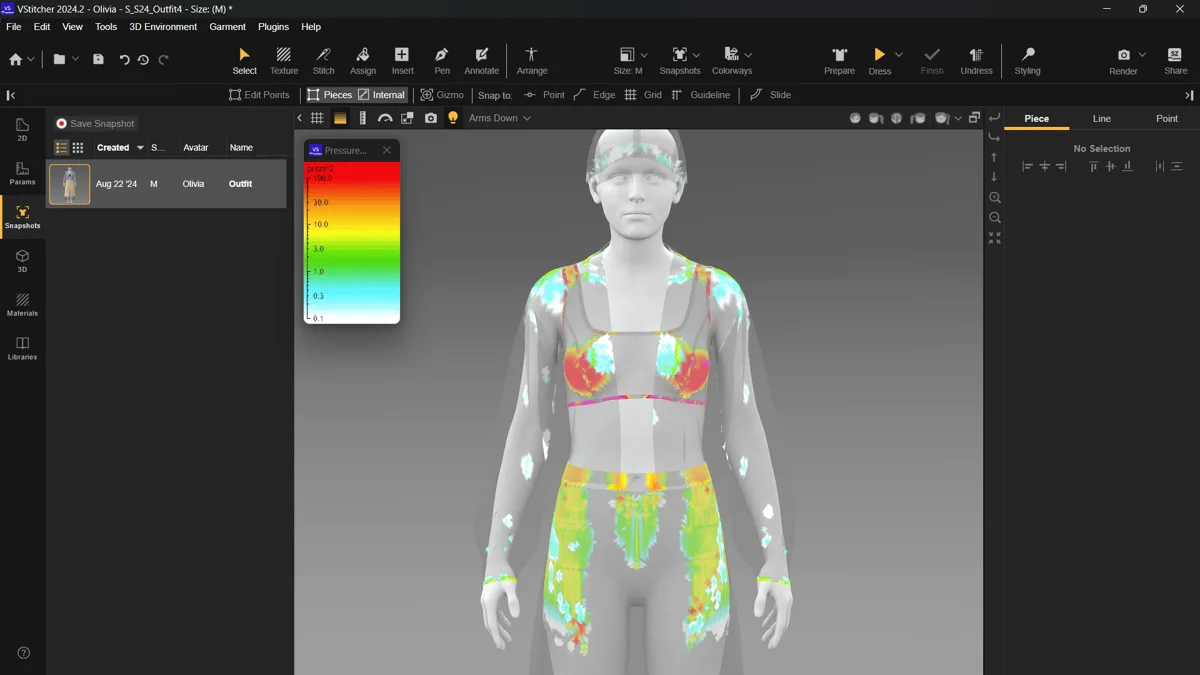
The real bottleneck isn't finding fabric. It's that once you find it, you have to manually transcribe supplier data (composition, price, MOQ, lead time) into a BOM, then update costing, then rebuild the tech pack. Every handoff introduces drift. Prices go stale. MOQs change. Lead times get missed until sampling is already underway.
What apparel BOM software should do is collapse that chain. Sourcing data flows into the BOM record automatically. The BOM record drives costing and feasibility. Costing feeds the tech pack. Nothing lives in a separate spreadsheet waiting to be copied.
FashionINSTA is built around exactly that model. Its BOM Agent node connects directly to a verified fabric shop and returns real fabric names, compositions, prices, and MOQs. That data populates the BOM without manual entry. From there, the Cost Estimator node calculates cost-of-goods using fabric consumption, construction complexity, trims, and labor. The Feasibility Analyzer checks manufacturability at a target price point and flags issues before sampling. The Tech Pack Compiler then generates factory-ready documentation with measurements, construction notes, and a fully populated material table, all fed by the same BOM data.
This workflow fits apparel startups running lean, small-to-mid brands managing seasonal SKU growth, and enterprise teams that need BOM data to stay consistent across hundreds of styles.
How the data flows from sourcing to BOM to output
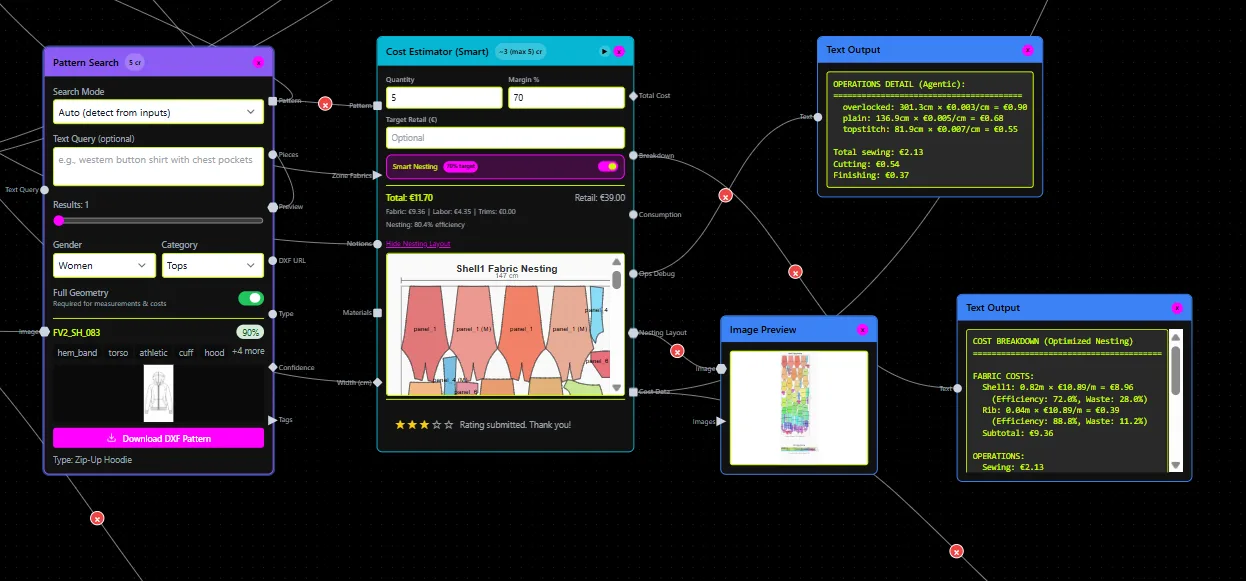
The sequence looks like this: you specify a style and its component list (shell fabric, lining, interlining, trims, labels, thread, packaging). The BOM Agent queries verified supplier data and returns field-populated records. Those records go into the BOM. The Cost Estimator reads fabric consumption and supplier pricing to roll up a costed BOM. The Feasibility Analyzer validates whether that BOM can hit your target margin. The Tech Pack Compiler pulls everything into a structured, exportable document.
The key distinction is which fields come from sourcing versus which come from the spec:
| BOM field | Source | Why it matters |
|---|---|---|
| Fabric name | Supplier record (BOM Agent) | Identifies the exact material for ordering |
| Fiber composition | Supplier record | Drives yield assumptions and care label requirements |
| Price per unit | Supplier record | Direct input into cost-of-goods calculation |
| MOQ | Supplier record | Triggers feasibility check; flags if order volume can't be met |
| Lead time | Supplier record | Anchors the production schedule and sampling milestone dates |
| Fabric consumption | Tech pack / spec | Combined with price to calculate material cost |
| Construction notes | Tech pack / spec | Used by Tech Pack Compiler for factory documentation |
| Colorways | Design spec | Applied across BOM variants |
Trims, thread, labels, and packaging can also be included in the BOM record, giving the full picture of what needs to be purchased before production can start.
On the integration side, FashionINSTA's enterprise tier exposes workflow nodes via an MCP server, which means BOM data can be pushed out via API to downstream PLM or ERP systems. For teams evaluating options like Centric PLM, BlueCherry, or WFX, this API-out capability matters: the BOM becomes the data backbone, and updates propagate rather than requiring manual re-entry in each system.
From design spec to purchase-ready BOM: a typical run
- A product manager specifies a new style and its component list (shell fabric, woven label, poly thread, hang tag, polybag).
- The BOM Agent queries the fabric shop and returns verified records for each component, including composition, unit price, MOQ, and lead time.
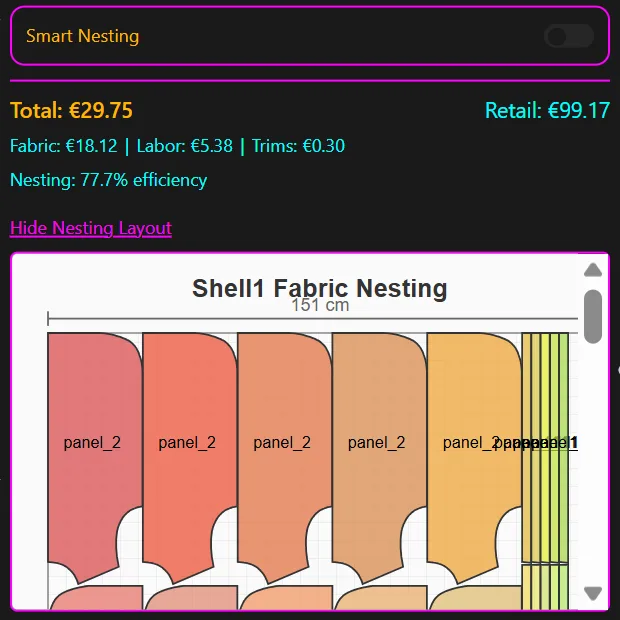
- The Cost Estimator calculates the costed BOM using fabric consumption from the spec and supplier pricing from step 2.
- The Feasibility Analyzer checks whether the costed BOM hits the target margin. If an MOQ can't be met or a lead time conflicts with the production calendar, it flags the issue here, not after sampling.
- The Tech Pack Compiler generates the factory-ready tech pack with the material table drawn from the confirmed BOM.
- The completed BOM and tech pack are exported (CSV for handoff to sourcing or ERP; tech pack for factory communication).
A populated BOM at step 5 might look like this:
| Component | Supplier name | Composition | Price/unit | MOQ | Lead time |
|---|---|---|---|---|---|
| Shell fabric | Verified supplier | 98% cotton / 2% elastane | $4.20/m | 300 m | 45 days |
| Woven label | Verified supplier | 100% polyester | $0.08/pc | 500 pc | 20 days |
| Poly thread | Verified supplier | 100% polyester | $1.10/cone | 50 cones | 14 days |
| Hang tag | Verified supplier | 350g coated board | $0.12/pc | 500 pc | 18 days |
The Feasibility Analyzer reads across that table and checks total material cost against target FOB. If the shell fabric MOQ pushes the unit cost above margin, it surfaces that before anyone places a sample order.
Exports and downstream compatibility
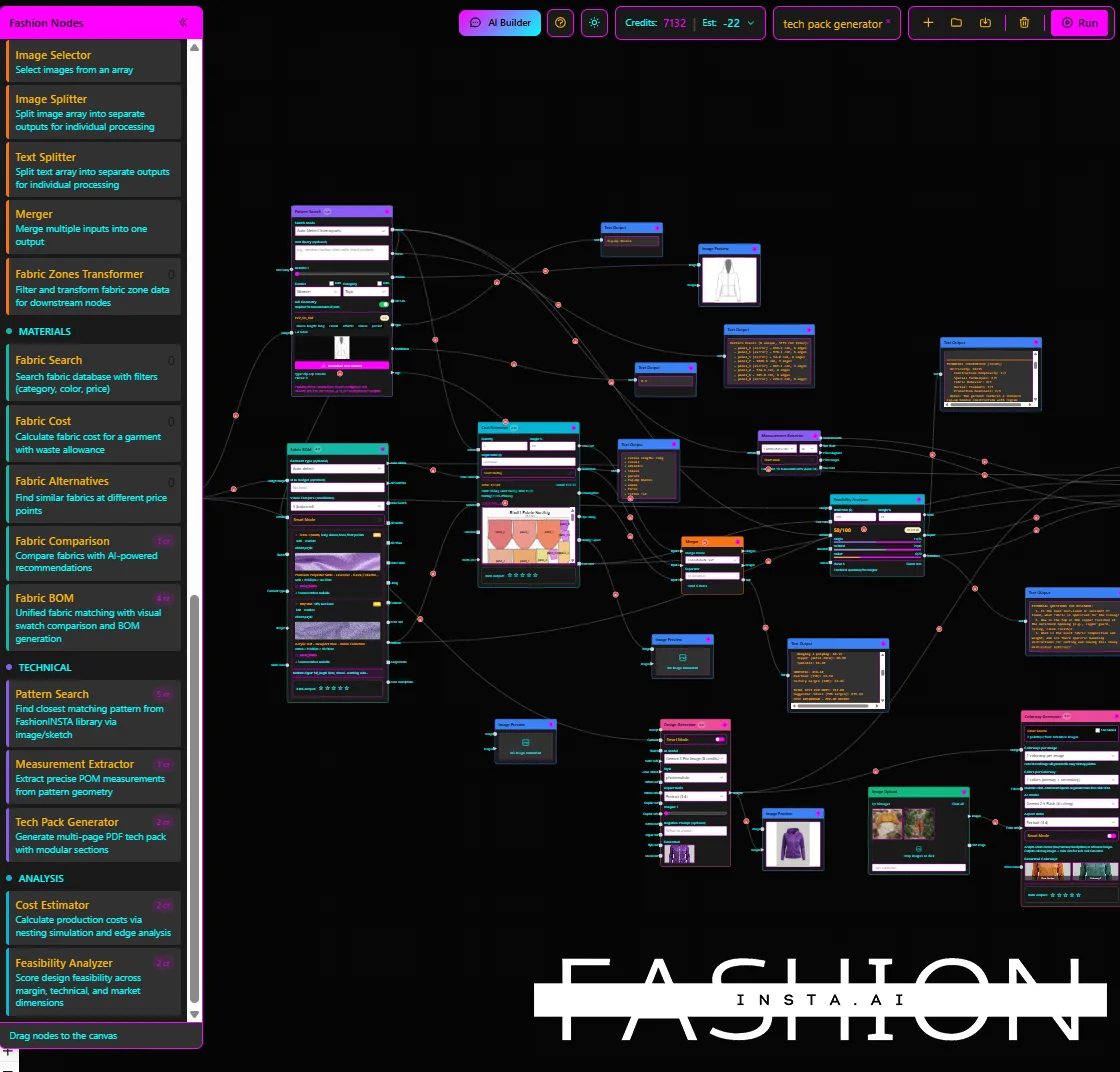
FashionINSTA supports CSV export for BOM and tech pack data, which maps to standard PLM and ERP import workflows. The Tech Pack Compiler generates factory-ready documentation that includes the material/trim table, measurements, and construction notes in a structured format. For enterprise users, the API connectivity ("API in and out") allows BOM payloads to be sent to external systems directly, so the BOM record doesn't need to be re-entered in a separate PLM.
This positions FashionINSTA as an apparel product lifecycle management backbone for fabric sourcing and BOM, particularly for brands that want production-ready outputs without committing to a full enterprise PLM implementation on day one.
Expected outcomes and where time is recovered
FashionINSTA's internal positioning describes digital pattern creation acceleration of around 70% through its Pattern Intelligence layer. For BOM and sourcing workflows specifically, the time recovery happens at three bottlenecks: fewer manual BOM revisions (because sourcing data is live rather than transcribed), fewer sourcing back-and-forth cycles (because MOQ/lead time is validated at BOM creation, not after a PO is drafted), and earlier margin visibility (because the Cost Estimator runs on the same data used to build the BOM, not a separate costing sheet updated later).
For a brand producing 50 new styles per season, the compounded saving across those three points is meaningful, even if the per-style time saving is modest.
Plan availability
The BOM Agent and connected nodes (Cost Estimator, Feasibility Analyzer, Tech Pack Compiler) are available across FashionINSTA's plan tiers:
- Free tier: 150 credits to explore Fashion Nodes, including the BOM Agent workflow.
- Enterprise Pilot: €5,000 one-time fee covering one product category (30-50 patterns), 10,000 node credits, and onboarding. This tier adds custom training on a brand's proprietary pattern archive.
- Fashion Complete OS: €23,900/year per seat, with unlimited categories, custom nodes, API in/out, and priority support. This is the tier for brands running high-SKU-volume, multi-category BOM workflows with downstream PLM/ERP sync.
Request a demo focused on fabric sourcing + BOM automation
Frequently asked questions
What's included in a fashion BOM? A complete fashion BOM covers shell fabrics, linings, interlinings, trims (zippers, buttons, elastic), thread, labels (woven, care, brand), hang tags, and packaging. FashionINSTA's BOM Agent populates verified data for each component category.
Can the BOM update when fabric prices or MOQs change? Yes. Because sourcing data flows from the BOM Agent rather than a static spreadsheet cell, re-running the node against updated supplier records refreshes the BOM fields. The Cost Estimator and Feasibility Analyzer then recalculate automatically.
How does lead time affect costing and feasibility? Lead time doesn't affect unit cost directly, but it feeds the Feasibility Analyzer's production schedule check. A 60-day lead time on a key fabric that conflicts with a confirmed ship date is flagged as a feasibility risk before sampling begins.
Do you support CSV/Excel export for tech packs and BOMs? Yes. CSV export is supported for both BOM data and tech pack outputs, which maps to standard import formats used in PLM and ERP systems.
Is the output compatible with PLM/ERP workflows? For enterprise users, API connectivity allows BOM payloads to be sent to external systems. For non-API workflows, CSV export covers standard data handoff requirements.
What data do I need to get started? At minimum: a style spec or component list, target suppliers or fabric categories, and a target FOB or cost-per-unit. An existing fabric list or size chart accelerates the first BOM run but isn't required.
How does the system handle multiple supplier alternatives when a MOQ can't be met? The Feasibility Analyzer flags the MOQ shortfall. From there, the BOM Agent can be re-queried against alternative supplier records to find a compliant substitute, keeping the BOM record accurate without manual sourcing research.