How a 1,000+ SKU Brand Cut Pattern Recreation Time by 70% with AI
TL;DR: By training a dedicated AI model on its 15-year pattern archive, a large-scale sportswear brand transformed its unusable .DXF library into a searchable, scored intelligence asset. This approach eliminated manual redrafting, shortening the product development cycle from four months to four weeks and reducing pattern recreation time by 70%.

At enterprise scale, the pattern room becomes a bottleneck that compounds season after season. A brand shipping more than 1,000 SKUs per season does not just face a volume problem. It faces a duplication problem, a consistency problem, and a knowledge-retention problem, all at the same time.
This is the story of how a large-scale sportswear brand tackled all three, reduced its product development cycle from four months to four weeks, and stopped its pattern makers from spending the majority of their time recreating work that already existed.
The situation: a pattern archive nobody could actually use
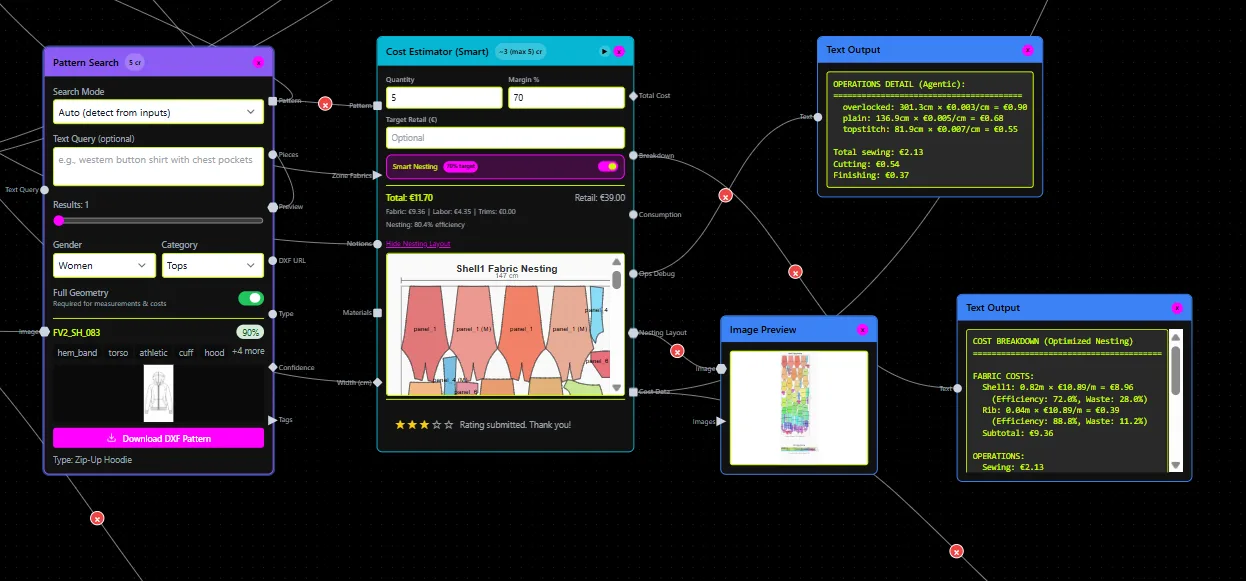
The brand had been operating for years with a substantial digital pattern library, thousands of .DXF files spread across shared drives, folder structures that varied by season and team, and tech pack PDFs that frequently didn't match the patterns they were supposed to describe.
The product development team was producing 1,000+ SKUs per season across multiple categories. Despite years of accumulated assets, pattern makers routinely started new styles from scratch. Finding a relevant base block took longer than drafting a new one. Nobody could tell which version of a jacket bodice was the approved production file, and which was a pre-fit draft from three seasons ago.
The hidden cost was significant. According to fashionINSTA's data from enterprise customers, traditional pattern library maintenance runs $100,000 to $500,000 annually in rework, storage overhead, and specialist labor, costs that rarely appear as a single line item but surface instead as missed deadlines and extra sampling rounds.
Sylwia Szymczyk, CEO of fashionINSTA, has spoken directly about this pattern: "Brands are sitting on years of competitive advantage locked inside .DXF folders. They can't search it, can't score it, can't reuse it intelligently. So teams recreate it, season after season."
The challenge: scale without a system
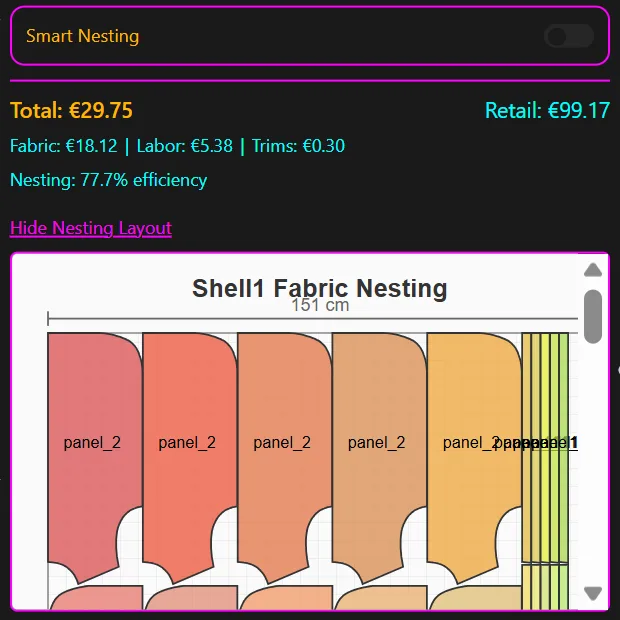
The brand's product development head framed the problem precisely: the team was not short of patterns. It was short of a way to make those patterns findable, comparable, and reusable. Every new season triggered the same cycle, designers submitted briefs, pattern makers searched manually through archives, gave up, and started drafting. Carryover decisions took weeks of manual review. Similarity between existing styles was invisible until someone happened to spot it during a physical review.
For a brand at 1,000+ SKUs, this is not an inconvenience. It is a structural drag on every development cycle. McKinsey's analysis of AI in fashion has estimated that generative AI could add $150 to $275 billion to apparel operating profits, but that number only materializes when AI is applied to the actual production pipeline, not layered on top of broken processes.
The team needed an approach that would work with their existing archive, not replace it, and that would produce results measurable enough to justify rollout across categories.
The approach: training AI on 15 years of brand data
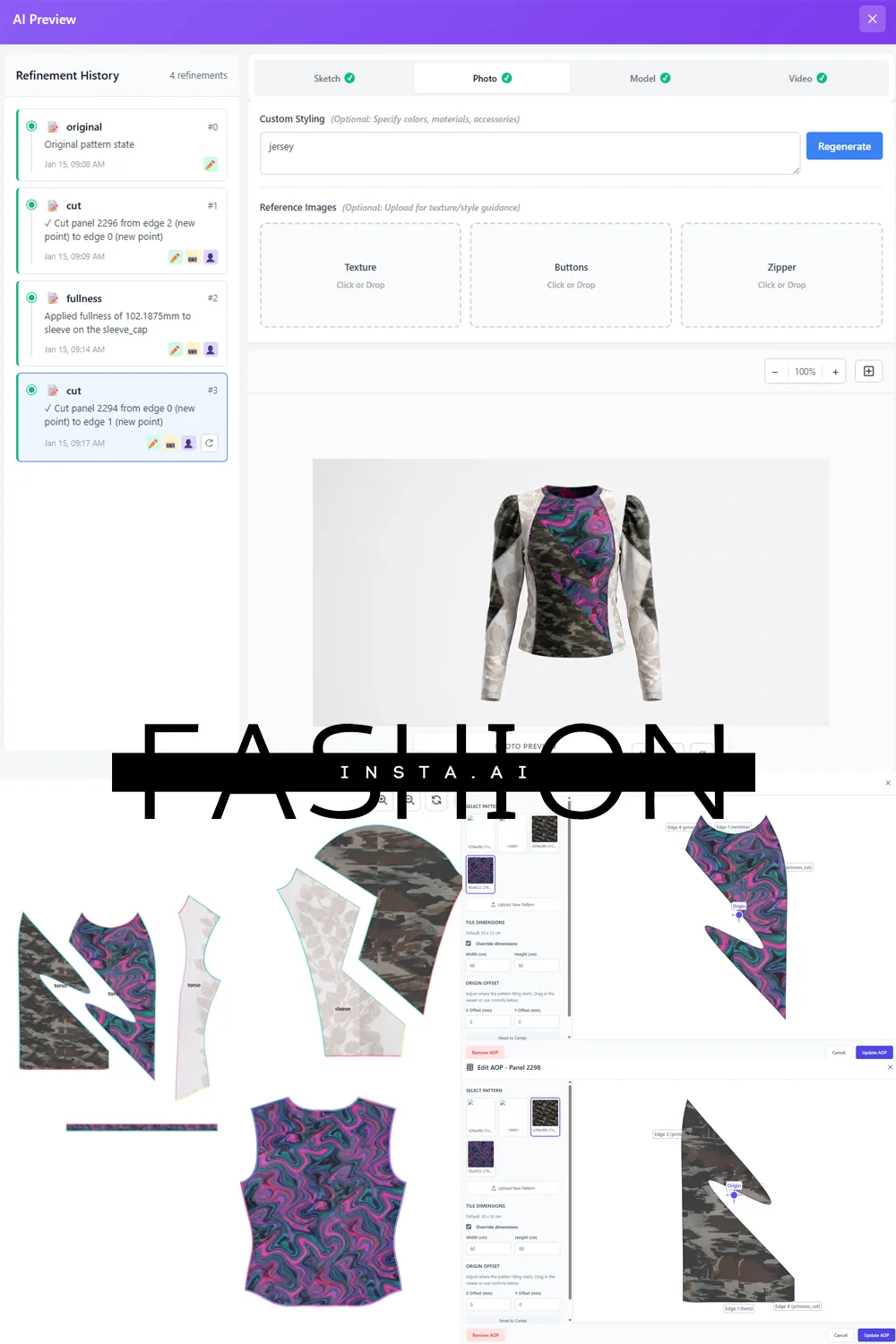
The brand entered a scoped 10-week proof-of-concept with fashionINSTA, starting with one garment category: outerwear. The process began with data collection, sharing .DXF files, tech packs, and archival sketches with fashionINSTA's team. fashionINSTA handled data cleaning and ingestion.
Over the first four weeks, fashionINSTA trained a dedicated AI model on the brand's pattern library. The platform extracted 750+ construction features per pattern, covering armhole geometry, ease distribution, pocket placement logic, collar construction, and grading increments. The result was not a generic template system. It was a searchable, scored index of the brand's own intellectual property, organized in a way no folder structure could achieve.
The brand's data was held on a dedicated AWS instance, with no cross-client training and no IP shared across fashionINSTA's system. Every output traces back to the brand's own approved construction blocks.
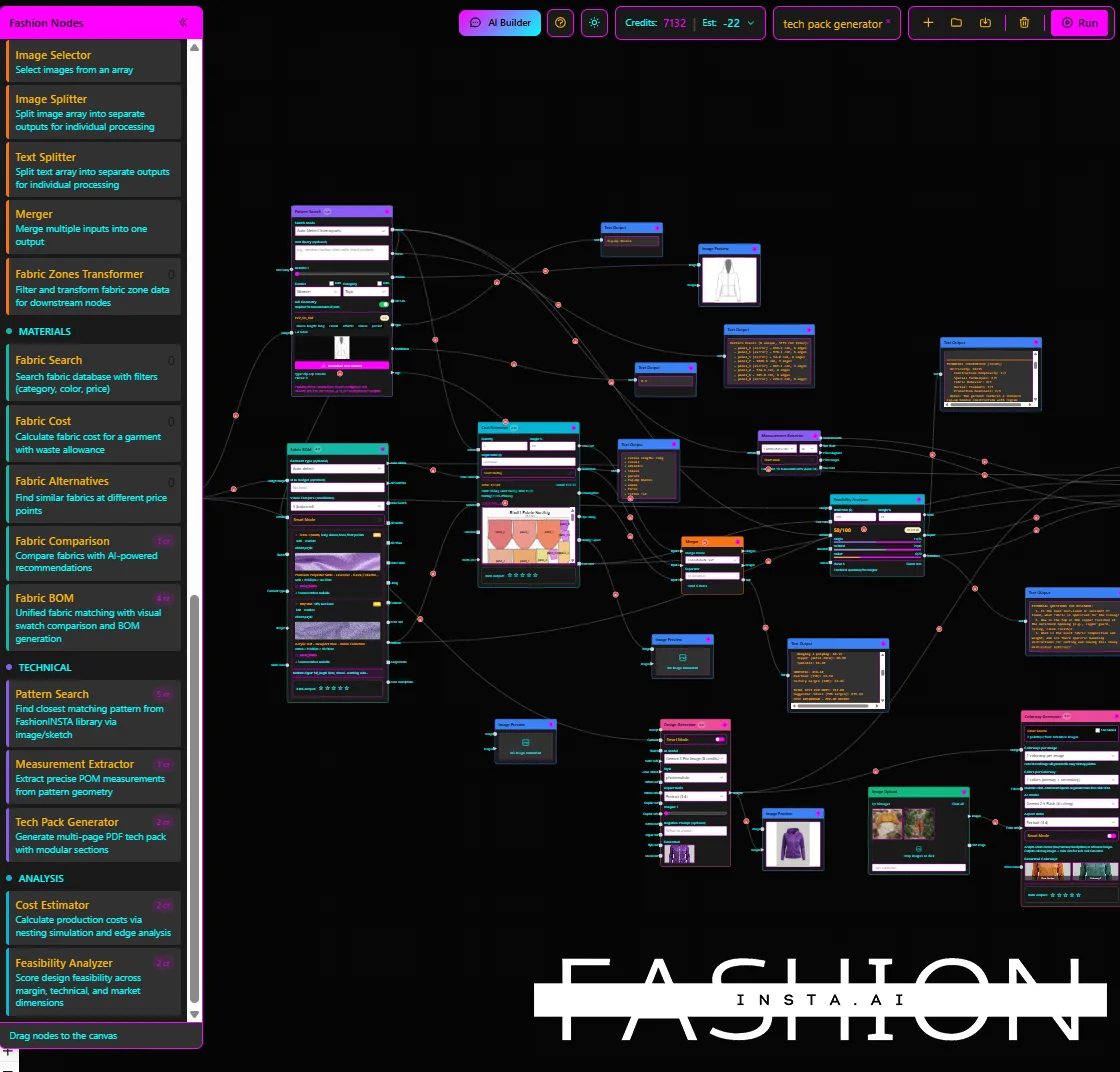
During the six-week active trial, three capabilities changed the team's daily workflow.
Pattern matching, not pattern recreation. When a designer submitted a new brief, the platform identified the closest existing match from the archive, not just by visual similarity, but by operational proximity: which existing garment required the fewest CAD operations to reach the desired result. Pattern makers stopped starting from zero. They started from the best available base.
Automatic carryover evaluation. For carry-over styles, the platform scored existing garments against current season criteria, market relevance, colour availability, fit history, and surfaced recommendations without requiring manual review. The JD Sports enterprise use case ran the same logic at scale: 470 out of 500 submitted design ideas were filtered out overnight before a single product developer touched them.
Real-time geometry-driven updates. Every pattern modification automatically updated both the technical sketch and a realistic garment preview. Buyers and commercial teams could review production-accurate visuals rather than mood board renders, compressing the approval cycle.
The results: four months to four weeks
At the week-10 review, the numbers were clear.
The product development cycle for the outerwear category shortened from four months to four weeks. Pattern recreation time dropped by 70%, consistent with fashionINSTA's platform-wide benchmark derived from enterprise customer deployments. A style that previously required 7 to 8 hours of manual drafting in Gerber AccuMark was reaching production-ready .DXF output in under 10 minutes.
The revision cycle, historically one of the largest hidden time sinks, collapsed. A design change that previously triggered a 45-minute correction cycle resolved in approximately 90 seconds inside the fashionINSTA workflow, as documented in the platform's sketch-to-production case study.
Carryover processing, which had consumed weeks of manual review, became an overnight automated run. Teams arrived in the morning with a scored, ranked shortlist.
The brand also regained technical ownership. Patterns developed through fashionINSTA traveled with the garment to manufacturers, so the same style produced across two different factories maintained fit consistency, a problem the brand had previously managed through intensive factory communication and corrective sampling.
Duplicate patterns in the archive surfaced through the similarity scoring system. The team found that roughly a quarter of their active library contained near-identical blocks that had been independently drafted across seasons, each one representing wasted hours the archive had never previously been able to flag.
What the team said
"Your generic patterns are good, but if I use them, I risk losing the fit consistency that took us 20 years to perfect. Can you train your AI on our pattern database instead?"
That question, asked by a pattern maker during fashionINSTA's beta phase, is what shaped the platform's enterprise architecture. The brand in this case study arrived with the same concern. The answer, a tenant-isolated, brand-specific training model rather than a generic AI layer, is what made adoption viable at the product development director level, not just the pattern room.
For teams at the intersection of design and technical product development, the value was immediate. Pattern makers shifted from manual searching and re-drafting toward review and calibration. Product developers spent less time chasing files and more time evaluating commercially viable ideas.
The lessons that transfer
For any enterprise brand managing 500+ SKUs per season, three takeaways from this deployment are worth applying directly.
Your archive is already an asset. The patterns you have accumulated represent years of fit development. The gap is not a lack of data, it is a lack of infrastructure to make that data searchable and operational. Addressing the hidden time drain in pattern rooms starts with treating your .DXF library as an intelligence asset rather than a storage folder.
Duplication is invisible until it is scored. Most enterprise pattern archives contain significant redundancy that nobody can see. A similarity-scoring system surfaces this within weeks of ingestion. That visibility alone changes how teams make carryover decisions and how quickly new styles reach production. The pattern inconsistencies draining development budgets are rarely spotted manually.
Speed without fit lock-in is not useful. The 70% reduction in pattern creation time only holds because fashionINSTA's model trains on approved, production-tested patterns. Fit parameters are locked by default, the platform applies only operations that change design, not fit. This is the distinction between a productivity tool and a pattern intelligence system. Why traditional pattern making fails enterprise brands covers this architecture in more depth.
The brands that get the most from this approach, as the JD Sports deployment demonstrated, are the ones that commit to a scoped proof-of-concept on real data, with agreed KPIs, rather than evaluating AI against demo datasets. The ROI becomes visible within the 10-week window. The decision to roll out or not is grounded in production-level evidence, not vendor claims.
For teams ready to stop rebuilding patterns they already own, fashionINSTA's enterprise pattern archive ROI approach details how the value compounds across categories as the AI model learns.