Transitioning from Pattern Maker to Designer
TL;DR: Transitioning from a pattern maker to a designer means expanding beyond technical execution into concept development and collection planning. This guide maps out realistic timelines—from six to 24 months—for building a portfolio that showcases both your construction expertise and your creative vision. By stacking the right skills and using modern digital tools, you can successfully make this career shift without leaving your current job.

You already know how a garment is built. You can read a block, spot a fit problem across a room, and grade a size run without thinking twice about it. The question isn't whether you have the technical foundation, it's how long it takes to layer design thinking, concept development, and presentation skills on top of that foundation so employers see you as a designer, not just the person who executes someone else's sketch.
There's no single answer, and anyone who gives you one number without context is oversimplifying. What follows are three realistic paths, the specific skills you need to stack in order, and a project cadence you can actually follow. This guide is for working pattern makers, technical designers, and CAD specialists who want a structured, honest answer instead of a marketing timeline.
What "transition" actually means here
Before any timeline makes sense, you need a working definition of "designer." It's not a title change. A designer is someone who can originate a concept, translate it into a coherent visual and verbal story, sketch and iterate quickly, plan a cohesive small collection, and hand off (or produce) spec-ready technical documentation that a factory can actually build from.
That last part is where pattern makers have a real edge that's often underrated. Design schools spend years teaching draping and concept work but comparatively little time on construction logic. You already have that. What you're missing is the front half of the process: concept, sketching fluency, trend interpretation, and collection storytelling.
So when we talk about a transition timeline, we're talking about the time it takes to build a portfolio and a skill set that proves you can do both halves of the job, not just the technical one.
Three realistic timelines, and what "done" looks like in each
FashionINSTA's own earlier guidance on this topic pointed to an 18-24 month window as a general benchmark. That's a reasonable average, but it flattens a decision that really depends on your hours per week, your starting point with sketching and CAD, and how aggressively you're job-hunting along the way. Here are three paths built around outcomes, not just calendar time.
Short path: 6 months
This works if you can commit 10-15 hours a week, you already have some comfort with a 3D or CAD tool, and your goal is a lateral move into a hybrid design-tech role rather than a pure creative director track. By month 6 you should have one finished capsule (4-6 looks), a working sketch practice, and one production-ready tech pack you can show in an interview.
Medium path: 12 months
This is the most common realistic path for someone working full-time with 8-10 hours a week available for skill-building. By month 12 you're aiming for two capsules or one capsule plus a secondary category (accessories, outerwear, knitwear), a fabric and color strategy that ties the work together, and your first freelance design inquiry or small paid gig.
Long path: 18-24 months
This matches the range FashionINSTA's earlier career guide cited, and it fits people building toward a true junior or associate designer role at a brand with a defined design department, or anyone starting from closer to zero on sketching and concept work. The payoff is a deeper portfolio narrative: one or two broader collections, evidence of concept-to-sample thinking, and a body of work that can survive scrutiny from a creative director, not just a technical reviewer.
None of these timelines assume you quit your day job. Most people who make this switch successfully do it while still working as a pattern maker or technical designer, which is actually an advantage: you're paid to stay sharp on construction while you build the design layer on your own time.
The skill map: what to learn, in what order
Trying to learn everything at once is the most common way this transition stalls out. Work through these roughly in order, though the later ones overlap.
Sketching and design communication. This is priority one because it's the visible proof of design thinking. You don't need illustration-school polish. You need consistent proportions, clear silhouette communication, and the ability to sketch three variations of an idea in ten minutes. Daily 15-20 minute sketch sessions for 8-12 weeks will move you further than sporadic long sessions.
Draping and form translation. Drafting and draping solve different problems. Drafting builds a pattern from measurements and math; draping lets you shape fabric directly on a form to discover silhouette in three dimensions, which is closer to how designers actually think about volume and movement. If you've only drafted, spend a few weeks on basic draping, even in miniature or on a dress form, to build that instinct.
Digital workflow and visual iteration. Tools like CLO 3D or Marvelous Designer let you test drape, proportion, and fabric behavior digitally before committing to a physical sample, which speeds up how many design ideas you can test in a week. Pair this with a faster path from sketch to spec-ready output, which is where a platform like fashionINSTA fits into a pattern maker's existing toolkit.
Trend research and concept development. A design needs a reason to exist. Practice building a one-page concept brief for every project: inspiration references, color story, silhouette direction, and the customer you're designing for. This is a muscle, and it gets stronger with repetition, not theory.
Collection planning. A capsule isn't five random garments. It's a scoped, cohesive set with a shared color palette, fabric logic, and sizing range that reads as intentional. Learn to plan a capsule brief before you start sketching individual pieces.
Portfolio-ready execution. Every project needs a presentation board, technical flats, and some proof of construction, whether that's a sample photo, a toile, or a detailed spec sheet.
Role readiness. The final layer is tailoring your existing work to what junior designer job postings actually ask for, which is usually a mix of sketching, Adobe Illustrator flats, trend awareness, and basic tech pack literacy.
A project cadence you can actually stick to
Progress stalls when "practice" has no deliverable. Build your calendar around mini-projects that end in something you can put in a portfolio, on a 2-4 week cycle.
Months 1-2 (any path): Pick one existing pattern block you know well and redesign it into three silhouette variations. Change the neckline, sleeve, or hem treatment. This uses your pattern-maker advantage directly: you're not starting from a blank page, you're iterating from a known-good foundation.
Months 3-4: Build your first capsule brief (concept, palette, 4-6 looks) and take it through sketch to technical flat. This is your short-path milestone if you're on the 6-month track.
Months 5-8: Add a fabric and costing strategy to your capsule. Start reaching out for small freelance design work, even unpaid or low-paid first gigs, to get outside feedback on real briefs.
Months 9-14: Build a second capsule or a secondary category. Refine your presentation boards. This is where medium-path readers should be assembling their first interview-ready packet.
Months 15-24: Expand into a broader collection narrative, apply for junior designer and design assistant roles, and use any freelance work as proof of concept-to-sample thinking.
A warning worth flagging here: don't let tech-pack perfectionism eat your design time. It's tempting, especially for pattern makers, to over-invest in flawless specs at the expense of sketch volume and concept variety. Reviewers hiring for design roles want to see range and idea generation as much as technical precision.
Building a portfolio that actually gets interviews
Portfolio requirements vary by employer, but the pattern is consistent across fashion programs and hiring managers alike. FIT's Fashion Design AAS portfolio requirements, for example, ask for an essay, two design projects, and a sewing project, with sketches drawn on figures the applicant drew themselves (no tracing), plus fabric swatches and garment photos. That structure, an essay-style intent, original design work, and construction proof, is a good template for a career-switcher portfolio too.
Aim for 5-8 strong projects rather than a large volume of mediocre ones. Each project should show a process, not just a final image: concept and inspiration, sketch iterations, a technical flat, a swatch or fabric reference, and a finished look photo or render. Reviewers are hiring for how you think, and the process pages are what prove that.
When you're ready to apply, target three tracks in parallel: junior designer or design assistant roles, freelance capsule or collection gigs, and in-house hybrid design-and-tech roles, which are often the easiest entry point for someone with your pattern background. That third category deserves attention: many brands are actively looking for people who can sketch and also understand construction and specs, because that combination reduces miscommunication between design and production teams.
Your application checklist should include: a PDF portfolio under 15-20MB (or a clean, fast-loading web link), a one-page resume that foregrounds design and concept work without hiding your technical background, 3-5 tailored project selections per employer type, and a short cover note that explains your transition story in two or three sentences. Don't bury your pattern-making experience. Frame it as a differentiator, not a past life.
Where the timeline actually gets shorter
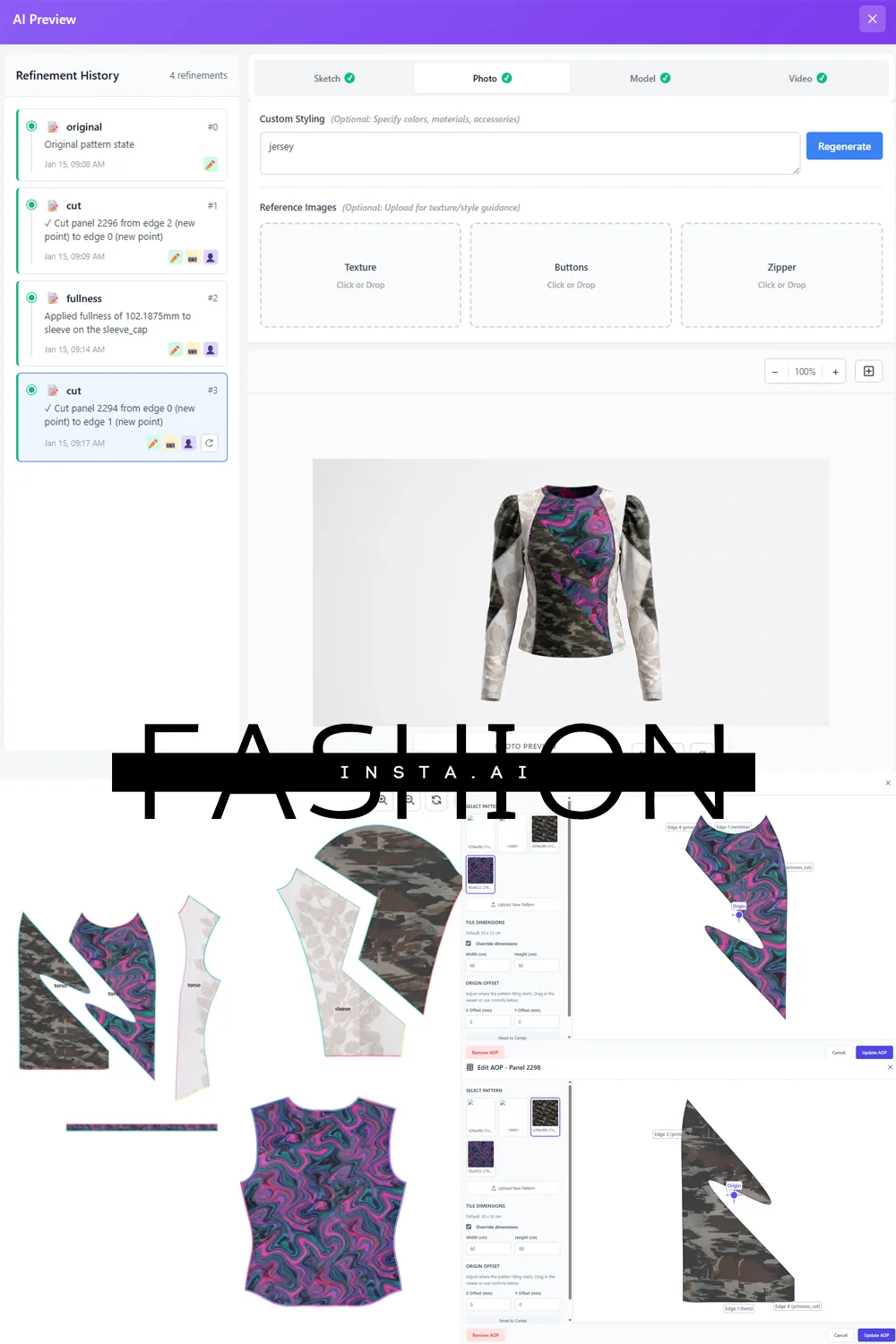
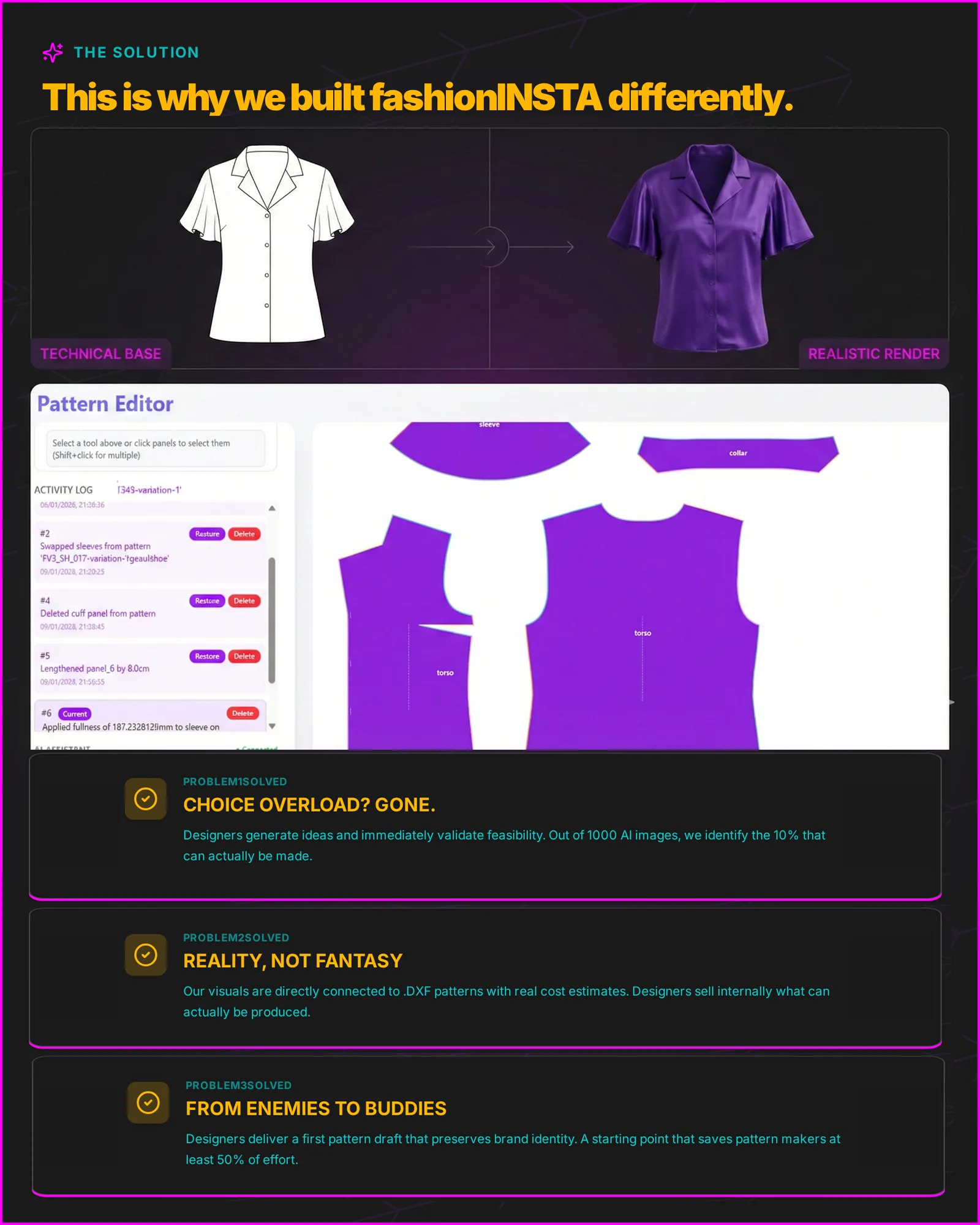
The biggest time sink in this transition usually isn't sketching or concept work, it's the hours lost redoing pattern drafts, chasing grading corrections, and rebuilding tech packs from scratch every time a design changes. That's exactly the bottleneck fashionINSTA's pattern intelligence workflow is built to remove.```plaintext
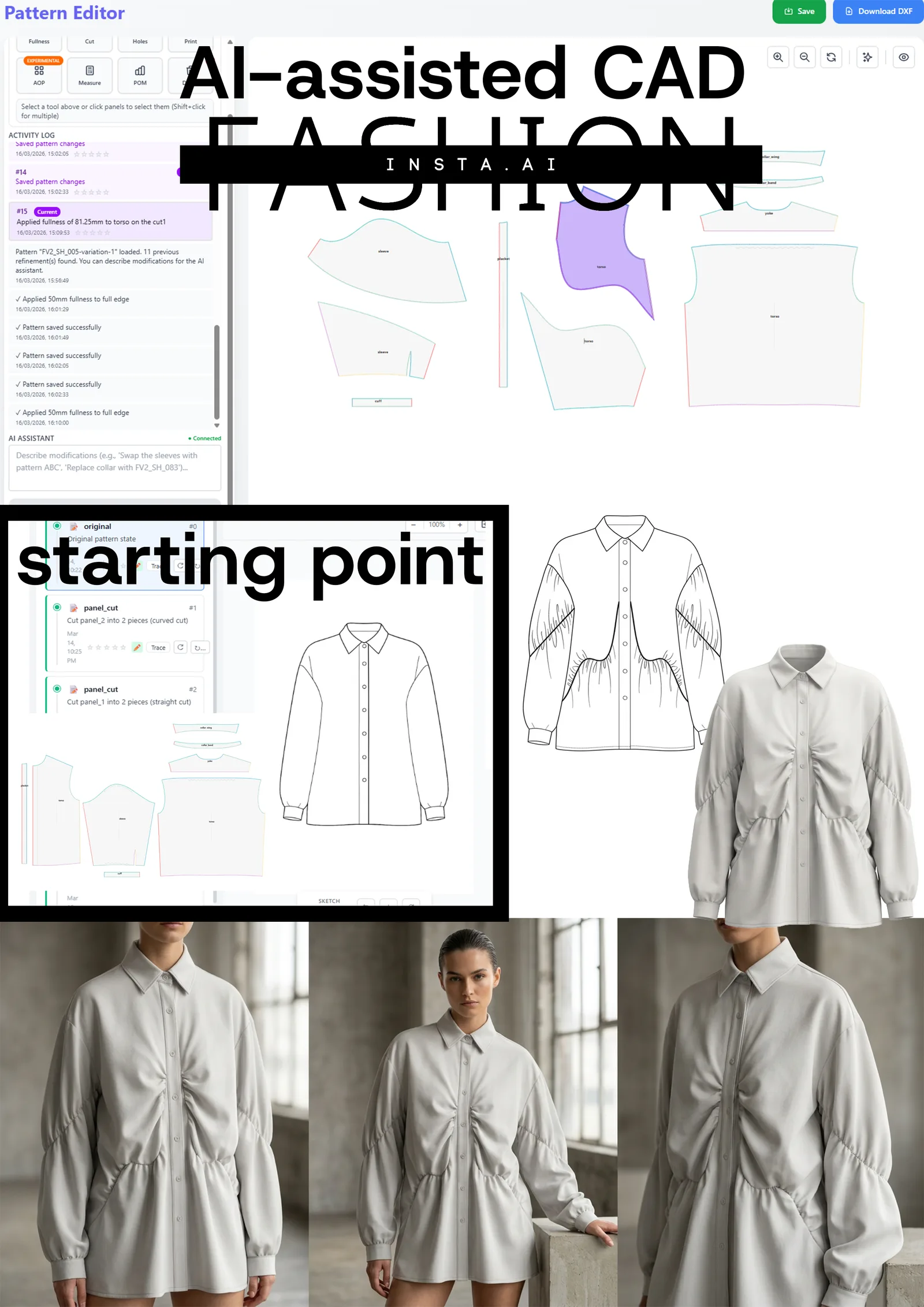
Here's how it maps onto the project cadence above. Instead of manually redrafting a block for every silhouette variation in your first capsule, the Pattern Generator node retrieves the closest matching pattern from your library or, once custom-trained on your own archive, generates new patterns while preserving fit-critical geometry like necklines and armhole shapes. Every output is a CAD-compatible [.DXF file](https://fashioninsta.ai/blog/ai-pattern-tools-transform-garment-development-complete-guide-2026), so it drops straight into the CAD software you already use.

Once a silhouette is locked, the Tech Pack Compiler auto-generates measurements and construction notes instead of you rebuilding a spec sheet by hand for every iteration. The BOM Agent returns real fabric names, compositions, prices, and MOQs from an actual fabric shop rather than placeholder swatches, and the Cost Estimator and Feasibility Analyzer flag manufacturability and pricing issues before you're deep into sampling, not after.

For pattern makers custom-training the system on their own archive, the enterprise proof-of-concept process is documented at roughly 70-150 patterns collected, about 2 weeks of training and data cleaning, and a 6-week [tryout window](https://fashioninsta.ai/waitlist?utm_source=BLOG&utm_medium=blog_post_join_waitlist&utm_id=blog_post), with an approximate 80% accuracy claim when the training data is correct. That's [fashionINSTA](https://www.fashioninsta.ai/what-is-fashioninsta/?utm_source=BLOG&utm_medium=blog_post_what_is_fashioninsta&utm_id=blog_post)'s own product benchmark, not an independent study, and it's worth treating it that way when you're evaluating fit for your own workflow. The Enterprise PoC itself runs as a 10-week program for one category, priced between €5,000 and €15,000 one-time, while the annual Fashion Complete OS tier (€23,900/year/seat) adds custom nodes and API connectivity for teams scaling this beyond a single category.

The practical effect for someone on the pattern-to-designer track: every hour you don't spend manually redrafting a collar or rebuilding a tech pack from a spreadsheet is an hour you can spend sketching a fourth silhouette variation, refining your capsule's color story, or polishing a presentation board. That's the difference between a portfolio that looks rushed and one that looks intentional.

## A resource stack organized by skill gap

Don't try to learn everything from one source. Match the resource to the specific gap.

For sketching and proportion, daily figure and flat-sketching practice beats any single course; look for croquis templates and commit to a fixed time slot. For draping, a basic draping course (in-person or video-based) will get you further in a few weeks than months of self-guided trial and error. For trend and concept development, trend-forecasting newsletters and mood-board practice using real seasonal references build the muscle faster than reading theory. For CAD/3D visualization, structured tutorials in CLO 3D or Marvelous Designer are worth the time investment since these tools have real learning curves. For portfolio presentation, study actual hired-designer portfolios in your target category rather than generic templates. For job search systems, build a simple tracking sheet with employer type, submission date, and tailored project selections, so you're not reassembling your packet from scratch every time.

Useful templates to build for yourself: a one-page capsule brief template (concept, palette, silhouette direction, customer), a tech pack checklist so nothing gets missed before a submission, a portfolio index page that maps each project to the skill it demonstrates, and a short interview rubric where you note what each interviewer seemed to care about, so you can adjust your pitch over time.

Communities matter more than most people expect here. Patternmaking and digital fashion forums, CAD/3D-specific groups, and portfolio-review swaps with other career switchers give you outside eyes on your work before a hiring manager sees it, which catches blind spots faster than working alone.

## Where you'll likely be at each checkpoint

By month 6, expect one finished capsule, a sketching habit, and your first tech-pack-to-spec deliverable. By month 12, expect two cohesive bodies of work, a fabric and costing point of view, and your first freelance inquiry or small paid project. By month 18-24, expect an interview-ready portfolio packet, proof of concept-to-sample thinking, and active applications for junior designer or hybrid design-tech roles.```plaintext
The timeline bends based on your hours, your starting CAD literacy, and how much of the repetitive drafting and spec work you can offload. Your construction background isn't a handicap here, it's the part most design-school graduates spend years trying to catch up on. Use it.
If you want to see how removing the pattern-and-tech-pack bottleneck fits into your own weekly practice plan, fashionINSTA's pattern drafting overview walks through the specific tools professionals combine for this exact kind of workflow.