Fashion Designer vs. Pattern Maker Salary Comparison
TL;DR: Pattern makers and fashion designers both play essential roles in garment production, but their compensation varies widely based on location, experience, and industry segment. While fashion designers often have a higher salary ceiling at the senior level, pattern makers earn a highly competitive and consistent median wage. Emerging AI tools are further shifting these dynamics by accelerating workflows and increasing the value of technical expertise for both roles.

The question sounds simple: do pattern makers earn more or less than fashion designers? The answer depends heavily on which country you're looking at, which data source you trust, and where a person sits on the seniority ladder. Both roles are essential to getting a garment into production, but they're measured differently across labor markets, which means direct salary comparisons require some care with the numbers.
A few things are worth setting up before diving in. Official occupational statistics (like those from the US Bureau of Labor Statistics) report median wages across all workers in a code, regardless of experience. Job-profile ranges from bodies like the UK's National Careers Service give starter-to-experienced bands. Crowdsourced platforms (Glassdoor, Payscale, Indeed) aggregate self-reported salaries and tend to skew toward active job seekers. None of these measures the same thing, so treat comparisons across sources as directional, not precise.
The headline takeaway: pattern makers earn a solid, consistent wage that holds up well against fashion designer pay at the median level. Fashion designers show a wider range overall, with higher upside at senior and brand-lead levels, but also a wider spread at the lower end.
US median salaries: what the BLS data shows
For the United States, the Bureau of Labor Statistics Occupational Employment and Wage Statistics program provides the most authoritative side-by-side comparison available.
Fashion Designers (SOC 27-1022): The BLS Occupational Outlook Handbook (updated August 2025, reflecting May 2024 data) reports a median annual wage of $80,690. The May 2023 OEWS data shows the full spread: $37,090 at the 10th percentile, $58,440 at the 25th, $79,290 at the 50th (median), and $107,260 at the 75th percentile. That's a wide band, the gap between the bottom quarter and the top quarter is roughly $70,000.
Fabric and Apparel Patternmakers (SOC 51-6092): The May 2023 OEWS data puts the median annual wage at $62,510, with a median hourly rate of $30.05. The 10th percentile sits at $15.28/hour (approximately $31,780 annually), which is considerably lower than the designer floor.
So the raw US gap at the median is roughly $18,000–$20,000 in favor of fashion designers, depending on which release year you use. That said, the top-end pattern maker wage closes that gap considerably for specialists with CAD expertise and grading skills.
For state-level context: both roles concentrate in coastal hubs. New York and California dominate employment for fashion designers, with correspondingly higher wages. Florida sits closer to the national median for both roles; pattern maker salary in Florida and fashion designer salary in Florida both reflect the state's more manufacturing-oriented, mid-market industry mix rather than the luxury-tier concentration you'd find in New York.
UK salary ranges: National Careers Service and market aggregators
The UK doesn't publish BLS-style occupational medians for these roles from a single official source, so the National Careers Service (NCS) occupational profiles provide the most consistent publicly available comparison.
Pattern cutter (UK): NCS lists a starter salary of £22,000 rising to £35,000 for experienced workers.
Fashion designer (UK): NCS lists a starter salary of £24,000 rising to £40,000 for experienced workers.
The gap at both ends is modest: roughly £2,000 at starter level and £5,000 at the experienced end. Glassdoor UK data broadly aligns with this range, though self-reported averages on crowdsourced platforms tend to pull slightly higher for designers working in London versus the national average. The pattern cutter salary on Glassdoor UK similarly clusters around the NCS midpoint for roles outside London, with London premiums adding 15–20% on top in practice.
EU salary context: why a single figure doesn't exist
For EU countries, there's no harmonized, BLS-equivalent occupational median for "fashion designer" or "pattern maker" published across the bloc. Each member state uses its own occupational classification and earnings survey methodology.
The most useful EU-wide anchor is the Eurostat average annual full-time adjusted salary figure: in 2021, this stood at €33,500 across all employees in the EU (European Commission / Eurostat, December 2022). That's a broad economy-wide average, not occupation-specific, but it provides context: a mid-career fashion designer or pattern maker in a major EU fashion hub (Milan, Paris, Amsterdam) typically earns above this benchmark, while roles in lower-wage EU labor markets may sit close to it or below.
For EU readers seeking occupation-specific figures, country-level national statistics agencies or local versions of salary aggregators (e.g., Glassdoor France, StepStone Germany) are the practical alternative. An EU-wide "fashion designer median salary" figure that claims precision should be treated skeptically.
Salary by seniority and employment type
Using BLS percentile bands as a proxy for experience levels (keeping in mind these aren't direct experience categories):
| Level (proxy) | Fashion Designer (US) | Pattern Maker (US) |
|---|---|---|
| Entry-ish (10th–25th pct) | $37,090–$58,440 | ~$31,780–$46,000 est. |
| Mid (50th pct / median) | $79,290–$80,690 | $62,510 |
| Senior-ish (75th pct) | $107,260 | ~$78,000–$85,000 est. |
For UK ranges (NCS bands):
| Level | Fashion Designer (UK) | Pattern Cutter (UK) |
|---|---|---|
| Starter | £24,000 | £22,000 |
| Experienced | £40,000 | £35,000 |
Freelance vs. in-house: Freelance pattern makers and designers often quote higher hourly rates than their salaried equivalents suggest, sometimes $40–$80/hr for experienced US freelancers. But that premium is offset by unpaid downtime between projects, self-funded health insurance, tax obligations, and the administrative overhead of running a sole proprietorship. Net annual income for freelancers often lands closer to in-house midpoints than the headline hourly rate implies, particularly for those without a strong repeat-client network.
What actually drives the pay gap
Several factors account for most of the difference between pattern maker and fashion designer compensation, regardless of market.
Location and industry cluster. Both roles pay more in fashion capitals. New York and Los Angeles pay significantly above the US national median for both codes. London adds a comparable premium in the UK. The industry segment matters just as much: luxury and premium brands pay more than mass-market or fast-fashion employers for both roles, but the gap is amplified at the senior designer level where creative direction intersects with brand economics.
Seniority and scope. Senior fashion designers who move into creative director or brand director roles take on strategic ownership that commands higher compensation. Senior pattern makers who specialize in fit consistency, grading automation, or production-ready technical packages can earn meaningful premiums, but the ceiling is typically lower than the creative leadership track.
Industry mix. Manufacturing-integrated patternmaking in a production environment is often valued differently from design-studio patternmaking. A pattern maker embedded in a factory or tight production operation may earn differently than one working in a design studio on sampling.
Union coverage and bargaining. Union membership varies significantly by country and sector. In unionized environments (more common in some EU countries and legacy US manufacturing segments), base pay floors and benefits can be notably higher than non-union equivalents. This can compress the visible salary gap between roles.
For more on how AI vs. traditional pattern grading compares on cost and time in production, the dynamics are worth understanding alongside compensation data.
How AI tools are changing the effective cost of both roles
The salary numbers above reflect what employers pay a person in a defined role. What they don't capture is how much output that person produces per dollar. This is where AI-assisted workflows are starting to shift the equation, and it's relevant to anyone thinking about compensation trends for both roles over the next few years.
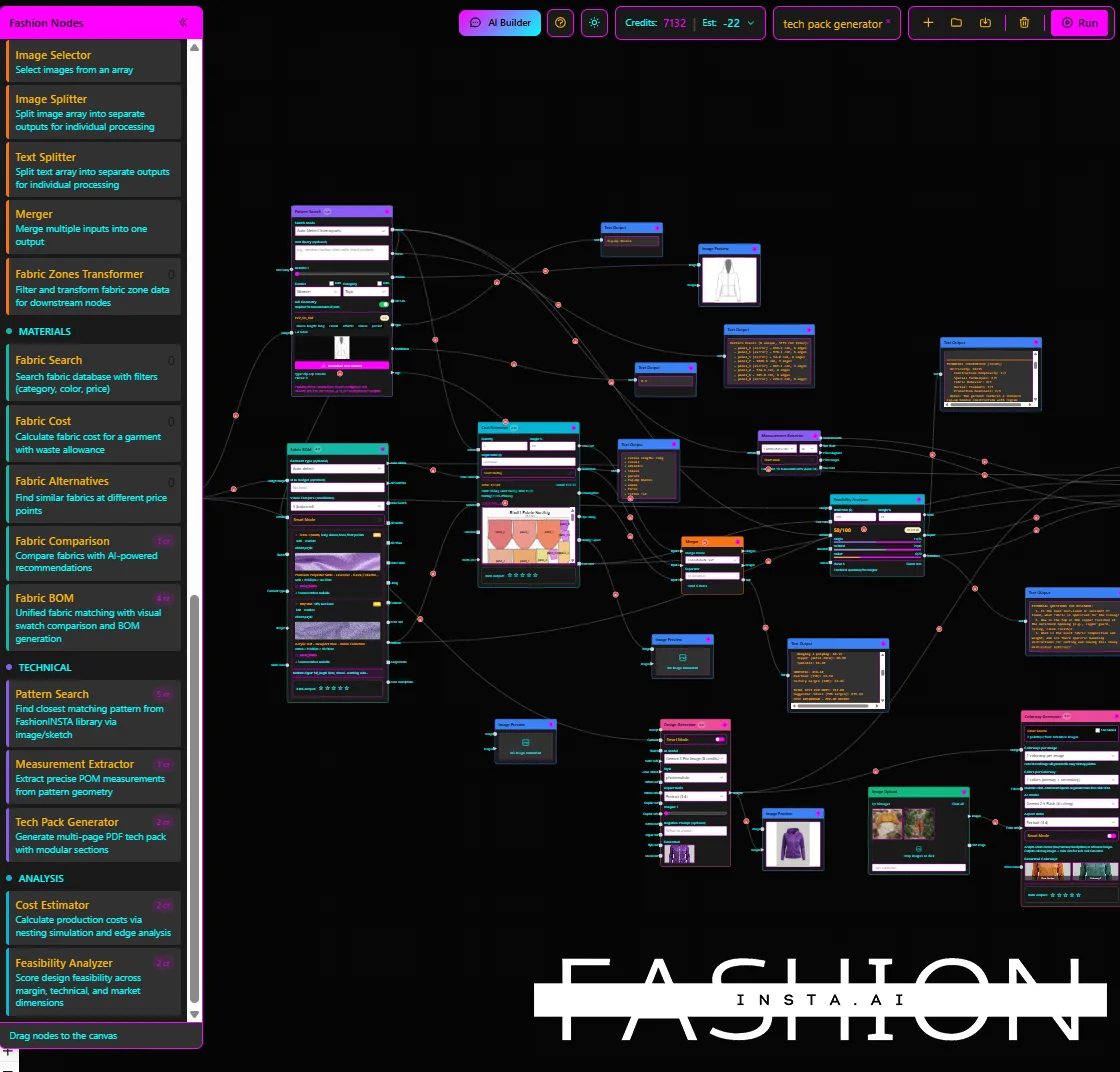
Pattern making and technical documentation are where productivity tools have the most direct effect on workflow throughput. Platforms like FashionINSTA, built around a "make real garments, not just pretty pictures" approach, accelerate the pattern development cycle by generating CAD-compatible .DXF outputs directly from design inputs. The platform claims a 4x faster product development cycle and 10x faster first draft, with nodes for BOM generation, cost estimation, feasibility analysis, and tech pack compilation running in sequence rather than as separate handoffs between roles.
For brands, this changes the effective labor cost calculation: a pattern maker who can validate and adapt AI-generated outputs against fit standards and manufacturing constraints is worth more per unit of time, not less. The traditional fashion design costs article breaks down where those hidden time costs accumulate. An AI tech pack compiler that reduces rework and feasibility surprises doesn't replace the judgment of an experienced pattern maker or designer; it concentrates their value on higher-leverage decisions.
This also has implications for the designer vs. pattern maker pay gap specifically. As routine CAD and documentation tasks become faster, the premium for human roles shifts toward people who can interpret AI outputs critically, catch construction errors before sampling, and maintain brand fit DNA across collections. Those skills exist in both job titles, but they're not evenly distributed.
The traditional vs. AI pattern making comparison covers the scale dimension in more detail if you want to see how this translates at a collection level.
Quick-reference comparison table and source notes
| Market | Role | Median / Mid-range | Source |
|---|---|---|---|
| US | Fashion Designer | $80,690 (median) | BLS OOH, May 2024 |
| US | Fabric & Apparel Patternmaker | $62,510 (median) | BLS OEWS, May 2023 |
| UK | Fashion Designer | £24,000–£40,000 | National Careers Service |
| UK | Pattern Cutter | £22,000–£35,000 | National Careers Service |
| EU | All employees (benchmark) | €33,500 avg (2021) | Eurostat / European Commission |
A note on interpreting these figures: BLS medians are calculated from employer payroll records and represent the midpoint for all workers in a code, regardless of experience, industry segment, or geography. NCS ranges are job-profile estimates, not survey medians. Glassdoor and Payscale figures are self-reported and may overrepresent active job seekers. Title mismatch is a real issue: "patternmaker," "pattern technician," "pattern cutter," and "sample room technician" can refer to overlapping or identical duties depending on the employer, which means some workers in those roles may be captured under different codes in official datasets.
Primary sources: US Bureau of Labor Statistics, Occupational Outlook Handbook: Fashion Designers (updated Aug 2025); BLS OEWS SOC 27-1022 (May 2023); BLS OEWS SOC 51-6092 (May 2023); National Careers Service: Pattern Cutter; National Careers Service: Fashion Designer; Eurostat / European Commission average earnings indicator (Dec 2022, referencing 2021 data).
For a deeper look at which fashion career path pays more across experience levels, the role-by-role breakdown covers the full career arc in more detail.