Eliminating Technical Busywork in Fashion Product Development
TL;DR: Fashion designers lose countless hours to technical busywork, such as re-exporting patterns and formatting tech packs, which derails the creative process. FashionINSTA provides an automated, node-based workflow that eliminates these manual tasks, enabling faster production cycles and reducing errors. By integrating AI-driven pattern retrieval, BOM agents, and feasibility checks, brands can streamline their product development from pilot to full production.
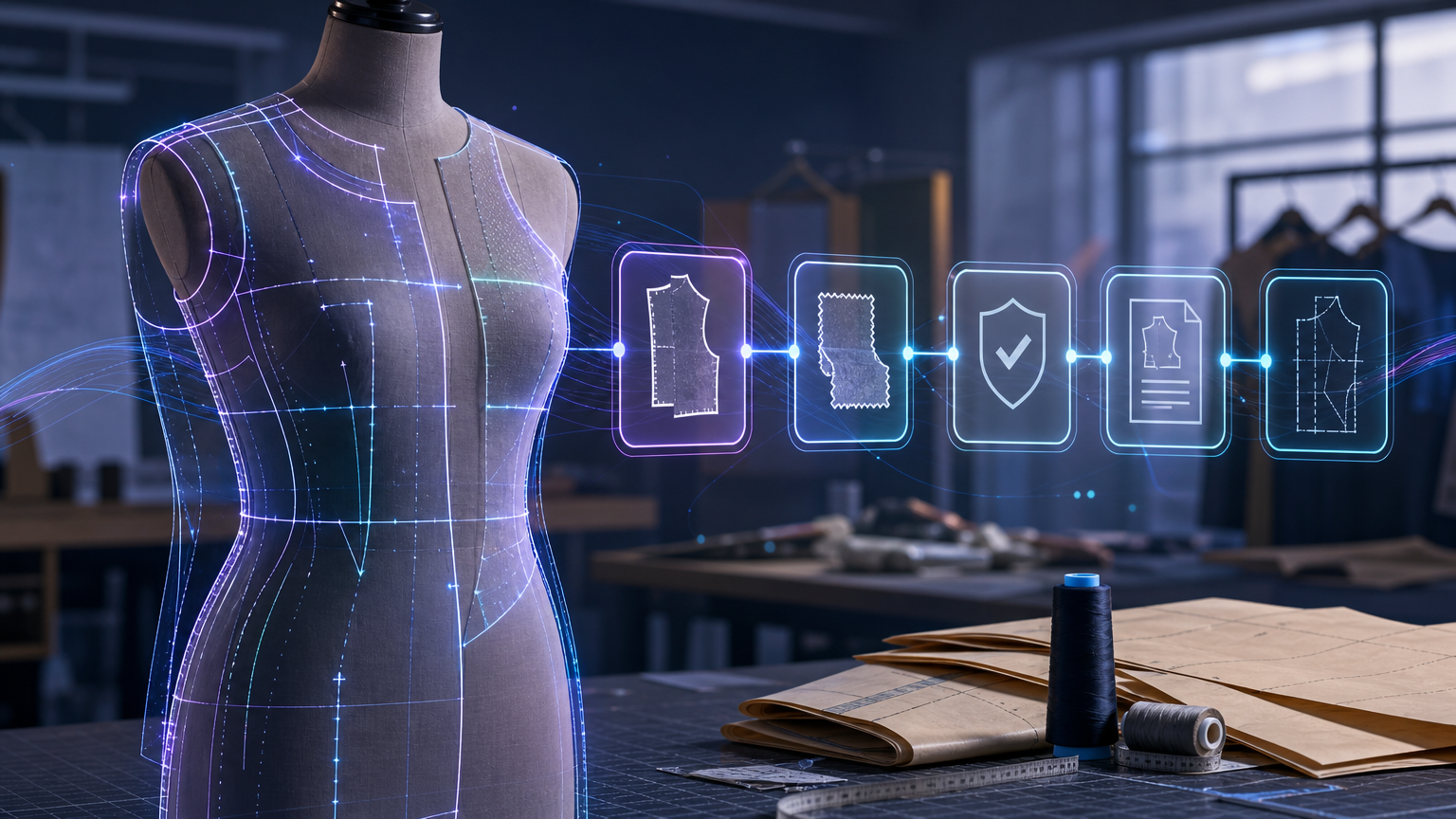
Technical busywork isn't a minor annoyance in fashion product development. It's the single biggest reason your best designers spend their week doing data entry instead of designing. Every hour a pattern maker spends re-exporting a .DXF, manually formatting a tech pack template, or hunting through folders for an existing block is an hour the collection doesn't move forward.
The fix isn't hiring more people. It's removing the translation layer that breaks down between design intent and manufacturable output.
The real reason designers lose time: busywork is the missing translation layer
Fashion teams talk about "technical busywork" as if it's background noise. It isn't. It's a structural failure at the handoff between creative decisions and production-ready deliverables.
The categories are consistent across teams: pattern rework and re-exporting into CAD tools, grading and size-table upkeep, pocket and facing creation from scratch, measurement extraction for each new style, BOM and spec formatting, costing inputs, feasibility flags, and the seasonal ritual of hunting for carry-over patterns buried somewhere in a shared drive.
None of these tasks require creative judgment. All of them eat creative time. And the downstream consequences compound: a missed seam allowance means a re-sample. A forgotten feasibility check means a costing surprise six weeks before delivery. A duplicated pattern block means two pattern makers solving the same problem in parallel without knowing it.
The promise of a real designers' technical busywork tool isn't to reduce this friction slightly. It's to remove it from the critical path entirely.
What automated handoff actually requires (and where most tools stop short)
The design-to-code automation market is genuinely growing, projected to expand from $4.91 billion in 2024 to $30.1 billion by 2032 (SixtyThirtyTen, 2026). Tools like Zeplin, Locofy, and Anima have done legitimate work automating the handoff between UI designers and frontend developers. Figma Dev Mode and design tokens similarly reduce the friction of translating visual specs into code.
But none of that solves fashion's problem. Zeplin automates design delivery between designers and developers. Locofy uses its "Large Design Models" to convert Figma layouts into React and HTML. Anima serves 1.8 million users converting screens into production-ready apps. These are all valid solutions to a real problem in software product teams. They are irrelevant to a pattern room.
Fashion handoff requires five separate translation layers to work correctly together:
- Geometry and pattern correctness, seam lengths, notches, grain lines, and ease that match the brand's fit standards
- Grading and sizing logic, grade rules applied consistently across a size run
- Tech pack data, measurements, construction notes, pocket and facing specs pulled automatically from the pattern
- BOM with verified data, actual fabric names, compositions, prices, and MOQs from connected supplier sources
- Costing and feasibility validation, cost-of-goods and manufacturability checks that catch problems before a single sample is cut
Generic handoff tools address none of these five layers. They produce specs and tokens for engineering teams, not CAD-compatible .DXF files and factory-ready documentation for garment production.
What FashionINSTA automates (mapped to real fashion outputs)
FashionINSTA is built specifically around this translation chain. It operates as a self-building fashion operating system, where each capability is a specialized node that connects into a user-defined workflow. The named nodes cover the full chain:
Pattern duplication and carryover hunting become pattern archive indexing and scoring via geometry-based similarity matching. The system extracts 750+ features per pattern and identifies which existing blocks are closest to a new design. Designers stop re-creating blocks that already exist. Enterprise teams have reported reducing seasonal carry-over work from weeks to hours.
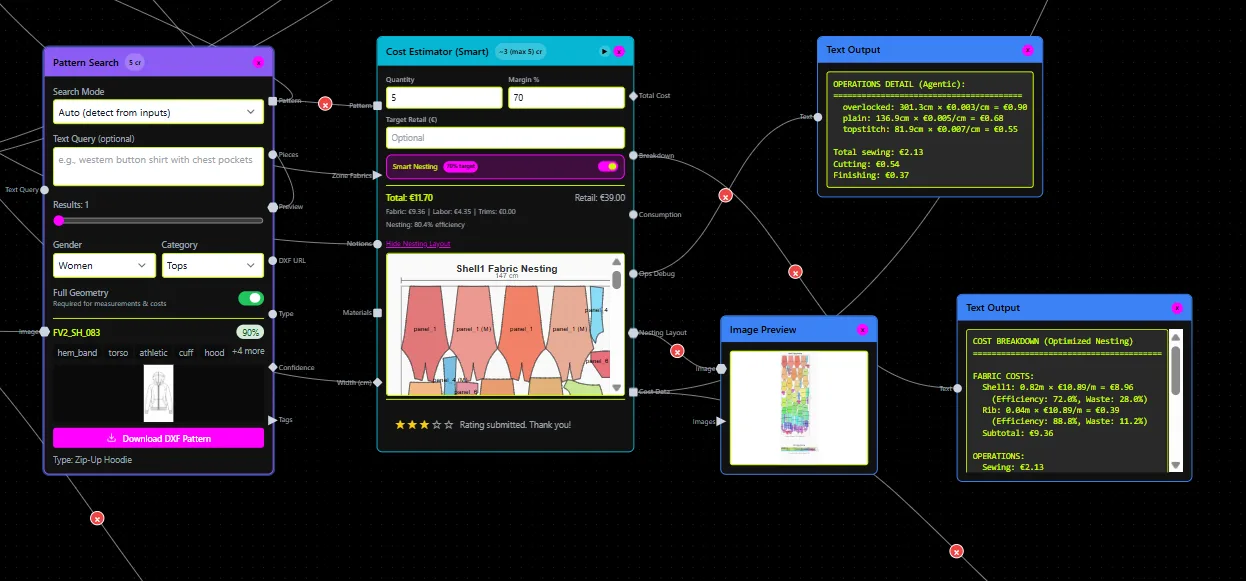
Manual pattern drafting and variant creation become parametric variation steps executed as workflow nodes. Sleeve modifications, seam adjustments, gathering operations, these are CAD operations the system runs automatically while preserving fit-critical geometry. The Pattern Generator retrieves the closest-matching .DXF from a trained dataset, or generates new patterns when the system has been custom-trained on a brand's proprietary archive.
Tech pack scaffolding becomes the Tech Pack Compiler node: auto-generated measurements, construction notes, fabric specs, and colorways assembled from the pattern data itself. No separate spreadsheet. No reformatting.
BOM guessing and spreadsheet churn are replaced by the BOM Agent, which connects to a real fabric shop and returns actual fabric names, compositions, prices, and MOQs. Not placeholder data. Verified supplier information.
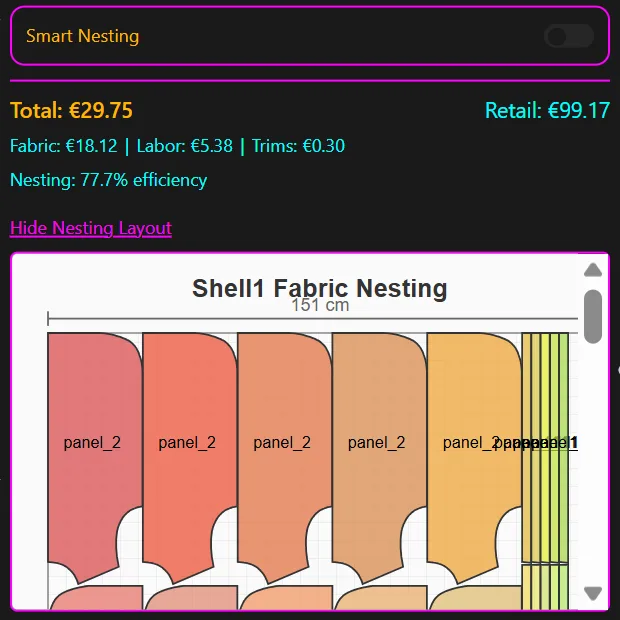
Late costing and feasibility surprises become pre-sampling gates via the Cost Estimator and Feasibility Analyzer nodes. Costing and feasibility checks run at around 80% accuracy with correct input data, according to FashionINSTA's own process documentation.
The sketch-to-DXF workflow that combines these nodes delivers a 10x faster first draft and a 4x faster overall PD cycle compared to manual processes.
How the node-based workflow functions in practice
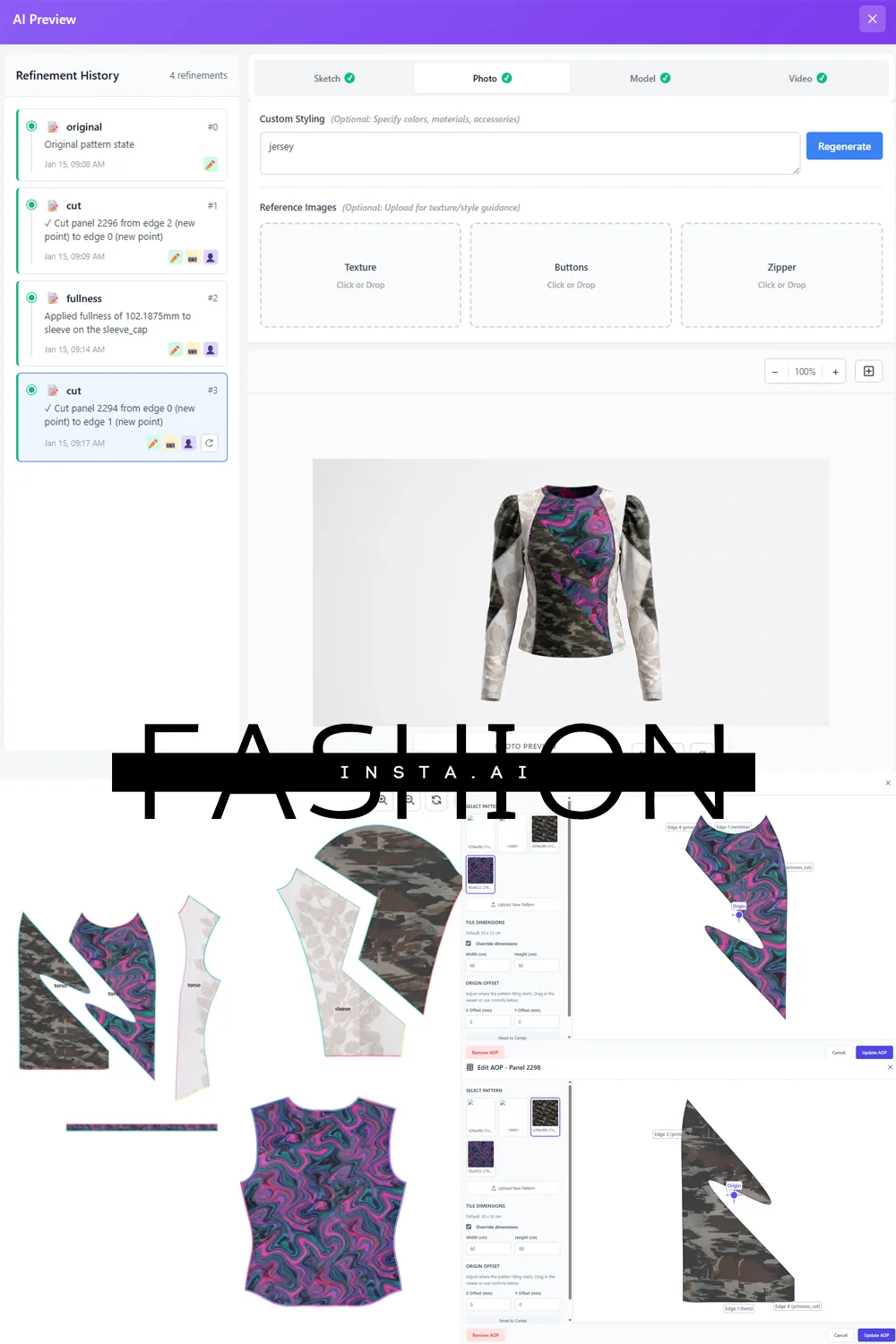
FashionINSTA's 40+ specialized nodes connect visually, without code, into workflows tailored to specific garment categories or SKU types. A typical apparel production workflow chains: Pattern Generator → BOM Agent → Cost Estimator → Feasibility Analyzer → Tech Pack Compiler, with Media and Render Nodes producing front and back views, e-commerce imagery, and 360-degree spin videos tied to the same design data.
The custom training layer is where the system earns its position as a pattern intelligence platform. Brands upload their existing .DXF pattern archive, typically 70 to 150 patterns for a category, and the system trains on that archive over approximately two weeks of cleaning and training, followed by six weeks of tryout. The result is a model that has learned the brand's fit philosophy and construction DNA. New patterns generated through the system carry that institutional knowledge automatically. Exports go directly to AMMA DXF for Gerber and V-Stitcher DXF formats.
This is the difference between automating handoff specs and automating garment assets. The AI vs. traditional pattern grading comparison makes the structural shift measurable.
What to automate first (before you scale)
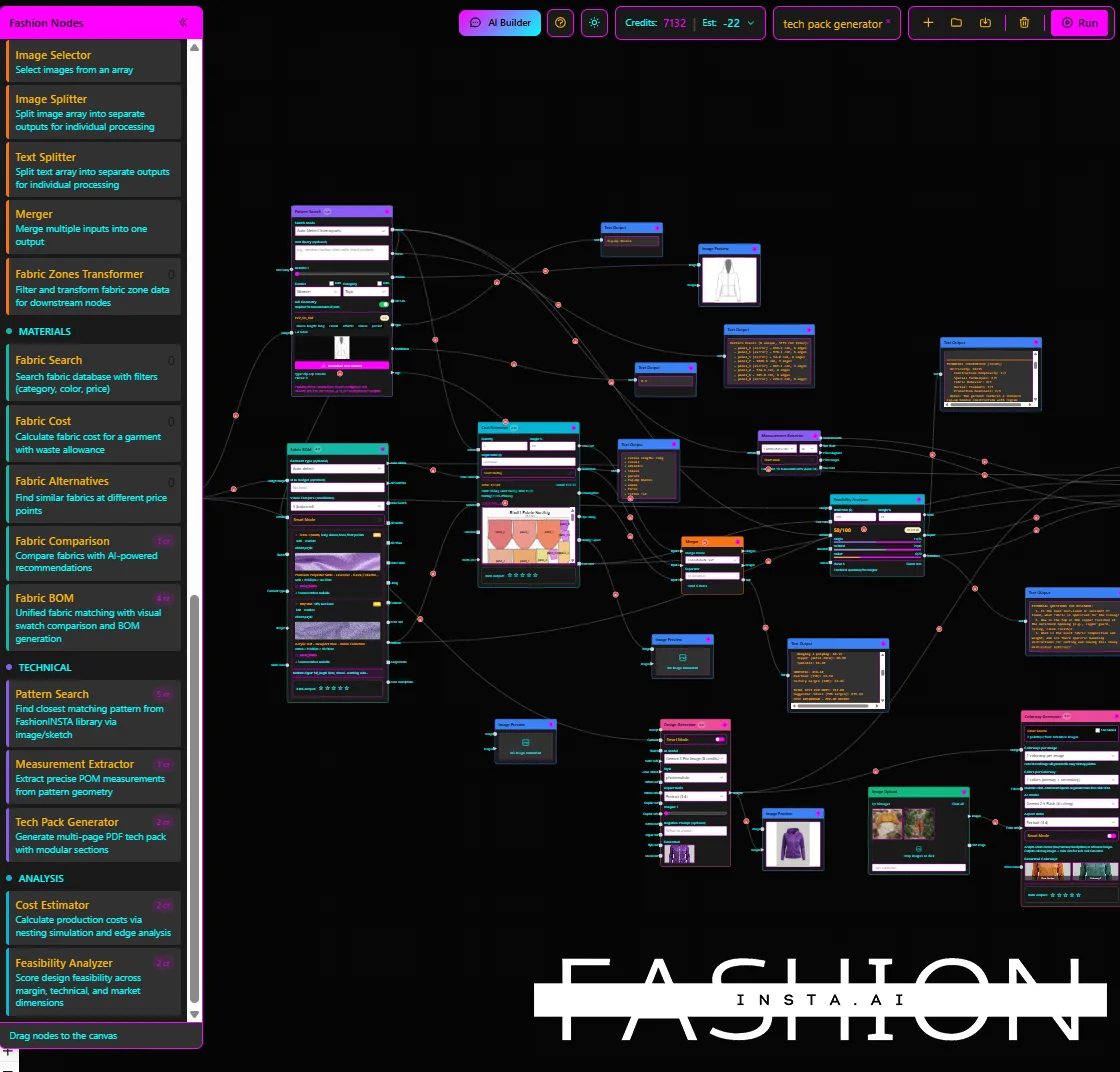
The practical starting sequence for teams adopting this approach:
Start with closest-pattern retrieval. Index the existing pattern archive and run the similarity scoring. This alone surfaces duplication, eliminates redundant blocks, and gives teams a clear picture of what they already own before creating anything new.
Add tech pack skeleton generation next. Connect the Tech Pack Compiler to the existing pattern outputs. The mechanical assembly of measurements and construction notes stops consuming designer hours immediately.
Then activate feasibility and costing gates before sampling begins. The Cost Estimator and Feasibility Analyzer nodes catch construction issues and price-point mismatches before physical samples are cut. Fewer sampling rounds means faster cycles and measurable cost reduction.
Data hygiene determines how well all of this works. Pattern archives need consistent file naming and format. Size charts need to be current and accurate. Fabric and trims data need to be verified before the BOM Agent can return reliable results. Garbage in, garbage out applies here as strictly as anywhere else.
The human-AI split is explicit by design: designers review fit-critical deltas and confirm construction intent. The AI handles the mechanical transformations, the CAD operations, the data extraction, the document assembly. Designers stay in creative mode. The AI pattern making won't replace pattern makers argument applies because the platform is structured around that division of labor.
What to measure when the busywork disappears
ROI from removing technical busywork shows up in four places:
Time-to-first-draft drops when closest-pattern retrieval and tech pack skeleton generation are running. The 10x faster first draft claim from FashionINSTA's benchmarks reflects this directly.
Sampling reduction follows from running feasibility and costing checks before any physical sample is cut. Catching a construction problem at the workflow stage costs nothing. Catching it after a sample arrives from the factory costs weeks.
Pattern duplication reduction is visible once the archive is indexed. Teams that have run the scoring consistently report surfacing blocks they didn't know they had, which eliminates the rework of recreating existing patterns season after season.
Feasibility flags as quality control give product development teams a pre-sampling checkpoint they previously didn't have. That gate alone justifies the workflow investment for brands running more than a few hundred SKUs per year.
Getting past the pilot stage
The FashionINSTA enterprise proof-of-concept is structured to avoid the common failure mode of pilots that generate data but never become production workflows. The 10-week Enterprise PoC covers one garment category, costs €5,000 to €15,000 as a one-time fee, and includes workflow node credits alongside the onboarding process. The training phase requires 70 to 150 patterns and takes approximately two weeks for data cleaning and training, followed by six weeks of tryout with the brand's actual design team.
The four-phase rollout path that works in practice: data onboarding (archive audit, format consistency, size chart verification) → workflow pilot on one category → measurable checkpoints at weeks four and eight → scale across additional categories and SKU volume.
Enterprise deployment runs on a dedicated AWS tenant with IP isolation. SSO, RBAC, and audit logs are included. The enterprise AI pilot guide covers the failure patterns that cause most fashion AI pilots to stall, and why the structured PoC approach avoids them. At full deployment, Fashion Complete OS is priced at €23,900/year/seat.
FAQ: the three questions every team asks
Will this replace designers? No. The platform removes mechanical busywork: the CAD operations, the data extraction, the document assembly. Designers retain creative direction and fit intent. The workflow is structured so that fit-critical review stays with humans, and repetitive transformations go to the AI.
How accurate is the output? Geometry scoring for closest-pattern retrieval is based on 750+ extracted features per pattern. Costing and feasibility results run at approximately 80% accuracy when input data (size charts, fabric specs, construction details) is current and correct. The accuracy improves as the system ingests more of a brand's specific archive.
How fast can we see results? Teams running the PoC process see measurable output within the six-week tryout window. Pattern retrieval and tech pack skeleton generation show time savings from the first workflow run. The pilot-to-production ROI guide lays out what to measure at each checkpoint to build the internal business case.
The core question isn't whether your designers are spending time on technical busywork. They are. The question is whether that work produces manufacturable garments or just well-formatted files. A production-ready AI fashion design platform that outputs actual .DXF patterns, verified BOM data, and factory-ready documentation changes that answer. Your designers get their time back. Your patterns go to production. Both things happen at the same time.