Is there a free AI designer for fashion?
TL;DR: While free AI fashion tools exist, they are primarily image generators rather than production-ready design systems. To create manufacturable garments with graded .DXF patterns and tech packs, fashion teams need specialized, pattern-connected AI solutions. Understanding this distinction is crucial before integrating AI into your design workflow.
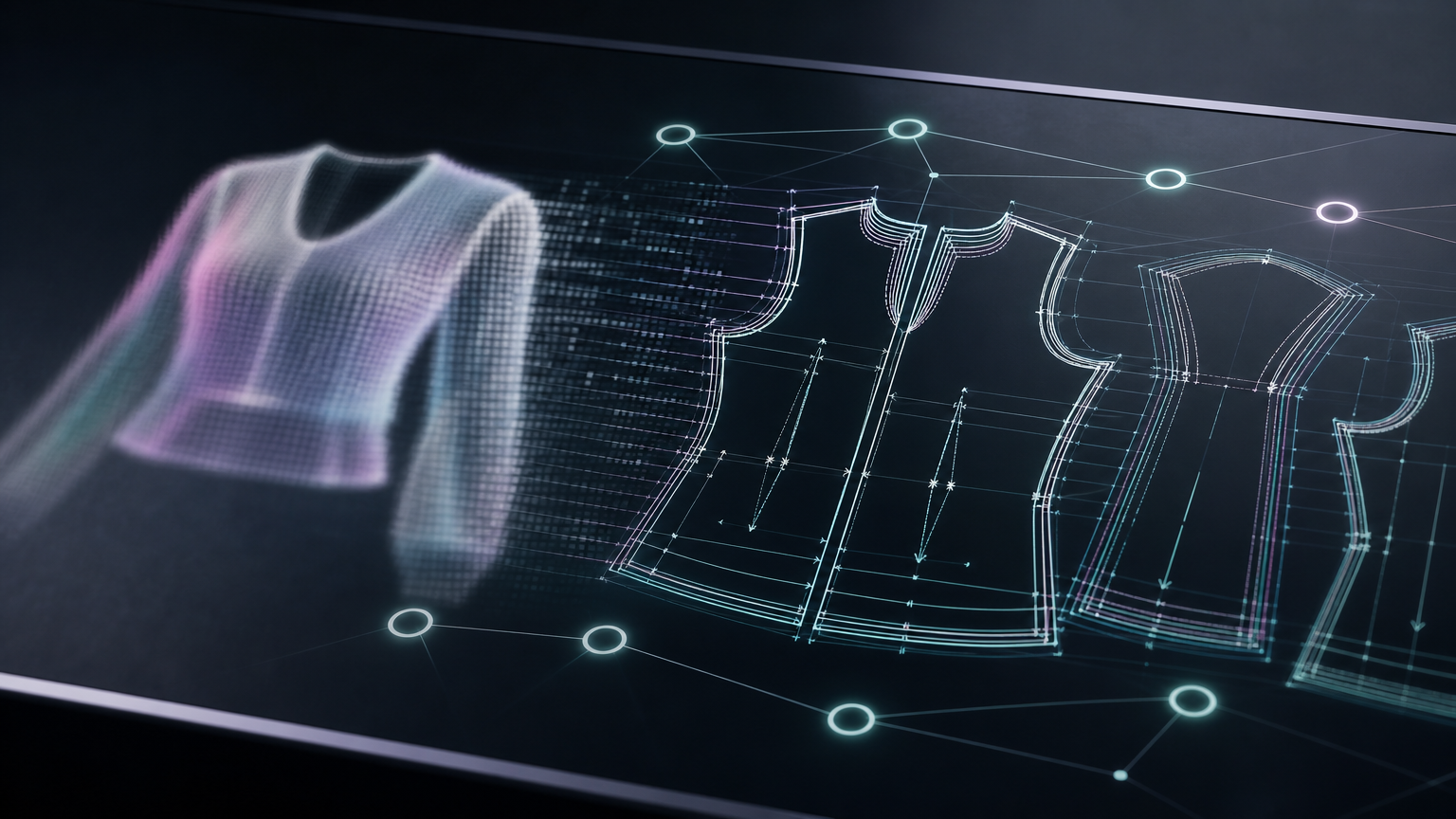
Yes, free AI fashion design tools exist. The more precise answer, though, depends on what you mean by "designer."
Most free or freemium tools in this category are image generators: they produce visual concepts, mood boards, and lookbook renderings from text prompts or sketch inputs. A smaller set of tools connects those visuals to actual garment geometry (graded .DXF patterns, tech packs, BOMs, feasibility checks). That second category is rarely free. Understanding which type you're looking at is the most practical thing you can do before committing to any tool.
What "free" typically means in fashion AI
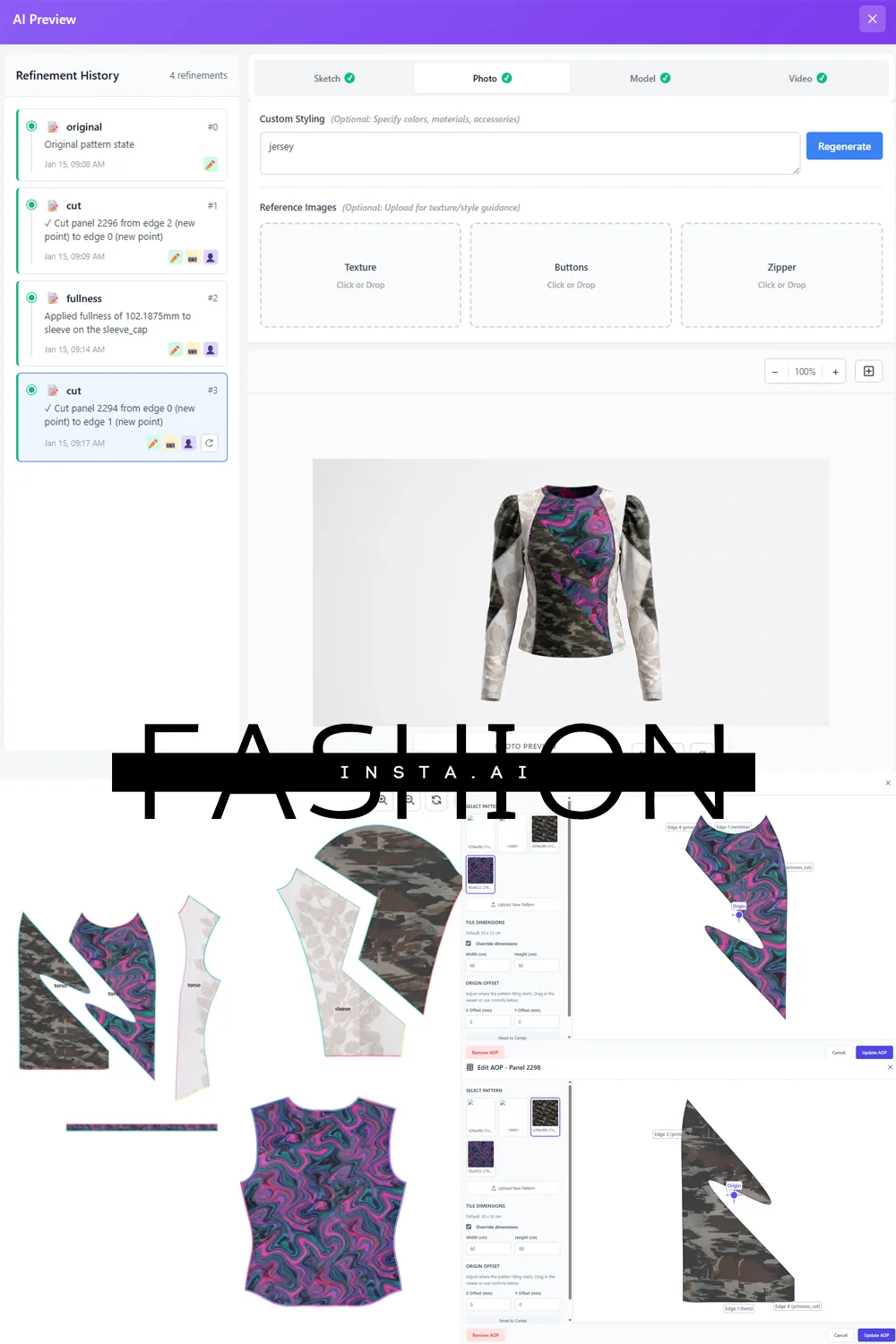
Free tiers across AI fashion tools generally share the same constraints:
- Daily credit or token limits that reset every 24 hours
- Image-only exports (PNG or JPG), not CAD-compatible files
- Watermarks or content credentials attached to outputs
- No .DXF pattern geometry, no size charts, no grading logic
- No tech pack generation or manufacturability checks
An image that looks like a finished garment is not the same as a garment that can be graded and cut. Image generators produce pixel-level predictions of what a garment might look like; they don't encode seam allowances, dart positions, curve geometry, or construction details in any form a pattern room can use. For concept work and client presentations, that's fine. For production-ready pattern workflows, it isn't.
Free tool examples and their actual limits
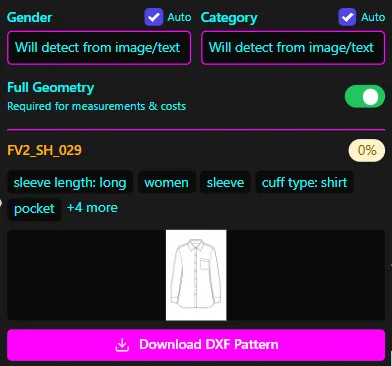
Adobe Firefly offers a free plan with daily generations included (per Adobe's plans comparison page). As of August 5, 2026, Adobe's Generative Credits FAQ confirms that "for features without the beta label, you can use Adobe Firefly-generated outputs in your commercial projects." Firefly produces high-quality fashion imagery. It does not output .DXF files, tech packs, or any garment geometry.
Leonardo.ai provides 150 daily tokens on its free plan, resetting every 24 hours (per Leonardo.ai's pricing page). Free-plan outputs are usable commercially, though Leonardo notes that free generations are public by default. Leonardo produces downloadable images at various resolutions. It does not generate pattern files or CAD-compatible exports.
Stable Diffusion Web UI (the automatic1111 open-source project on GitHub) can be run locally at no cost, or accessed through ad-supported hosting. It exports PNG and JPG. Like the tools above, it produces no garment geometry, no .DXF, and no tech pack data. The quality of fashion outputs depends heavily on the model checkpoint and prompt tuning used.
For a broader comparison of free vs paid AI fashion tools and what each tier actually delivers, the distinction between image output and manufacturable output becomes even clearer at scale.
When to move to paid or enterprise solutions
The use-case split is straightforward:
- Students, stylists, and creative teams producing mood boards, client decks, and lookbooks can work effectively within the free tiers of image-based tools.
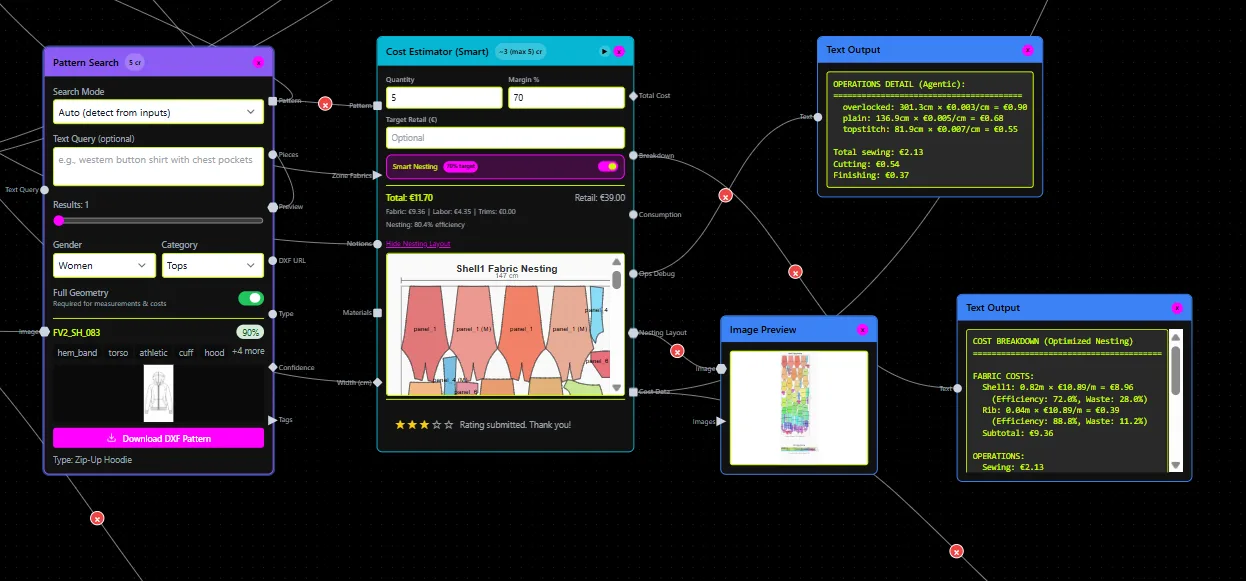
- Patternmakers, technical designers, and brand development teams need outputs that connect directly to a factory: graded .DXF files, tech packs with construction notes, BOM data, feasibility assessments, and cost estimates.
If your workflow requires any of the following, a free image generator won't cover it:
- .DXF export compatible with Gerber, Lectra, CLO3D, or Browzwear
- Tech packs with measurements and construction specifications
- BOM with actual fabric names, compositions, prices, and MOQs
- Cost-of-goods estimation or manufacturability checks before sampling
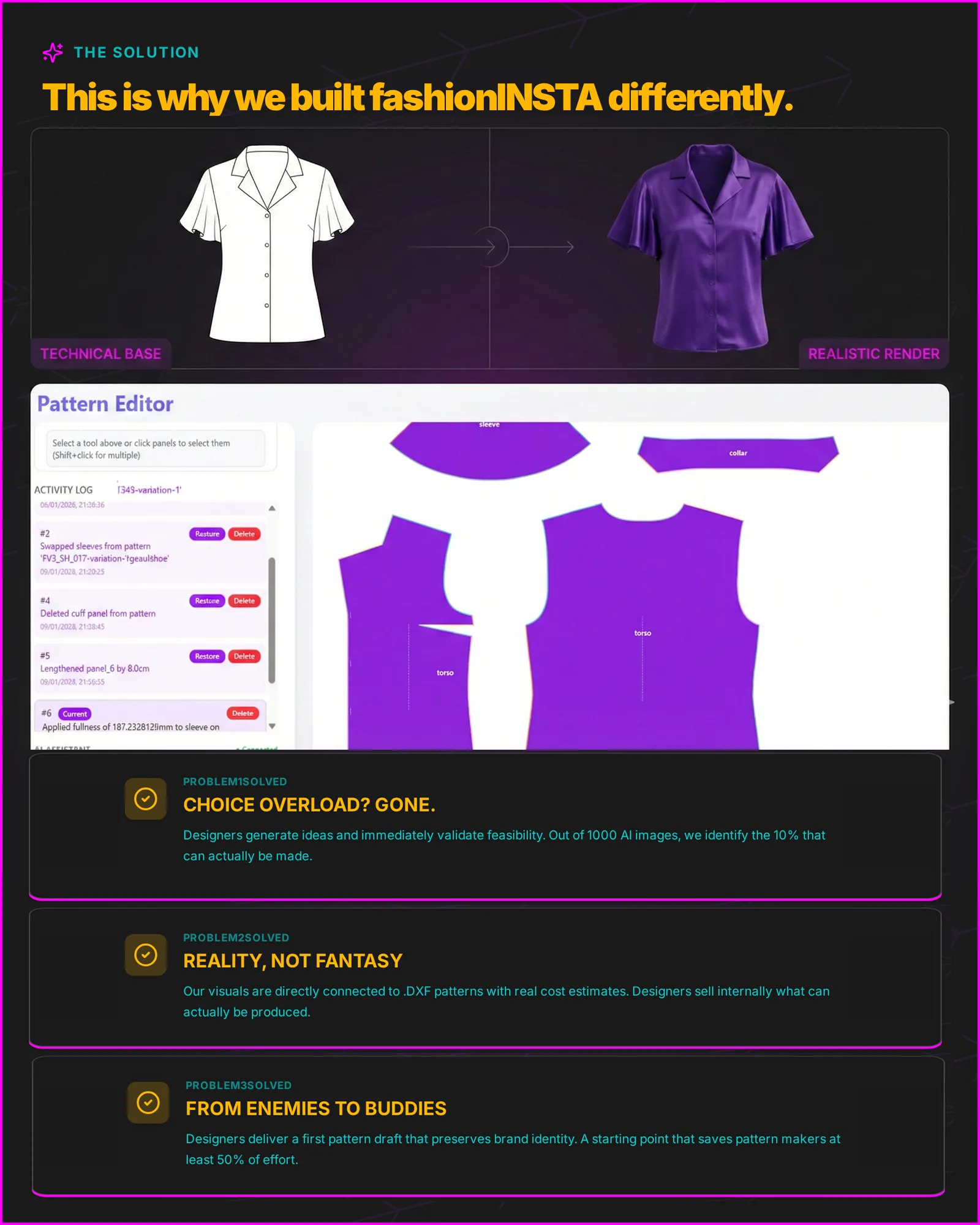
FashionINSTA is built for that second set of requirements. Its AI pattern intelligence platform trains on a brand's existing .DXF archive, extracts 750+ features per pattern to learn the brand's fit geometry, and returns outputs that include working .DXF patterns, tech pack compilation, BOM data, and feasibility analysis. The enterprise PoC is a 10-week engagement (Weeks 1-2 data collection; Weeks 3-4 training and setup; Weeks 5-10 active trial), priced at €5-15k one-time and scoped by category and volume, with 100-150 patterns trained. It's a defined PoC structure, not a free tier. Feasibility and cost estimation accuracy is described as approximately 80% of actual production cost when connected to current supplier data.
The sketch-to-DXF workflow and the distinction between visual AI and pattern-connected AI are covered in more detail for teams evaluating where their current tooling falls short.
FAQ
Is there a free AI designer for fashion? Free AI tools for fashion exist, but they are image generators, not production-ready design systems. They work for creative visualization; they don't produce manufacturable outputs.
What's the difference between a creative image generator and a production-ready tool? An image generator produces PNG/JPG visuals. A production-ready tool outputs .DXF pattern geometry, tech packs, grading data, and feasibility information that a factory can act on.
What do free tiers typically limit? Daily credits or tokens, export file types (image only), output resolution, and access to specialized features like CAD export or tech pack generation.
Quick reference: free-tier limits by tool
| Tool | Free tier | What it outputs | What it doesn't output |
|---|---|---|---|
| Adobe Firefly | Daily generations included | Fashion imagery (commercial use permitted) | No .DXF, no tech pack |
| Leonardo.ai | 150 tokens/day (public outputs) | Downloadable images (commercial use permitted) | No .DXF, no tech pack |
| Stable Diffusion Web UI | Free (local/hosted) | PNG/JPG | No .DXF, no tech pack |
| FashionINSTA | 150 free node credits; enterprise PoC from €5k | .DXF patterns, tech packs, BOM, cost/feasibility | Full production workflow requires paid plan |
If you're evaluating any AI fashion design tool in 2026, free or paid, the most useful filter is a short set of output-level questions rather than feature lists. Ask what file format the tool exports, whether those files carry measurable geometry, and whether the outputs connect directly to a downstream workflow.
A checklist worth running through:
- Does it export .DXF files compatible with your CAD system (Gerber, Lectra, Optitex, CLO3D)?
- Does it generate tech packs with construction notes, measurements, and colorways?
- Does it include a BOM with real supplier data, MOQs, and fabric compositions?
- Does it run a feasibility or cost check before you commit to sampling?
- Does the free tier give you access to any of the above, or just image exports?
If the answer to the first four questions is no, the tool is a visualization aid. That has genuine value in the right context. It's a problem only when it's mistaken for a production tool. As noted in the hidden costs of free AI design tools, the rework cycle from converting a rendered image into a usable pattern manually can cost more time than the free tier saves.
For teams evaluating where image generation ends and pattern-connected AI begins, the output format is the clearest line. A PNG is a reference. A graded .DXF with seam allowances and notches is a production asset.