AI is automating parts of the pattern-making workflow
TL;DR: AI is transforming the pattern-making workflow by automating repetitive tasks like grading and block retrieval, drastically speeding up production timelines. Rather than replacing pattern makers, these tools elevate their roles to focus on fit-critical decisions, complex construction logic, and quality assurance.

AI is automating parts of the pattern-making workflow. It is not replacing the people who understand why a pattern works.
That distinction matters because "replacement" in production terms means something specific: a system that independently delivers CAD-ready geometry, correct grading across a full size run, construction-feasible seam and facing logic, and brand-consistent fit, all factory-ready without human sign-off. No current AI tool reliably does all of that, end to end, unsupervised.
What AI is doing is eliminating the repetitive, bottleneck-creating tasks that consume most of a pattern maker's working hours. That changes the job. It doesn't eliminate it.
The core responsibilities AI hasn't replaced
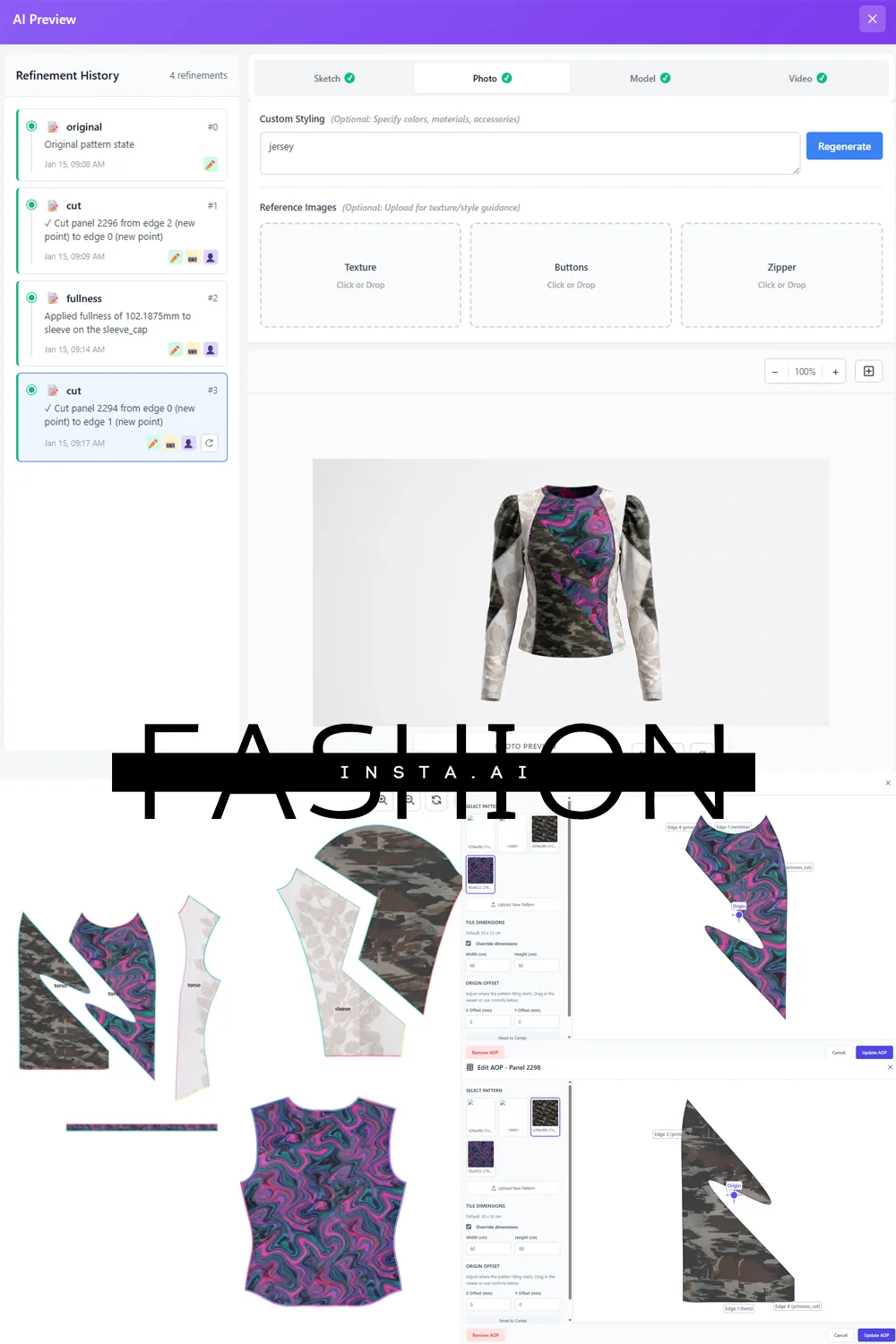
Pattern makers do at least five things that are genuinely difficult to automate:
- Fit-critical geometry decisions, the millimeter-level curves, notch placements, and ease allowances that determine whether a garment fits a real body, not just passes a measurement tape check.
- Construction logic, knowing how a facing folds back, where a pocket bag needs clearance, how a lining behaves against shell fabric under tension.
- Grading rules, scaling geometry across a full size run while preserving proportions that aren't arithmetically linear (armhole depth, back rise, crotch curve).
- Marker and nesting judgment, optimizing cut plans for actual fabric widths, grain requirements, and pattern tilt tolerances.
- QA against spec, verifying that what the software generated actually matches the size chart, construction intent, and the factory's capabilities.
When any of these steps fail, the consequences compound downstream. A pattern piece that passes a measurement audit can still break fit entirely because the cross-chest curve is wrong. Catching that requires a trained eye, not a measurement comparison.
What AI is already doing in pattern making today
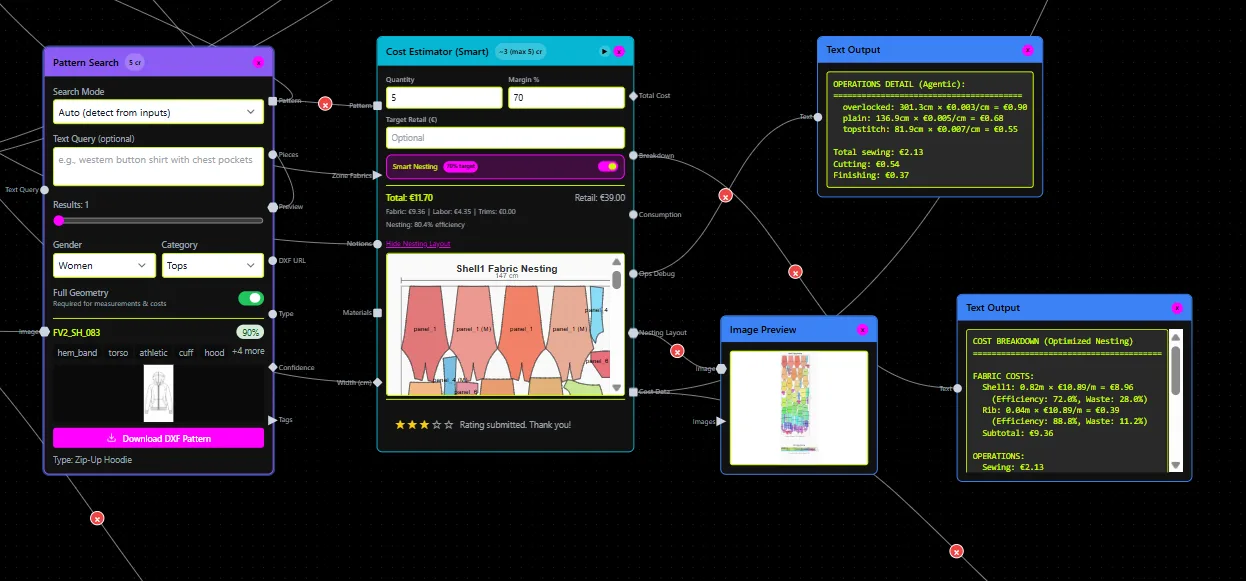
The honest picture is that AI pattern making tools are genuinely useful for a substantial portion of the workflow.
- First-draft generation from existing blocks. When an AI system is trained on a production archive, it retrieves geometrically matched patterns rather than inventing shapes. FashionINSTA's Pattern Generator, for example, "retrieves the closest matching .DXF pattern, or generates new patterns from your trained building blocks" by comparing image input to the geometry of existing production files, not image-to-image matching.
- AI grading automation. Tools like CLO's Pattern Drafter (updated March 2026) already offer "Auto POM & Grading" that automatically generates measurements from a sketch to produce a drafted pattern, reducing manual size-grade work inside 3D workflows.
- Virtual prototyping. Reducing physical sampling rounds through 3D simulation is now standard practice at brands using CLO, Browzwear, and similar platforms. Fewer samples doesn't mean no human review, it means earlier, cheaper iteration before fabric is cut.
- Tech pack generation. AI-compiled tech packs that pull measurements, construction notes, and fabric specs directly from a pattern's geometry are faster and more internally consistent than manually assembled documents.
FashionINSTA claims a 10x faster first draft and a 4x faster overall product development cycle when its Pattern Intelligence platform is trained on a brand's archive. Those numbers represent acceleration of specific tasks, not full replacement of the role.
Pretty patterns vs factory-ready patterns (why pattern makers still matter)
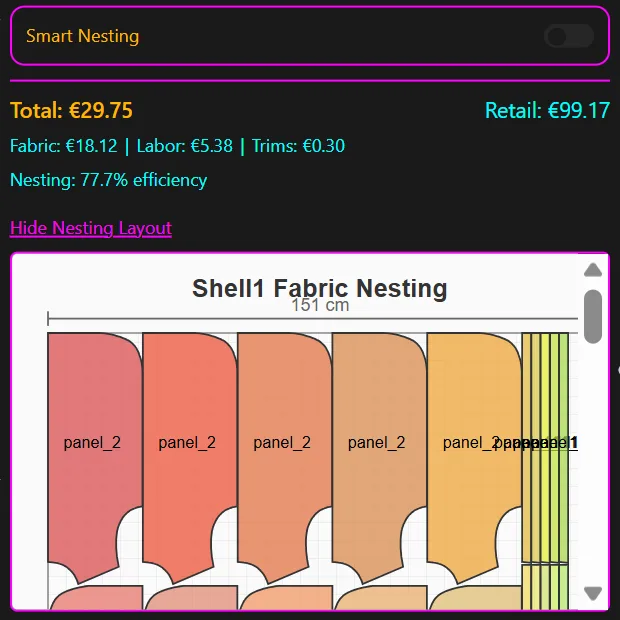
This is where the "AI replaces pattern makers" argument usually falls apart.
Most AI image generators can produce something that looks like a flat pattern. The output is visual. It carries no geometry that a CAD system can read, no seam allowances a factory can cut, no grading data a marker room can use. Sending an AI image to a factory is not an option. Sending a validated DXF file is.
Production-ready patterns require: - A CAD-compatible DXF export (AMMA/Gerber, V-Stitcher, Lectra Modaris, CLO, specific format, not a generic file). - Geometry that holds up under grading, meaning the curves are mathematically correct, not visually plausible. - A feasibility pass: does this construction work at the target price point, with real fabric widths and MOQs?
FashionINSTA addresses this by training its AI on a brand's production DXF archive, extracting 750+ features per pattern to preserve the brand's construction DNA. The system then exports to AMMA DXF for Gerber, V-Stitcher DXF, CLO, and Lectra Modaris. Its feasibility and cost estimation nodes, connected to live fabric supplier data, reach roughly 80% of production-reality accuracy when tied to correct input data.
That last qualifier, "when tied to correct input data", is exactly where pattern makers remain indispensable. Someone has to verify the data, validate the output, and sign off on the file before it goes to a factory.
Three ways the pattern maker role is shifting
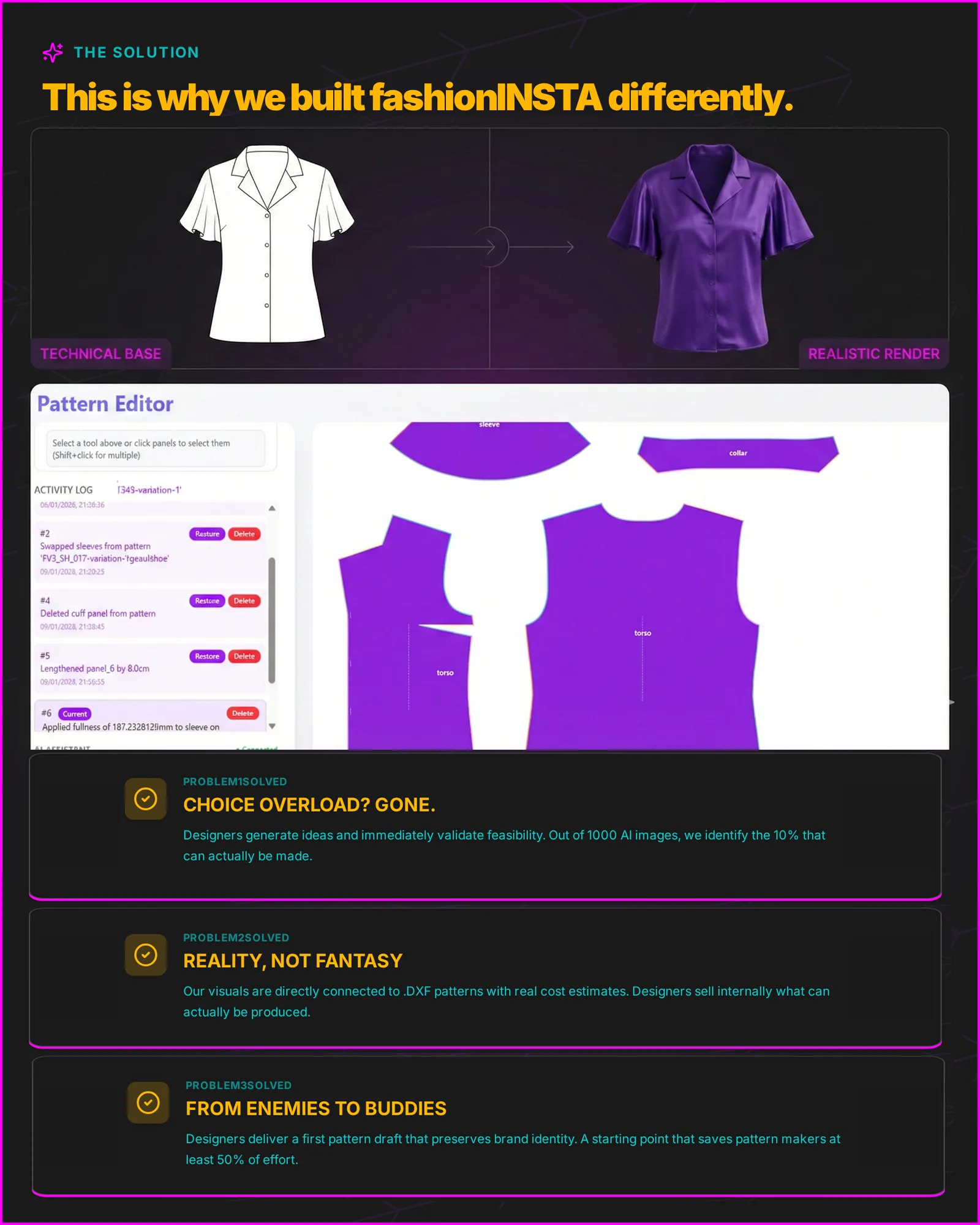
Rather than disappearing, the role of pattern makers in fashion is reorganizing around three practical shifts:
1. From drafting to directing. Instead of spending six to eight hours building a block from scratch, a pattern maker specifies the design intent, reviews the AI's closest geometric match, and applies construction judgment to the retrieved pattern. The drafting time compresses; the judgment work stays.
2. From manual repetition to edge-case resolution. AI handles variations on established blocks efficiently. Pattern makers focus on the styles that don't fit the existing library, new silhouettes, unusual construction details, experimental materials, where no trained match exists.
3. From production bottleneck to automation operator. Pattern makers who understand DXF workflows, grading logic, and feasibility checking are now the people who configure, supervise, and validate AI workflows. Manual CAD operations that once consumed 80% of a pattern maker's week drop significantly, freeing capacity for higher-value construction decisions.
An AI-ready skills roadmap for pattern makers
If you're a pattern maker evaluating where to invest time in 2026, these are the skills that make you more valuable alongside AI tools, not less:
- DXF workflow fluency, understanding file structure, seam allowance settings, and CAD ecosystem compatibility (Gerber, Lectra, CLO).
- Grading logic, being able to specify and verify grade rules, not just apply them manually, so you can audit AI grading outputs.
- Virtual fitting review, evaluating 3D simulation results with the same critical eye you'd bring to a physical toile.
- POM literacy, reading and writing Points of Measure specs precisely enough to validate AI-extracted measurements.
- Data annotation, cleaning and tagging pattern archives so AI training produces useful outputs rather than noisy ones.
- Geometry debugging, spotting broken curves, missing notches, and incorrect grain lines in AI-generated DXF files before they reach a factory.
AI pattern analysis workflows are only as good as the human reviewing the output. That review role is where experienced pattern makers are hardest to replace.
FAQ
Will AI replace pattern makers completely?
No. AI can automate repetitive drafting, grading support, documentation, and variation generation. It cannot independently handle fit-critical construction decisions, geometry debugging, or factory QA without human oversight. The role changes; the expertise becomes more valuable, not less.
Can AI create custom-fit patterns that factories can actually cut?
Only if the output is a properly structured, CAD-compatible DXF file, not an image. Systems like FashionINSTA that train on a brand's production archive and export to Gerber/AMMA, Lectra, and CLO formats can produce cuttable files. Generic AI image generators cannot.
What tasks should pattern makers automate first?
Start with first-draft generation from existing blocks, tech pack compilation, and measurement extraction. These are high-volume, time-consuming tasks where AI delivers clear speed gains with low risk, as long as a human validates the output before it leaves the team.
Does learning AI tools mean starting from scratch?
No. The most effective AI workflows in pattern making are built on top of existing CAD expertise. Pattern makers who understand DXF structure, grading rules, and construction logic learn AI tools faster and get better outputs than those without that foundation.
What are the biggest risks when using AI in pattern making?
Three: wrong geometry that passes a visual check but fails in construction, IP and data security issues when uploading proprietary patterns to third-party platforms, and feasibility gaps when AI cost and nesting estimates aren't connected to live supplier and factory data. All three are manageable with the right QA checkpoints and a platform that handles training on private, brand-owned archives.
How long does it take to run a pilot?
Based on FashionINSTA's Enterprise PoC structure: approximately two weeks for data collection, two weeks for training on one product category, then six weeks of active use. Total PoC cost ranges from €5,000 to €15,000 depending on category complexity.
AI is changing how pattern development fits into the broader product workflow, compressing timelines, reducing rework, and making institutional pattern knowledge portable. What it isn't doing is replacing the judgment, verification, and construction intelligence that experienced pattern makers bring to every style.
If your team is ready to test what AI-assisted pattern development looks like in practice, talk to FashionINSTA about a pilot workflow for your pattern team.