The ROI math that actually matters when deploying AI in fashion product development
TL;DR: To prove the real financial value of AI in fashion product development, teams must measure baseline costs—like sampling rounds, labor hours, and fabric waste—before deployment. Factoring in the true Total Cost of Ownership (TCO) allows brands to accurately calculate long-term ROI and move beyond failed pilot projects.

Most fashion AI pilots end the same way: the tool worked, the team was cautiously optimistic, and then the project stalled because nobody could prove the numbers. That's not a technology failure. It's a measurement failure. And it's expensive, because the economic potential is real. McKinsey estimated in June 2023 that generative AI could add 0.5 to 3.4 percentage points annually to productivity growth as deployment scales. Yet Gartner found that by end of 2025, at least 50% of generative AI projects had been abandoned after proof of concept, most often because of poor data readiness, not because the models underperformed.
This case study exists to give you the arithmetic. Not a framework. Not a KPI checklist. The actual math, from baseline cost to implementation cost to measured benefit to ROI percentage and payback period, so you can take this directly to a board conversation or a pilot sign-off meeting.
ROI here means: (labor savings + sampling cost reduction + rework/waste avoidance + margin protection from better fit) minus total cost of ownership (TCO). TCO is not just the subscription. It includes integration, change management, training, and ongoing validation. Every honest ROI model accounts for all of it.
Before you run any AI tool trial, collect these six inputs:
- Fully loaded hourly rate for your pattern/tech design team (fully burdened: salary + benefits + overhead)
- Number of sampling rounds per SKU or category (initial + revision rounds separately)
- Cost per sample round (pattern development labor + cutting/sewing + shipping + factory review time)
- SKU volume per season (the scale multiplier)
- Fit issue or defect rate on first sample (percentage of SKUs requiring at least one additional revision)
- Fabric overbuy or carry-over waste rate (expressed as percentage of seasonal fabric spend, or season-over-season pattern re-creation cost)
If you can't populate all six, collect what you have and use conservative industry benchmarks for the rest. Leaving any of them out systematically underestimates your ROI.
Why fashion AI ROI is so hard to prove, and how to avoid a false negative
The pattern is consistent across enterprise AI rollouts in apparel: a brand runs a 4-to-6-week pilot, sampling doesn't obviously improve, the innovation team can't quantify savings, and the project enters "pilot purgatory." Leadership loses confidence. The tool gets shelved.
The cause is almost never model quality. It's the absence of a measurement architecture before the pilot started.
The specific mistakes that kill AI ROI measurement:
- No documented baseline window: if you don't record how many sampling rounds and labor hours your current workflow consumes before the AI is switched on, you have nothing to compare against. Post-hoc estimates from memory are unreliable and won't survive board scrutiny.
- Attribution mixing: a pilot that runs at the same time as a design leadership change, a new fit block revision, or a new factory relationship will confuse cause and effect. Your ROI model must isolate what the AI workflow changed.
- Ignoring hidden costs: vendor pricing shows subscription cost. It doesn't show integration engineering hours, PLM/DXF handoff configuration, training time for patternmakers, or the ongoing cost of output validation. Gartner predicts that through 2026, organizations will abandon 60% of AI projects unsupported by AI-ready data, and "data readiness" includes the operational cost of cleaning and maintaining that data.
- Wrong KPI-to-cost mapping: measuring "time saved on sketching" when your actual cost leak is in sampling revisions and fit corrections means your KPIs don't connect to any financial lever. The KPIs that matter in fashion product development are the ones tied to physical cost events: sampling rounds, rework cycles, fabric waste, and carry-over pattern re-creation.
The financial stakes are high enough to take this seriously. On the returns side alone, Coresight Research reported in April 2023 that the average US online apparel return rate is 24.4%, which is 7.9 percentage points higher than general retail. Research published via ScienceDirect estimated that in 2022, fashion returns cost the UK industry approximately £7 billion. If your AI workflow improves fit accuracy early in product development, even a 2-to-3 percentage point reduction in your own brand's return rate becomes a material revenue line.
What to measure before you deploy (the baseline cost model)
Run this for 4 to 8 weeks before switching any AI tool on. Track it by category, not across all SKUs at once, because you'll use the non-AI category as your control.
The table below is designed to be copy-pasted into a spreadsheet. Fill in your actual values in the "Baseline value" column.
| Metric | Baseline value | Unit cost | Formula: total cost impact |
|---|---|---|---|
| Pattern/tech pack labor hours per SKU | [Hours] | [Fully loaded hourly rate, e.g., $65/hr] | Hours × Hourly rate × SKU count |
| Sampling rounds per SKU (initial) | [e.g., 1.0] | [e.g., $800/round incl. shipping] | Rounds × Cost × SKU count |
| Revision sampling rounds per SKU | [e.g., 1.8 avg] | [e.g., $650/round] | Rounds × Cost × SKU count |
| Fit issue rate on first sample (% of SKUs) | [e.g., 65%] | [Rework labor: $200–$400/SKU] | Fit issue rate × Rework cost × SKU count |
| Pattern re-creation from carry-over (hrs/season) | [Hours] | [Hourly rate] | Hours × Hourly rate |
| Fabric overbuy from failed iterations (% of spend) | [e.g., 4%] | [Seasonal fabric budget] | Overbuy % × Fabric spend |
Total your six rows. That number is your baseline cost for one season in one category. It's likely higher than anyone on your team expected.
For a mid-sized womenswear brand producing 120 SKUs per season with a team of 5 technical designers billing at $65/hr, rough math on labor alone (12 hours per SKU including iteration) yields $93,600 per season in one category before a single sample ships. Add sampling costs at 2.8 rounds average ($800 initial + $650 × 1.8 revisions = ~$1,970/SKU × 120 SKUs = $236,400) and the combined baseline approaches $330,000 per season for one product category.
That's the number your AI implementation has to work against.
Total cost of ownership, not just the subscription price
The honest TCO calculation for a fashion AI deployment over 12 months covers four categories:
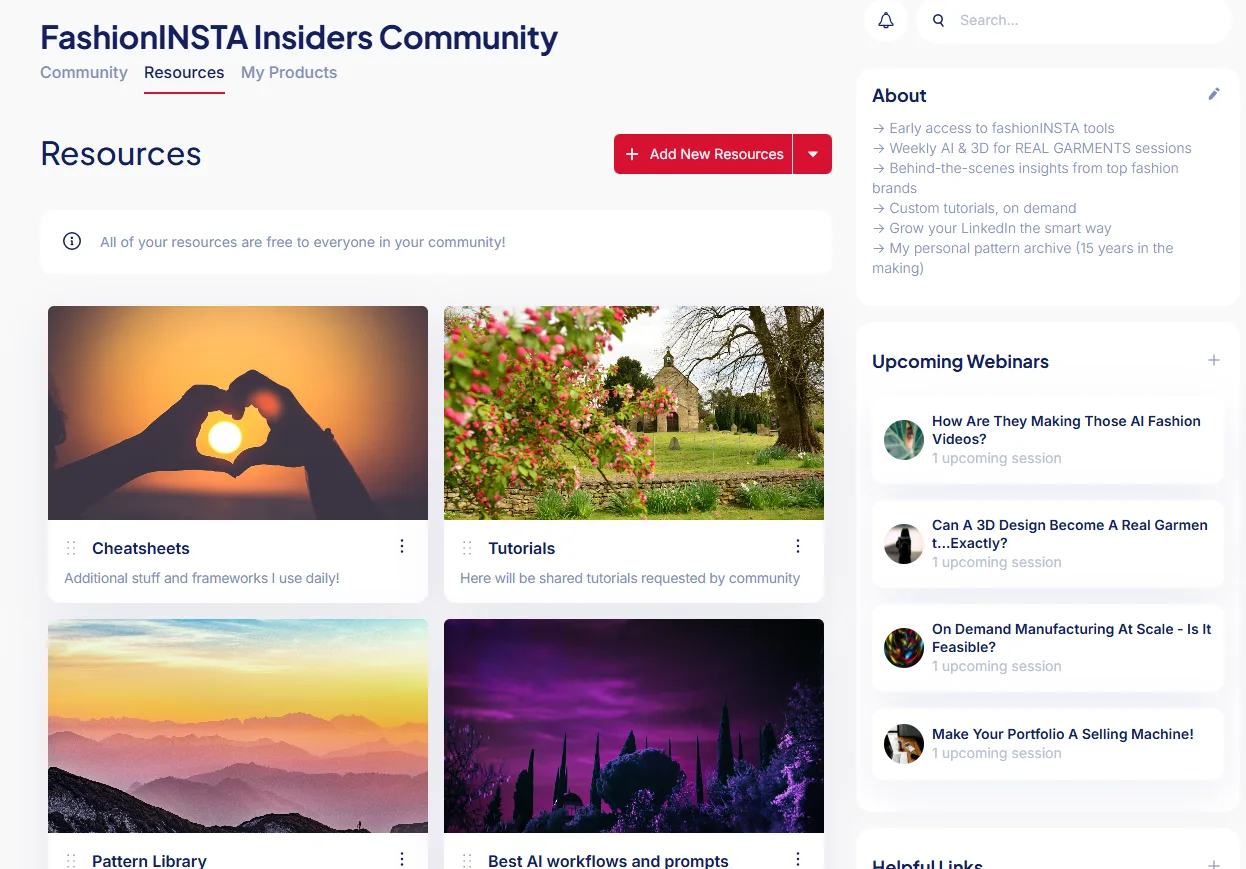
AI tool costs. A platform like FashionINSTA, which operates as a modular fashion operating system producing factory-ready DXF patterns, tech packs, BOM/costing inputs, and feasibility checks through node-based workflows, prices enterprise PoC engagements at €5,000 to €15,000 one-time for a 10-week pilot covering one product category. Full annual deployment (Fashion Complete OS) runs at approximately €23,900 per seat per year, with training on proprietary pattern archives included at higher tiers. For this case study, use €12,000 one-time PoC + €24,000 annual seat as your Year 1 AI tool cost (placeholder: adjust to your actual contract).
Integration costs. DXF output handoff to your existing CAD environment (Gerber, Lectra, Tukatech, CLO3D, or others) typically requires 20 to 40 hours of technical configuration, even with pre-built integrations. At $100/hr for technical staff, that's $2,000 to $4,000. PLM system connection, if required, adds another 40 to 80 hours depending on the system.
Change management. Pattern team re-training and process redesign: budget 16 to 24 hours per team member for an initial cohort. For a team of 5, that's 80 to 120 hours, or $5,200 to $7,800 at $65/hr fully loaded. Process redesign documentation adds another 20 to 40 hours for the project lead.
Ongoing ops. Output validation (reviewing AI-generated tech pack measurements, BOM accuracy, pattern geometry for fit-critical areas like armholes and sleeve caps) should be built into every workflow cycle. Budget 20% of pattern review labor as an ongoing validation overhead in Year 1. This number typically decreases in Year 2 as the team calibrates acceptance criteria.
| Cost category | Year 1 estimate (placeholder) |
|---|---|
| AI tool: PoC fee | €12,000 (~$13,000) |
| AI tool: annual seat | €24,000 (~$26,000) |
| Integration engineering | $3,000 |
| Change management / training | $6,500 |
| Ongoing validation overhead | $8,000 |
| Total Year 1 TCO | ~$56,500 |
Timeline: run your baseline measurement for weeks 1 to 4. Begin PoC in weeks 5 to 14 (the FashionINSTA 10-week pilot structure aligns here: 2 weeks data collection/training + 6 weeks tryout + 2 weeks measurement). Capture results through weeks 15 to 24 to align with a full sampling cycle, since pattern changes don't appear in physical outcomes until the sample is made and reviewed.
What you actually measure after deployment
Time savings are the easiest to capture and the easiest to misattribute. Track hours per SKU stage by stage: pattern generation (initial block retrieval or generation from archive), iteration/variation, tech pack compilation, and measurement table extraction. Compare directly to your baseline log by the same team members, on the same category.
Sampling reduction is the highest-value metric. Separate initial sample outcomes from revision rounds. The metric to track: what percentage of SKUs went to revision sampling? Compare your baseline revision rate (e.g., 65% of SKUs required at least one revision) against the AI-workflow rate. A first-pass fit rate improvement from 35% to 55% in the PoC period is a measurable outcome: that's 24 fewer revision samples in a 120-SKU run, at $650 each, or $15,600 saved in one pilot window. That single metric, annualized, often pays back the PoC cost alone.
Quality improvements (reduced fit corrections) translate directly to fewer rework cycles. If the AI platform's Pattern Intelligence was trained on your production archive of, say, 100 DXF patterns, learning your neckline geometry, armhole curves, and sleeve cap construction DNA, the patterns it generates or retrieves start closer to your actual fit standard. The counterfactual question to ask: how many of the revision samples would have been eliminated if the initial pattern had matched the brand's fit block within tolerance? That's your attribution anchor.
BOM and costing changes are material if the AI workflow includes live-priced BOM generation. Fewer revision samples means fewer emergency fabric pulls and shorter lead-time purchasing, which typically reduces material cost by 2 to 5% on the affected SKUs.
The ROI arithmetic, worked in full
Use this formula consistently:
ROI % = (Total Benefits - Total Costs) / Total Costs × 100
Payback period (months) = Total Costs / Monthly Net Benefits
Worked example with the numbers from this case study (these are illustrative placeholders: swap in your actual baseline and measured outcomes):
| Line item | Value |
|---|---|
| Baseline cost, one category, one season | $330,000 |
| Labor savings (30% reduction in pattern/tech pack hours) | $28,080 |
| Sampling round reduction (24 fewer revision rounds × $650) | $15,600 |
| Fabric/rework waste reduction (2% of $80k seasonal fabric spend) | $1,600 |
| Total measured annual benefits | $45,280 |
| Total Year 1 TCO | $56,500 |
| Net Year 1 result | -$11,220 |
| Year 1 ROI | -19.8% (break-even in progress) |
| Year 2 benefits (same category + second category added) | $90,560 |
| Year 2 TCO (subscription only, integration amortized) | $34,000 |
| Year 2 ROI | +166% |
| Payback period | ~15 months |
Year 1 is almost always negative or near break-even when you account for full TCO. This is normal. Any vendor telling you ROI appears in the first quarter is either measuring incompletely or not counting their own integration costs. The ROI in fashion AI is a Year 2+ story for most enterprise teams, which is exactly why you need a 24-month commitment framing, not a 90-day pilot mindset.
Sensitivity analysis: what if sample reduction is lower or higher than expected?
The biggest variable in this model is how much the AI workflow actually reduces revision sampling rounds. The table below shows annualized ROI (Year 2) across three scenarios, holding all other assumptions constant.
| Sample revision reduction | Annual benefit (sampling only) | Total annual benefit (all levers) | Year 2 ROI |
|---|---|---|---|
| Conservative: 25% fewer revision rounds | $8,600 | $32,480 | -4.5% |
| Base case: 50% fewer revision rounds | $17,200 | $41,080 | +20.8% |
| Strong case: 70% fewer revision rounds | $24,080 | $47,960 | +41.1% |
The conservative scenario barely breaks even in Year 2. That's the honest answer. If your sampling revision rate doesn't drop by at least 40%, the ROI is marginal unless your labor savings are proportionally larger. This is why the baseline measurement is non-negotiable: if your actual baseline revision rate is 80% of SKUs (not 65%), a 50% reduction saves far more, and your ROI profile looks significantly better.
What keeps ROI alive past the pilot (governance and adoption)
The KPIs that survive year two in fashion AI are the ones wired directly to fashion economics. Cycle time maps to labor cost per SKU. Sampling rounds map to prototyping spend. Fit issue rate maps to rework and downstream waste. And for brands that track it, wrong-size return rates map to margin protection. Keep exactly those four measurement tracks running continuously, not just during the pilot window.
Governance needs a named owner. Someone on the technical design team has to own output validation: reviewing AI-generated tech pack measurements, confirming BOM line items against actual supplier pricing, auditing DXF pattern geometry on fit-critical construction points. Without a defined validation owner and documented acceptance criteria, output quality drifts and the team loses confidence. Confidence loss is the second most common ROI killer after bad measurement, and it's just as avoidable.
The adoption model that works is human-AI collaboration with explicit review loops, not full automation. At FashionINSTA, the node-based workflow architecture is designed for this: a pattern generator retrieves or generates a DXF candidate, a feasibility analyzer flags manufacturability issues before the pattern goes to sample, and a tech pack compiler auto-generates the documentation that the technical designer then reviews and approves. The AI accelerates; the human certifies. Review loops should have defined acceptance criteria (e.g., pattern geometry within X% of fit block tolerance, BOM price within Y% of target cost), escalation paths for out-of-tolerance outputs, and a documented feedback cycle so the AI output improves over time.
One practical governance note specific to pattern intelligence: if the AI is trained on your proprietary .DXF archive, the training data itself needs to be maintained. Patterns that were retired due to fit issues shouldn't continue training the model. Designate someone to manage the archive hygiene, especially as new production patterns are added each season.
The brands that extract durable ROI on AI tools in fashion product development are the ones that treat measurement as a permanent operating discipline, not a one-time pilot activity. Build the baseline worksheet into your season-start process, track the six input metrics on every category, and run the ROI formula at season close. Over two to three seasons, you'll have attribution data strong enough to justify scaling, and specific enough to know exactly which workflow nodes are generating the return.
If you want a pre-built version of the baseline worksheet and a calculation model you can populate with your own team's numbers, FashionINSTA's team can run through the inputs with you as part of an enterprise consultation. The math is the same whether you use our platform or another tool: what matters is that you start measuring before you start deploying.