Yes, you can sell clothes made with AI
TL;DR: While generating fashion imagery with AI is easy, producing actual manufacturable garments requires a distinct, data-driven workflow. By leveraging AI for production-ready patterns, tech packs, and accurate costings, brands can transition from concept to physical product without compromising fit or margins.
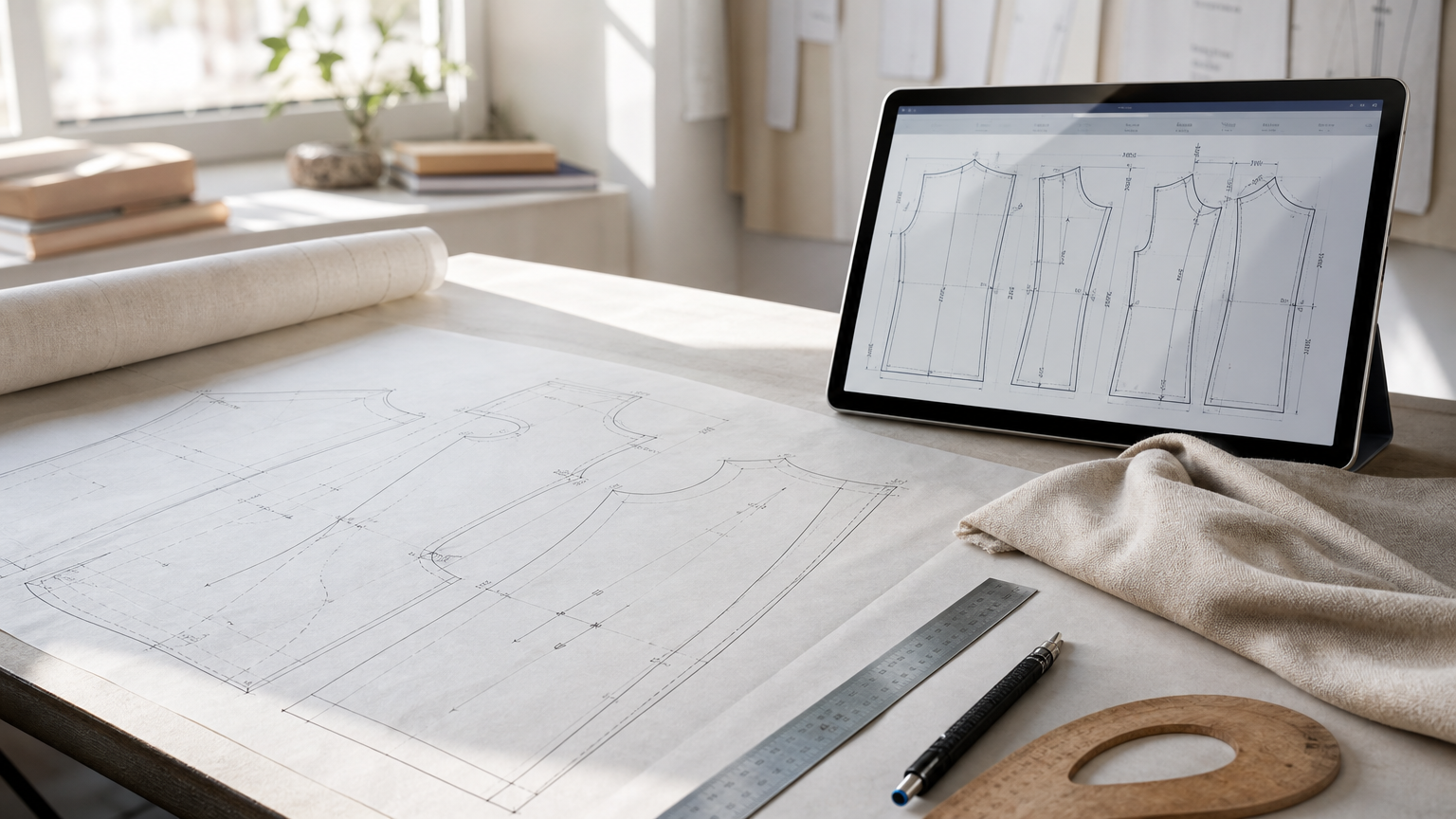
Yes, you can sell clothes made with AI. The answer is that simple, and that conditional. What matters is not whether AI was involved in your design process, but whether your AI output is actually manufacturable. That distinction separates brands that ship product from those that post renders and wonder why nothing arrives at a customer's door.
Why an AI image is not a garment
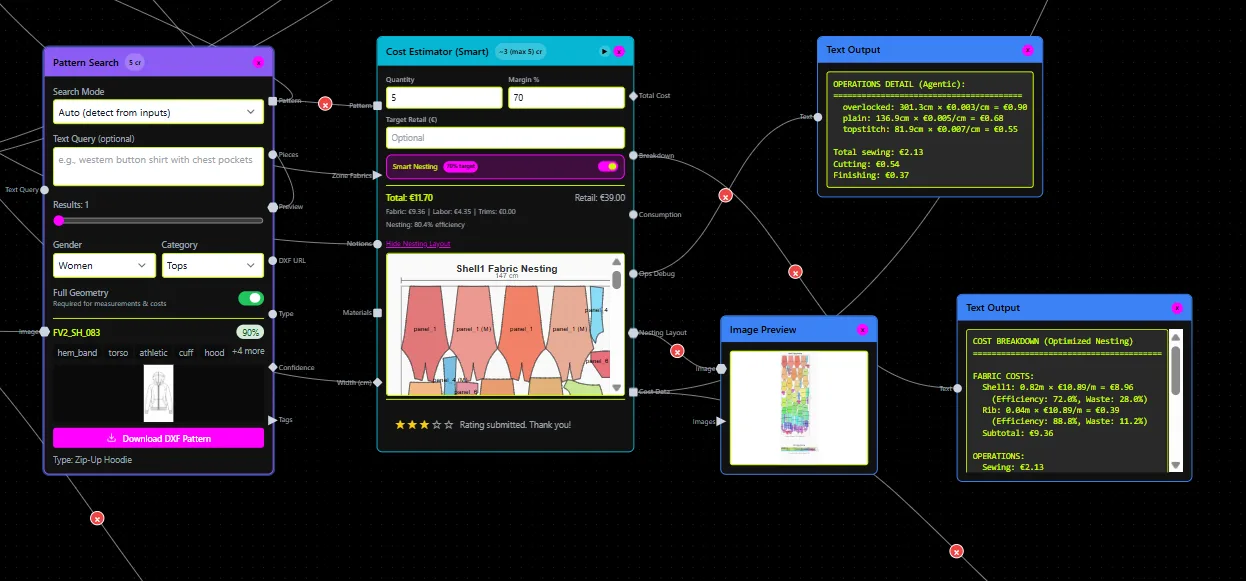
"Clothes made with AI" means two completely different things in practice. The first meaning: you used an AI image generator to produce visual mockups of garments. The second: you used AI to generate production-grade garment data, graded .DXF patterns, tech packs, BOM, costing, and feasibility outputs that a factory can open and act on.
If you only have images, you don't have a garment yet. A factory needs graded CAD patterns, construction notes, measurement specs, size charts, and fabric data before cutting a single piece of fabric. Without those, your AI-generated design is a mood board, not a product. Fit-critical geometry, neckline shape, armhole depth, sleeve pitch, must be encoded in actual pattern files to survive sampling intact. A rendered image, no matter how detailed, cannot preserve that geometry.
This is where most "sell AI clothes" tutorials stop short. They walk you through setting up a print-on-demand store and call it done. That approach works for AI-designed graphics printed on blank T-shirts. It does not work for original constructed garments at any real production scale.
How production-ready AI actually works
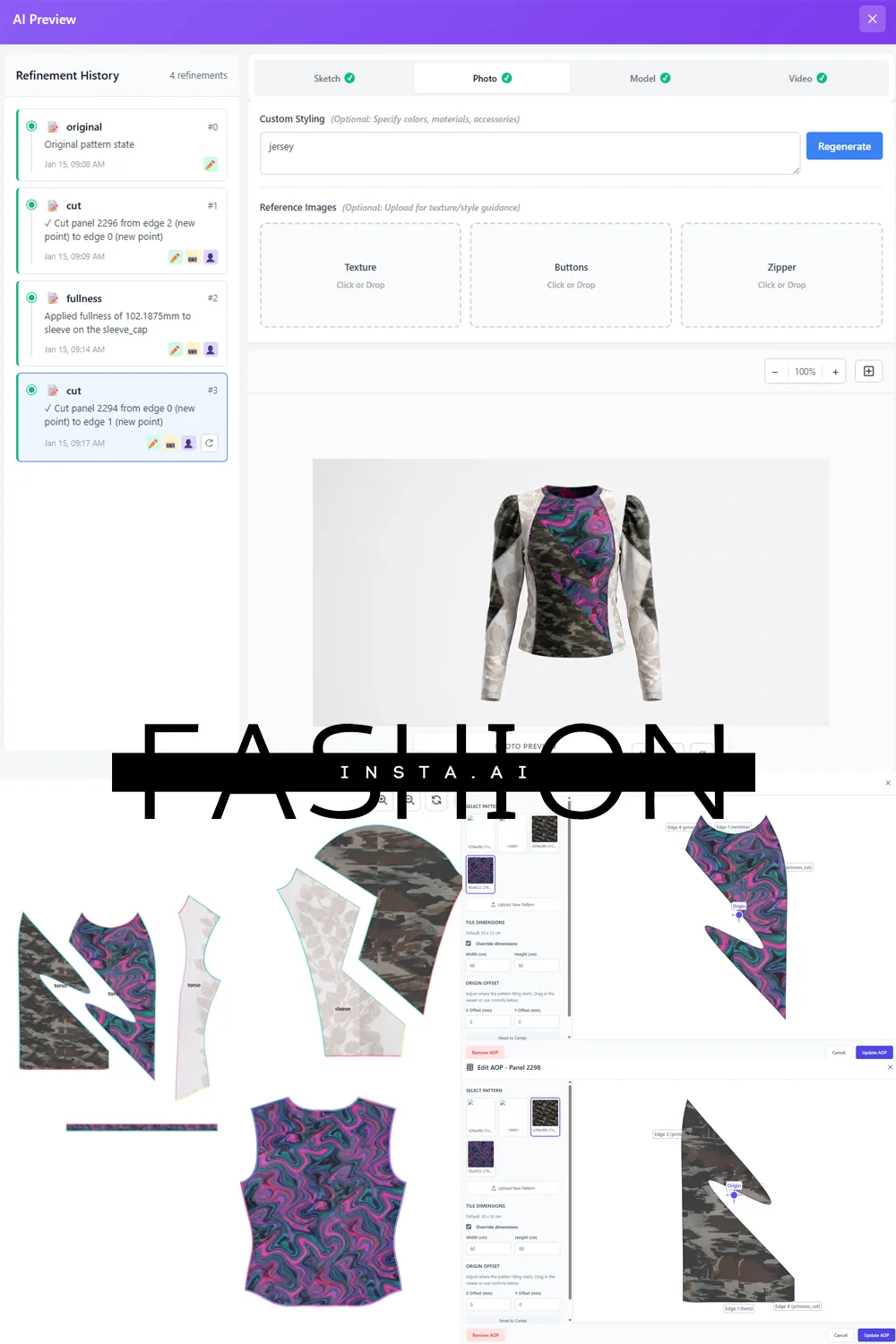
The production data chain runs in one direction: pattern geometry (.DXF files) → grading and size logic → tech pack compilation → BOM and fabric sourcing → cost-of-goods estimation → feasibility check → sample and test.
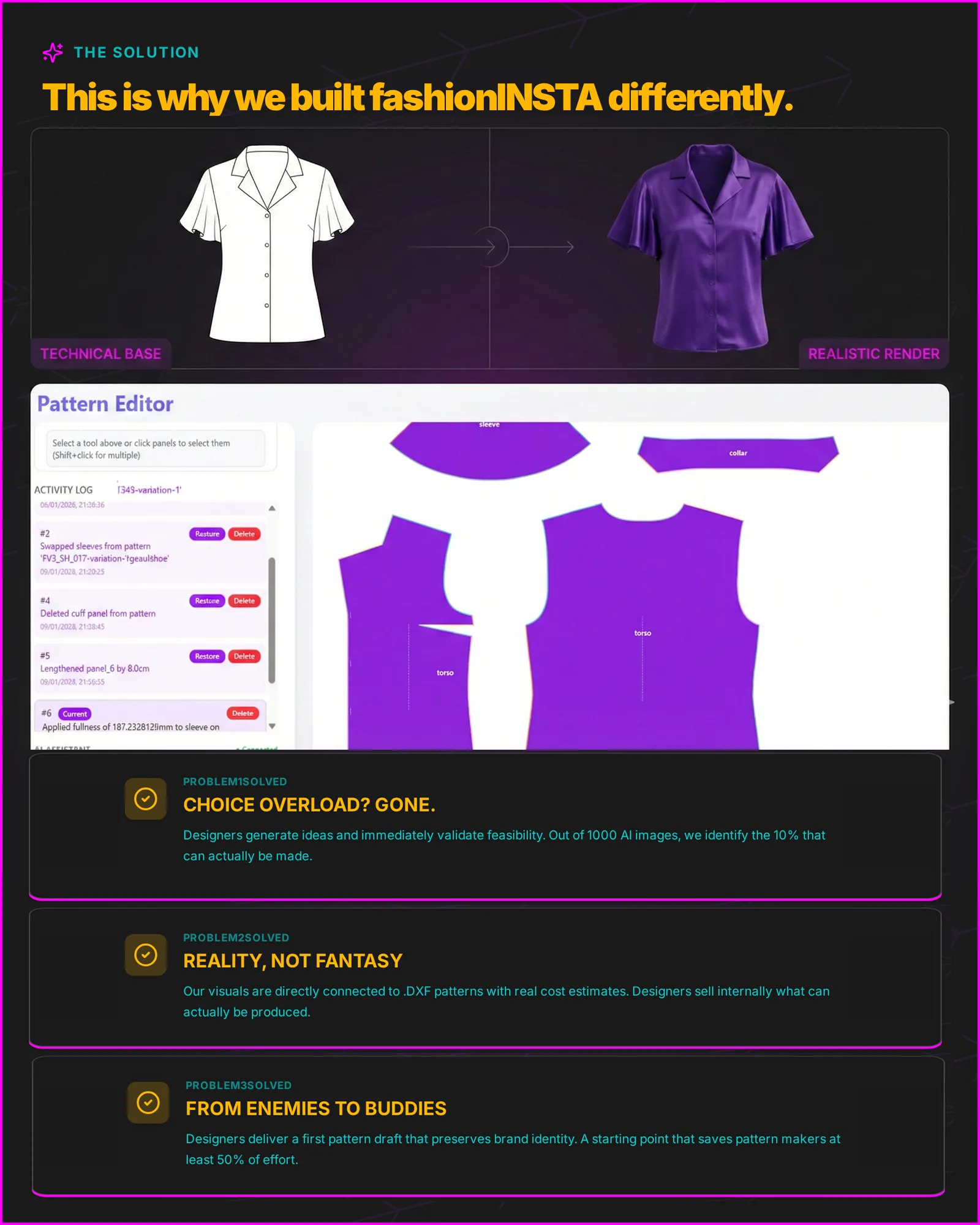
FashionINSTA is built around exactly this chain. The platform trains on a brand's production .DXF archive, extracting 750+ features per pattern to learn fit blocks and construction logic. The Pattern Generator then retrieves the closest matching .DXF from that archive, or generates new patterns from the trained building blocks, producing real files you can download and use, not image outputs. The platform has ingested 50,000+ patterns and claims a 10x faster first draft and a 4x faster overall PD cycle as a result.
From there, the Tech Pack Compiler auto-generates factory-ready documentation with measurements, construction notes, fabric specs, and colorway details. The BOM Agent connects to a real fabric shop and returns actual fabric names, compositions, prices, and MOQs, not stock photos or swatches. The Cost Estimator calculates COGS based on fabric consumption, construction complexity, trims, and labor. The Feasibility Analyzer then checks whether the design can be manufactured at your target price point and flags construction issues before they become sampling problems.
All exports open cleanly in CLO3D, Style3D, Tukatech, Gerber, Lectra, Marvelous Designer, and VStitcher. That compatibility is part of what "production-ready" means.
Step-by-step: AI design to market
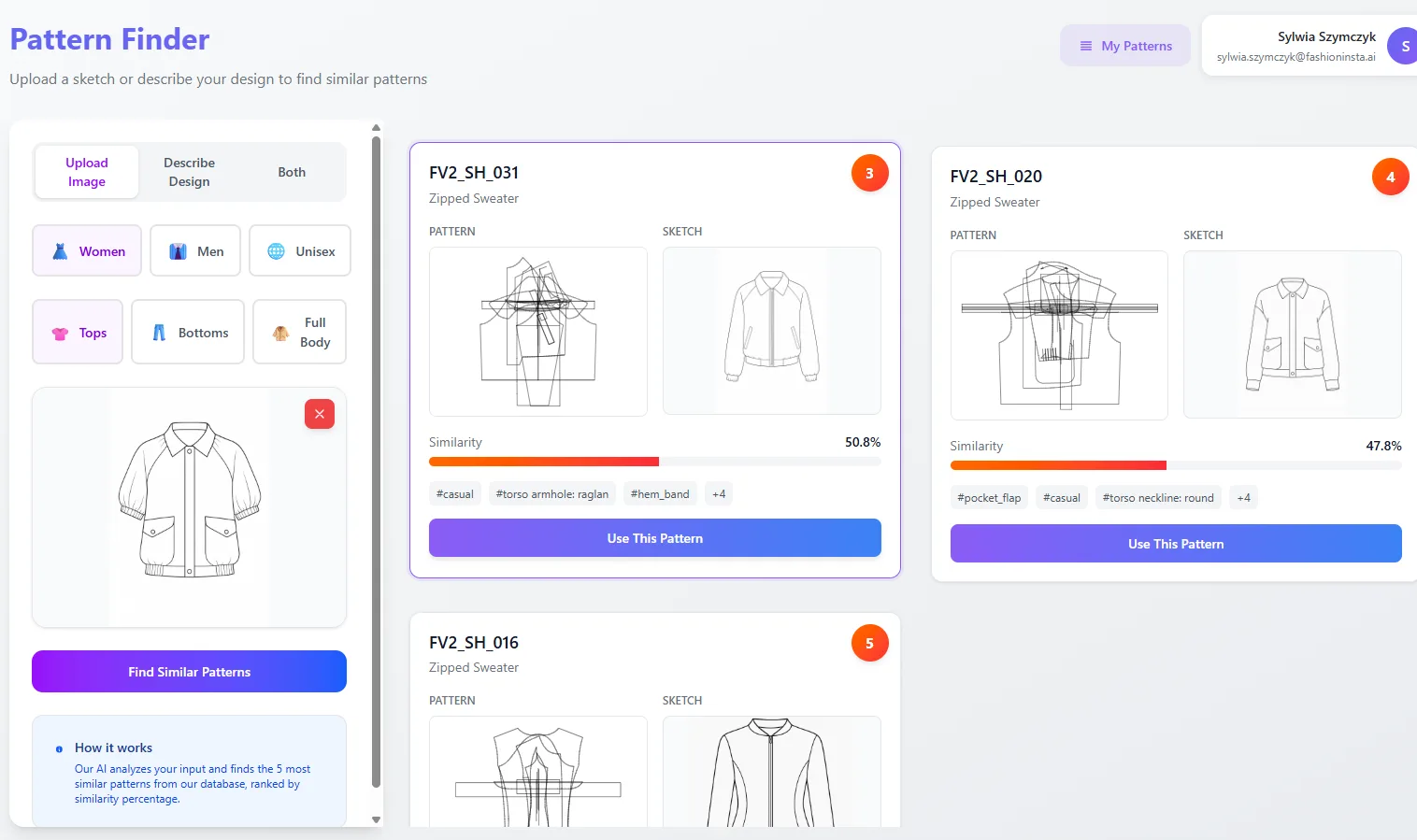
Follow this workflow to move from design intent to sellable garment.
-
Write your garment brief. Define the silhouette, target consumer, price tier, and key construction requirements. Decide upfront: pre-order to validate demand, or build inventory and risk it? Pre-order is almost always the right call for a first AI-designed style.
-
Generate and validate pattern geometry. Use the Pattern Generator to retrieve the closest-match .DXF from your archive, or generate from trained building blocks. FashionINSTA scores pattern closeness based on geometry, not image similarity, then applies CAD operations (sleeve length changes, seam relocation, gathering, facings) as needed.
-
Produce graded assets. Confirm size chart alignment and grading rules across your full size run before proceeding. A pattern that only fits a size M is not a product.
-
Compile the tech pack. The Tech Pack Compiler outputs measurements, construction notes, callouts, and colorway details in factory-ready format. Review every callout, this document is the contract between your design intent and the factory floor.
-
Run the BOM Agent. Get actual fabric names, compositions, prices, and MOQs from a connected fabric shop. Guessing at fabric costs at this stage will destroy your margin model downstream.
-
Run the Cost Estimator and Feasibility Analyzer. Cost the garment using real COGS inputs. If the Feasibility Analyzer flags a construction issue or the margin is unsustainable at your target retail price, address it now. Fixing it in sampling costs 10x more in time and money.
-
Hand off to the factory. Provide the graded .DXF, completed tech pack, BOM, and costing outputs as a package. Do not send renders as stand-ins for pattern files.
-
Evaluate the first sample. Define pass/fail criteria before the sample arrives. Check measurements against the spec, evaluate fit on a dress form or fit model, and log every variance. Iterate before committing to production.
-
Run your market test. FashionINSTA's Media and Render Nodes generate front/back views, editorial imagery, e-commerce visuals, and 360-degree spin videos tied to the underlying design data. Use those assets for your landing page and pre-order campaign before scaling production volume.
Factory handoff checklist
Before you send anything to a manufacturer, confirm every item on this list:
- Graded .DXF patterns that open cleanly in the factory's CAD system
- Fit-critical geometry (neckline, armhole, sleeve pitch) matches your brand's fit standards
- Tech pack includes measurements, construction notes, fabric specs, colorway details, and all callouts
- BOM reflects real fabric names, compositions, prices, and MOQs from a verified source
- Cost Estimator output reviewed and margin confirmed at target retail price
- Feasibility Analyzer flags resolved before sampling begins
- Sample sign-off process defined: who approves fit, what tolerance is acceptable, what triggers a re-sample
- Measurement chart aligned with your internal size chart methodology
If any item is missing, the factory will either ask for it (delaying your timeline) or substitute their own judgment (destroying your fit).
AI-generated clothing: copyright and trademark basics
This is informational context, not legal advice. Consult a qualified IP attorney for your specific situation.
The U.S. Copyright Office published "Copyright and Artificial Intelligence" guidance (Part 2) on January 29, 2025, directly addressing the copyrightability of AI-generated outputs. The current legal position: works created entirely by AI generally lack the human authorship required for copyright protection. Printful stated as recently as January 2026 that "purely AI-generated images usually do not get copyright protection because the law focuses on human authorship, not machines." Congress.gov's CRS analysis (LSB10922, July 2025) notes that authors may claim protection only for "their own contributions" to a work.
The practical implication for brands: if a human designer makes meaningful creative selections, prompt construction, editing, arrangement, selection from outputs, there may be a basis for a mixed-work copyright claim on those human contributions. The AI-generated portions alone are not protected under current U.S. guidance.
Trademark is a separate question. A brand name or logo used in commerce on garments can be registered as a trademark regardless of whether the underlying design was AI-assisted. The key is actual use-in-commerce, not the method of creation.
For ai generated clothing trademark questions specifically: the origin of the design does not affect whether your brand identifiers are protectable. What matters is distinctiveness, use, and registration.
Common pitfalls to avoid
Selling AI imagery you can't manufacture is the fastest path to customer refunds and brand damage. If the product shown in your marketing doesn't match what a factory can actually produce from your spec, every sale becomes a liability.
Skipping BOM realism is the second most common error. Brands price speculatively, using rough fabric estimates or ignoring trims and labor, then discover at costing that their margin is negative. The BOM Agent and Cost Estimator exist specifically to prevent this.
Format mismatch is a practical but solvable problem. If your .DXF exports don't open in the factory's CAD system, nothing else matters. Verify compatibility before the handoff, not after.
Low-differentiation designs are a longer-term brand risk. FashionINSTA's pattern scoring and similarity matching can flag when a new design duplicates an existing block, which prevents unnecessary carry-over work and keeps your line differentiated season over season.
The short answer to "can I sell clothes made with AI" is yes. The operative question is whether your AI workflow ends with a render or ends with a graded .DXF, a complete tech pack, a real BOM, and a costed feasibility check. Only the second path produces garments you can actually sell at scale.